


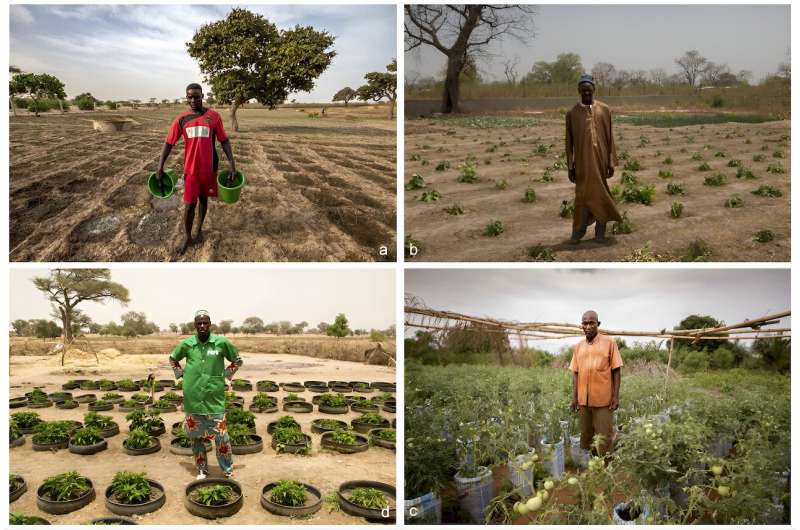
 organic matter. His method helps significantly reduce water consumption by using only what is needed to fill the pockets; (c) on the ferralitic plateaus of Kpomassè, Benin, water is a rare and precious resource. François grows his tomato plants inside canvas bags to save on water and prevent soilborne diseases; (d) in Ngouloul Sérère, Fatick Department, Senegal, Diouf uses recycled tyres to keep manure and water supplies concentrated at the roots of his chilli plants. Credit: Raphael Belmin/CIRAD” width=”800″ height=”530″/>
(a) In Mboro, Meouane Department, Senegal, Modou Fall has carved up his onion plot with little indentations to keep manure and water supplies concentrated at the roots; (b) in Medina Yoro Foulah, Kolda Department, Senegal, this grower has transplanted his aubergines into pockets filled with organic matter. His method helps significantly reduce water consumption by using only what is needed to fill the pockets; (c) on the ferralitic plateaus of Kpomassè, Benin, water is a rare and precious resource. François grows his tomato plants inside canvas bags to save on water and prevent soilborne diseases; (d) in Ngouloul Sérère, Fatick Department, Senegal, Diouf uses recycled tyres to keep manure and water supplies concentrated at the roots of his chilli plants. Credit: Raphael Belmin/CIRAD
Hubert Reeves once wrote that “on the cosmic scale, liquid water is rarer than gold”. And what is true for the universe is even truer in the Sahel, the name given to the vast, arid belt that skirts the Sahara and stretches across Africa from east to west.
Since 3,000 BCE, the peoples of this region have invested tremendous effort into coming up with myriad ways to capture and control this remarkably scarce resource. Faced with the poor distribution of water across space and time, they have had to resort to intelligent, thrifty methods to make the most of even the tiniest drop.
Overlooked for many years, the secrets of the Sahelian landscape are starting to pique the interest of researchers and decision-makers.
The art of catching rain
Each year in the Yatenga, northern Burkina Faso, the first June rains arrive to soothe the scorch of the seemingly interminable dry season. The now-quenched soil breathes life back into the bushland as clumps of millet and sorghum spring up just about everywhere, transforming parched savannahs into verdant thickets.
But in some villages, the fragile Sahelian ecosystem has been completely upended. Due to thinning plant cover after the heavy drought period of the 1970s and 1980s, the unstable, iron-rich soils of the Yatenga have been stripped bare by erosion. They are now a desolate crust where torrential rains are simply swept away as run-off before they have a chance to seep through. Instead of bringing new life, the water erodes the land along with the hopes of local farmers.
However, some have attempted to adapt and innovate in this hostile landscape. Yacouba Sawadogo is one of them. In a barren field in the village of Gourga, Yacouba, and his family are hard at work perforating the crusted soil in preparation for the first rain. Each wielding a daba (which is a traditional tool similar to an adze), they dig down into the red laterite earth.
The farmers perform a pattern of vigorous movements, dividing up the plot with their neat, orderly divots. Into each one, they drop a handful of compost, a few grains of sorghum, and a dusting of light soil. Job done! » …