

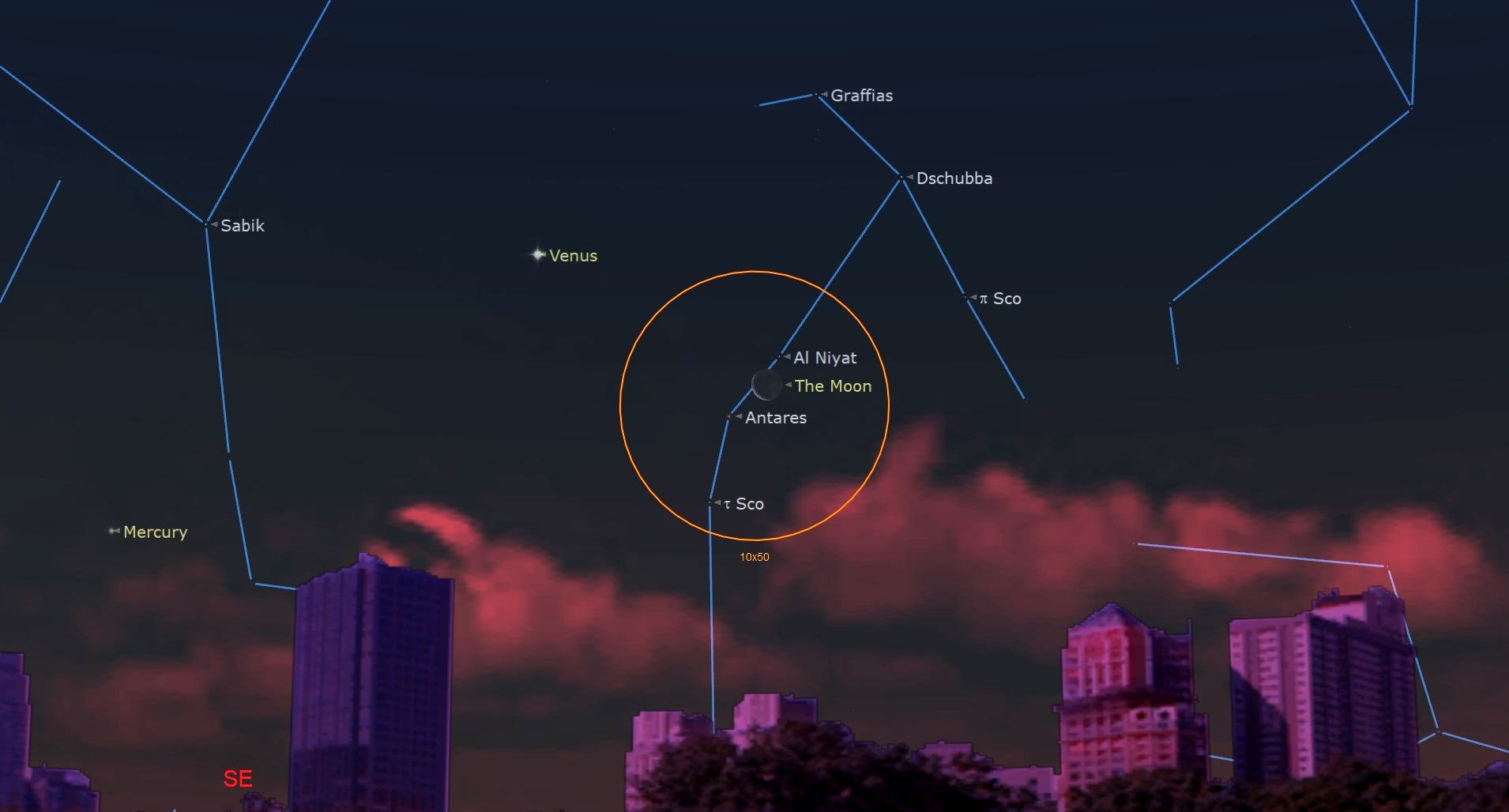

Celebrate the cosmic wonder of the celestial event on Jan. 8, as the moon gets up close and personal with Antares.
(Image credit: Chris Vaughan/Starry Night)
As the moon makes its monthly circuit around the sky it often passes in front of stars, blotting them out for as much as an hour or so.
Such an event is called an occultation (derived from the Latin word occultāre, which means “to conceal.”), and it can be a startling spectacle, especially if the star happens to be bright. The star appears to creep up to the moon’s limb, hangs on the edge for a minute or two, and then, without warning, abruptly winks out. Later it pops back into view just as suddenly on the moon’s other side. The suddenness with which occultations take place was one of the first proofs that the moon has no atmosphere. If our natural satellite were cloaked with an atmosphere, a star approaching its limb would appear to fade away gradually, just like one seen setting beyond the western horizon from here on Earth.
If you live in the Pacific or Mountain Time Zone, make sure to set your alarm clock for before sunrise on Monday, Jan. 8, for early on that morning a waning crescent moon, 11% illuminated, will occult the 1st-magnitude red supergiant star Antares, one of the brightest stars in the sky. This should be well worth rousing yourself out of bed in the dawn hours to watch if you live in one of the far-western states.
Unfortunately for those who live farther east, across the central and eastern states, this stellar eclipse occurs after sunrise in a bright daytime sky. From these regions, Antares will appear very close to the lower left of the moon as they slowly ascend the east-southeast sky pre-sunrise. But as they gradually draw closer, the increasingly bright twilight sky will ultimately overwhelm Antares before the moon gets a chance to hide it.
Related: Night sky, January 2024: What you can see tonight
Region of visibility
For westerners, the action begins when Antares disappears behind the moon’s bright limb. For those living in the Northwestern States the moon will be barely above the horizon, so poor seeing will compound the problem. From Seattle, for instance, the disappearance of Antares comes right after moonrise.
Farther south, the moment of disappearance will appear higher. From San Francisco the pair will be 6 degrees high and from Los Angeles they’ll be 11 degrees above the horizon. (Your clenched fist held at arm’s length measures about 10 degrees in width.) Moon and star will make a striking sight as the latter disappears near the south cusp of the lunar crescent.
Since Antares will disappear behind the moon’s bright limb, binoculars or a telescope will probably be needed to watch this event.
However, those same Northwestern states, as well northern California will be in excellent position to see the star’s reappearance,