


This article was originally featured on The Conversation.
Upon observing the varying seasons on other planets, it has become clear that Earth’s regular pattern of seasons is extraordinary. The unique tilt of Earth produces a regular change in seasons that is not present in all planets.
According to my research, the rotational axis that Earth spins on isn’t quite aligned with the vertical axis perpendicular to Earth’s orbit around the Sun. This seemingly minor tilt has large implications for everything from seasons to glacier cycles, and even life habitation.
It’s fascinating to note that Earth’s misalignment, referred to as an obliquity, is around 23 degrees from vertical. As a result, the Northern Hemisphere experiences more intense sunlight during the summer, causing different seasons on Earth. The intensity of sunlight gradually decreases as the Northern Hemisphere tilts away from the Sun, leading to winter.
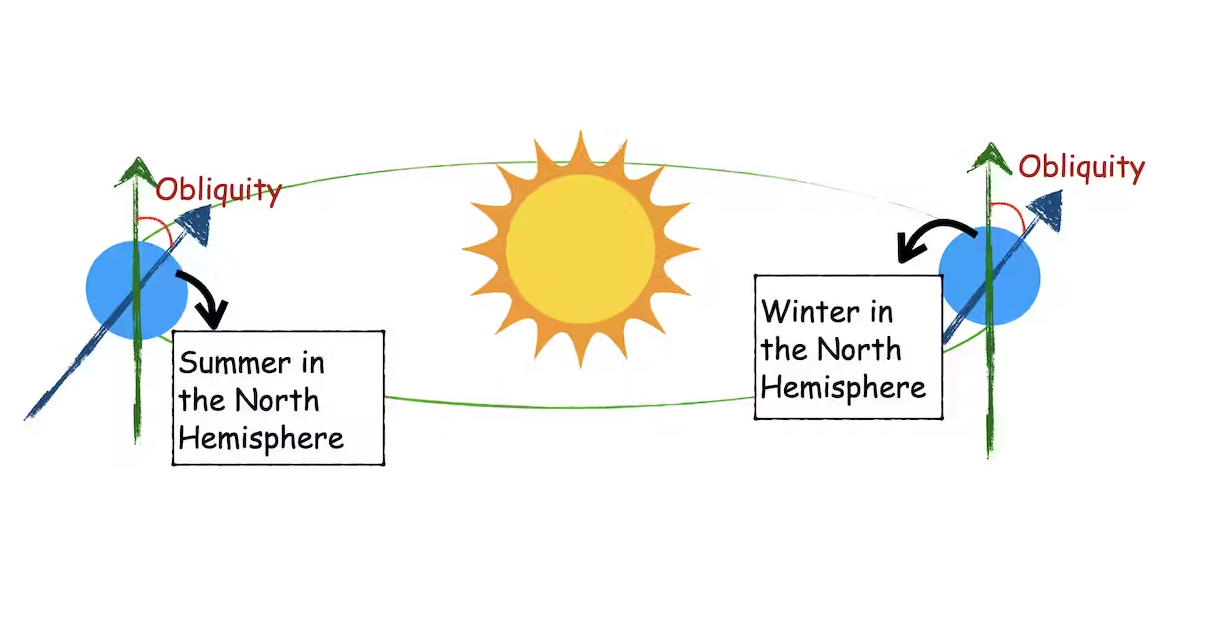 The obliquity marks the difference between the Earth’s spin axis (blue) and the vertical from orbit (green). The Northern Hemisphere experiences summer when the tilt lines it up directly with light from the Sun. CREDIT: Gongjie Li.
Earth’s wobbles, including spin precession and variations to the shape of Earth’s orbit, can significantly affect the planet’s climate. These small changes in tilt and orbit shape can consequently contribute to Earth’s larger temperature shifts and various climatic events.