

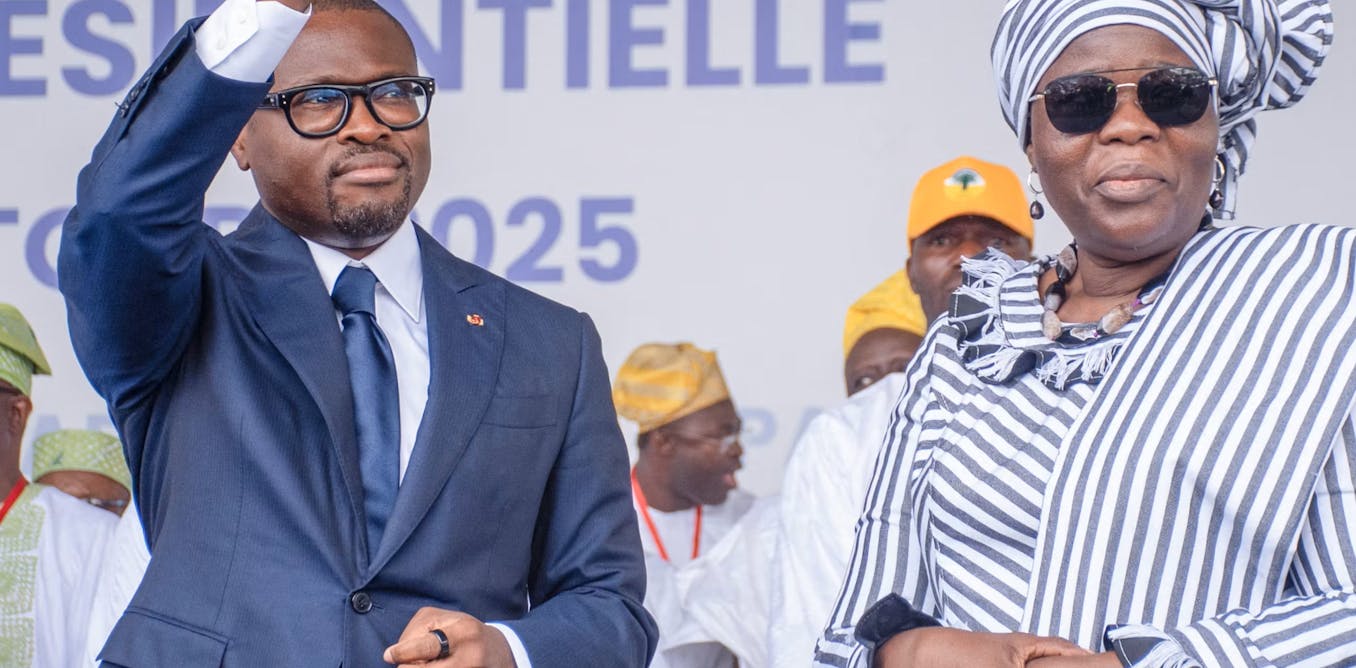

Romuald Wadagni won the 2026 presidential election in Benin with over 94% of the vote. Wadagni, 50, is a technocrat who became an influential finance minister under Patrice Talon from 2016 until his election.
The Beninese political system is a pluralist democracy organised around a presidential system, with regular elections and political alternation. It is also characterised by a strict institutional framework governing electoral competition, particularly since recent reforms.
The outcome raises questions about the current dynamics of Benin’s political system. How should the 2026 presidential results be interpreted in a context marked by reforms to the party system and the electoral framework? Political sociologist Narcisse M. Yèdji offers some insights.
How do you interpret the 94% result?
With the current national political climate, the landslide victory raises several questions. At first glance, the results suggest very strong support for the presidential majority. Statistically, this means a very low dispersion of votes between the two competing duos: the winning ticket formed by Romuald Wadagni and Mariam Chabi Talata, and the one formed by Paul Hounkpè and Rock Judicaël Hounwanou. More broadly, such a scenario is typical of electoral contexts where the opposition plays only a formal role and has no real chance of winning.
That said, the enormous margin between the two main candidates may also reflect strong support for the winning pair, giving the impression of a broad consensus in their favour.
Clearly, recent changes introduced to the country’s party system and the electoral code have tilted the balance in favour of the ruling party. Such a victory was predictable. The margin, however, was not.
A comparison with the 2021 presidential election places the 2026 result in a broader perspective. The 2021 election was won by Patrice Talon with 86% of the vote. The race was slightly more open. It involved a larger number of candidates: three pairs in total.
The statements are not contradictory. In a context where the political offer is restricted, voters have several options: either to stay at home, or to cast a default vote. Therefore, the 94% may reflect strong popular support. Or, given the limited set of choices, it may reflect the option of a default vote. The 2026 landslide victory can thus be read as a reflection of growing electoral support for the incumbent administration.
The latest complete overhaul of the rules of political competition left voters without meaningful and credible alternatives, thereby increasing the likelihood of people voting by default.
However, what might appear to be a gradual consolidation of electoral support for the ruling party could, in fact, be the effect of these reforms. The endorsement system, in particular, has played a key role in shaping how votes are distributed. It is a system that requires any presidential candidate to obtain the formal support of a certain number of elected officials (members of parliament or mayors) in order to be eligible to run.