


Few things in the universe compare to the mystifying reputation of black holes, and a special one of these gravitational titans has just been recognized as the oldest among them all.
An international research team led by the University of Cambridge has discovered the oldest known black hole through the James Webb Space Telescope. Its appearance more than 13 billion years ago — 400 million years after the big bang — has twisted traditional beliefs about black hole formation and growth. The results, published in a new study in Nature, represent “a giant leap forward” according to lead author Roberto Maiolino.
How Big Is the Black Hole?
The black hole struck researchers as an anomaly due to its sheer size, being a few million times the mass of our Sun. Prior to this observation, astronomers accepted that supermassive black holes at the center of galaxies grew over billions of years. They normally originated from what remained of dead stars, whose collapse could produce black holes about a hundred times the mass of the Sun.
Read More: What Happens in a Black Hole?
How Did the Black Hole Form?
The enormity of this newly discovered black hole presents unexplored scenarios that could explain alternative ways of formation. Researchers speculate that they could be born at a large size, or that they could consume matter at a rate five times higher than previously thought.
If this black hole grew in the expected process, it would have taken about a billion years to reach its current size. This explanation isn’t possible, however, because the universe was not yet a billion years old when the black hole was identified.
“It’s very early in the universe to see a black hole this massive, so we’ve got to consider other ways they might form,” said Maiolino, from Cambridge’s Cavendish Laboratory and Kavli Institute of Cosmology in a press release. “Very early galaxies were extremely gas-rich, so they would have been like a buffet for black holes.”
Read More: How Do Black Holes Form?
How Did the Black Hole Get so Big?
To fuel its growth, a black hole ingests matter from its host galaxy; this is standard in all cases, but the newly discovered black hole stands apart because it absorbs material more aggressively than others.
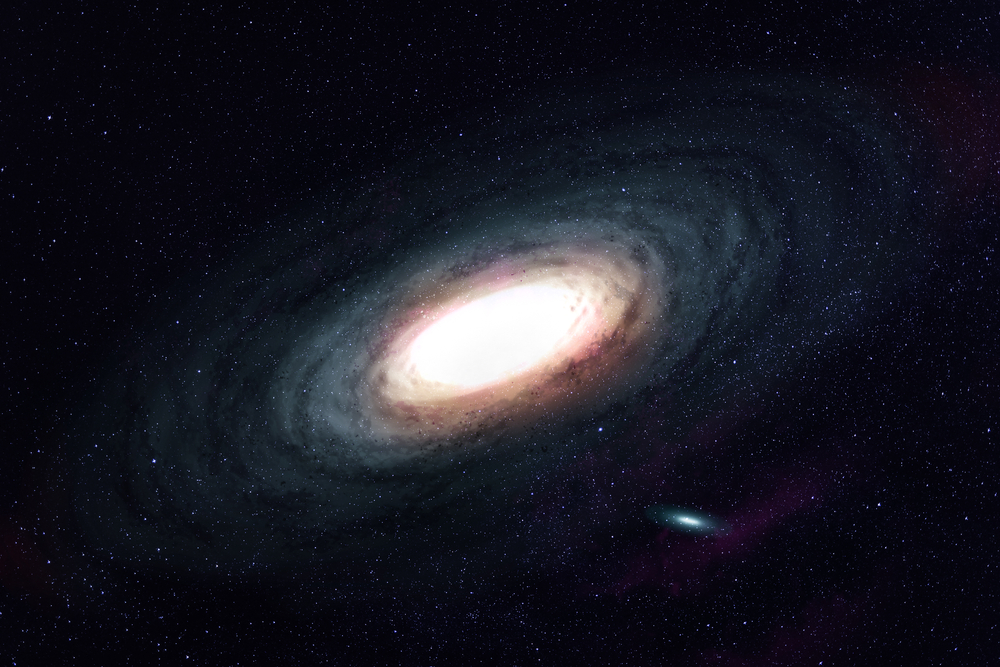
The host galaxy for this black hole, called GN-z11, emanates a radiating aura. This phenomenon comes from the presence of the black hole, which astronomers cannot see directly; instead, they perceive it by the flow of material in an orbital motion. This generates an accretion disk, a glowing structure at the edges of a black hole. The glow occurs as gas in the accretion disk becomes hot and emits energy in the ultraviolet range.
The continued development of GN-z11 — 100 times smaller than the Milky Way — might be thwarted by the matter-hungry black hole.