


Scientists did not expect to find the world’s largest deep-sea coral reef off the eastern coast of the United States. The huge 6.4 acre area stretches from Miami, Florida up to Charleston, South Carolina.
By
|
Published Jan 18, 2024 12:45 PM EST
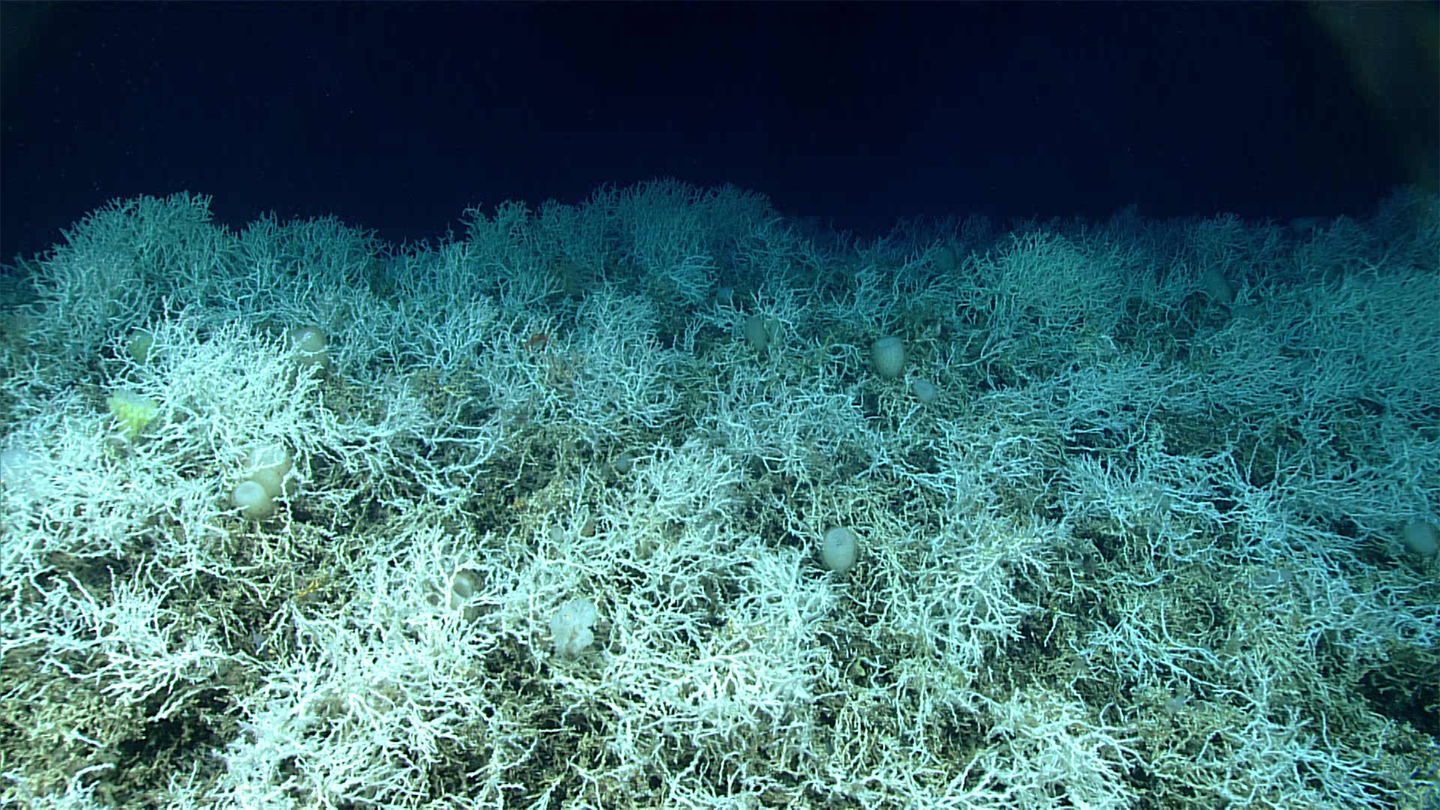
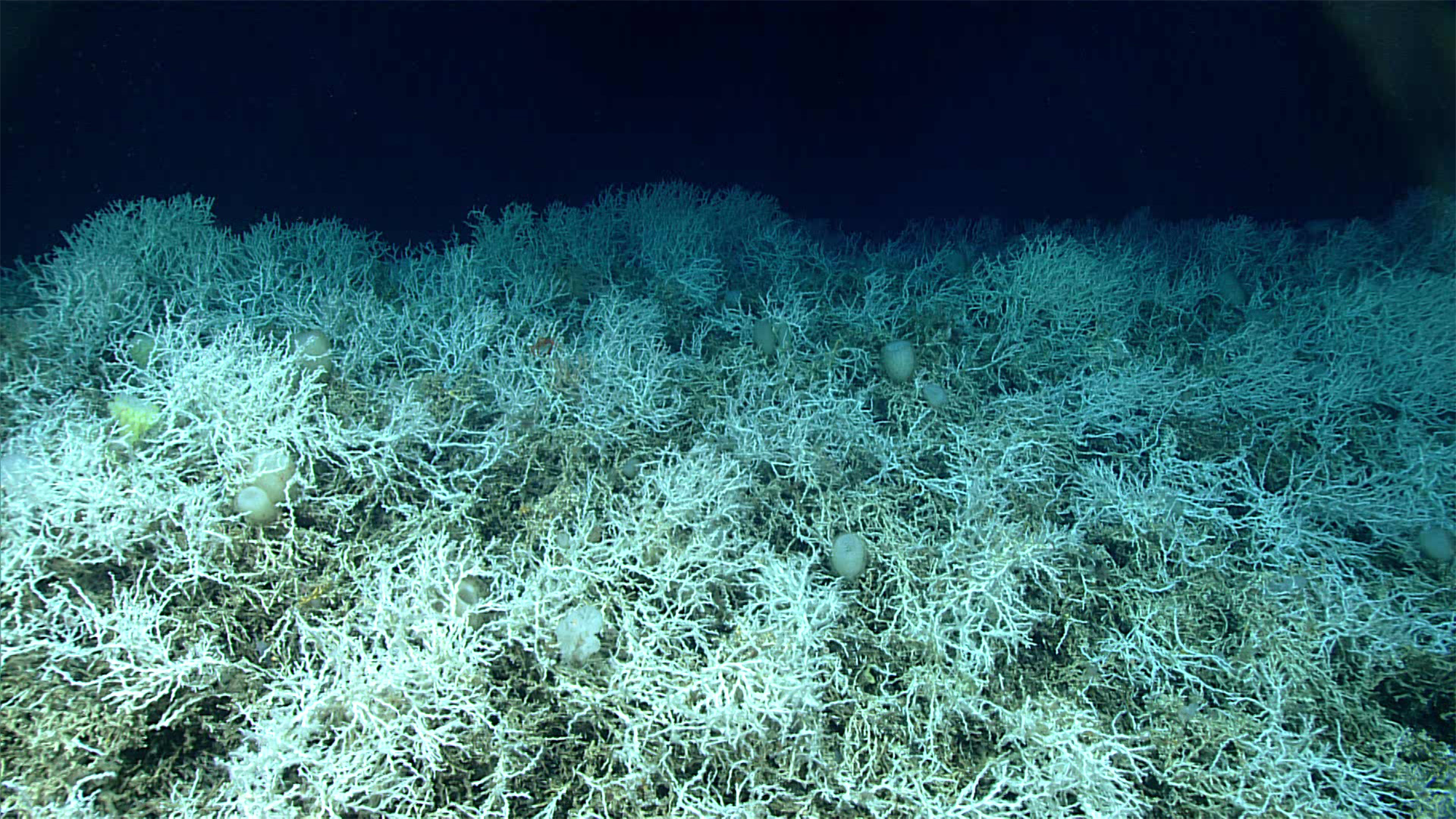
Dense thickets of the reef-building coral Desmophyllum pertusum make up most of the deep-sea coral reef habitat found on the Blake Plateau in the Atlantic Ocean. The white coloring is healthy–deep-sea corals don’t rely on symbiotic algae, so they can’t bleach. Images of these corals were taken during a 2019 expedition dive off the coast of Florida. NOAA Ocean Exploration, Windows to the Deep 2019
SHARE
Scientists have found the world’s largest deep-sea coral reef off the coast of the southeastern United States. Stretching from Miami, Florida up to Charleston, South Carolina, this massive 6.4 acre area was thought to be a dead zone. According to the National Oceanic and Atmospheric Administration (NOAA) this is an area larger than the state of Vermont. The findings were described in a study published January 12 in the journal Geomatics.
[Related: To save coral reefs, color the larvae.]
The Blake Plateau is in the western Atlantic Ocean off the coasts of Florida, Georgia, South Carolina, and North Carolina. Earlier studies of the area found that the region may be a dead zone–an area of the ocean that has less oxygen dissolved in water, which generally kills most of the sea life. During a multi-year mapping project of this perceived dead zone, scientists instead found a very alive ecosystem full of reef-building coral.
“For years we thought much of the Blake Plateau was sparsely inhabited, soft sediment,” study co-author and NOAA Ocean Exploration Operations Chief Kasey Cantwell said in a statement. “Past studies have highlighted some coral in the region, particularly closer to the coast and in shallower waters, but until we had a complete map of the region, we didn’t know how extensive this habitat was, nor how many of these coral mounds were connected.”
Located off the Southeast United States, the Blake Plateau is an unusual, broad, flat feature with a steep drop-off into the very deep sea. CREDIT: NOAA Ocean Exploration, Windows to the Deep 2021.
There were hints that a massive reef was in the Blake Plateau first found in 2019, but scientists waited until a mapping project from NOAA, the University of New Hampshire, the Bureau of Ocean Energy Management, Temple University, and the US Geological Survey could confirm it to officially announce it. They combined data from over 30 multi-beam sonar mapping surveys and 23 submersible dives to create a nearly complete map. They identified 83,908 individual coral mound peak features and a core area has high-density mounds that are up to 158 miles long and 26 miles wide.