



New GlobeScan data highlights leading areas of concern for global businesses in 2026. Read More
By
Tove Malmqvist
May 11, 2026

Geopolitics, AI and economic pressures dominate business risks. Source: Shutterstock/FabrikaSimf
Key Takeaways:
- Geopolitical risk is the top concern for corporate affairs practitioners across every sector surveyed.
- Beyond geopolitics, priorities diverge: The impact of AI is highly salient in services, extractives and media, while climate change is more prominent in food, agriculture and beverages.
- Corporate affairs practitioners are increasingly central in helping organizations interpret risk signals.
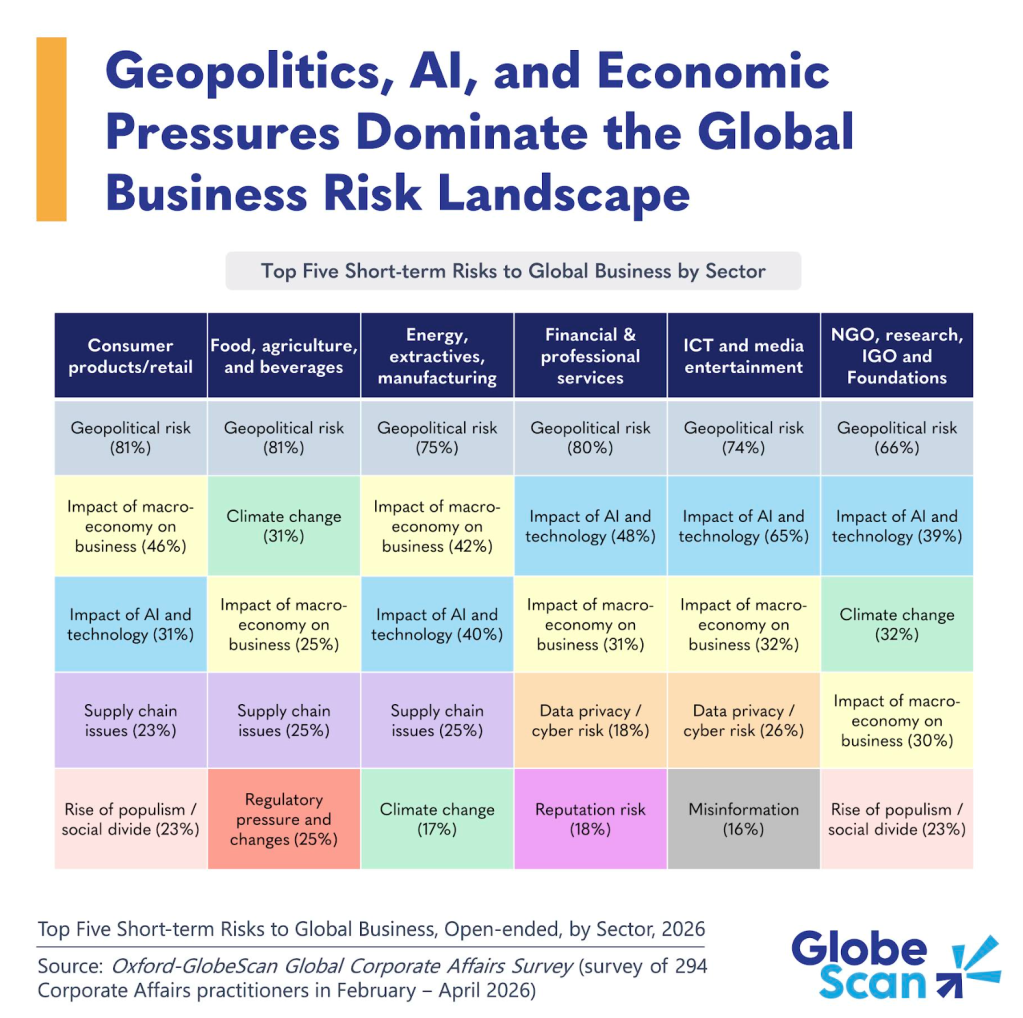
GlobeScan’s 2026 corporate affairs research shows geopolitical instability has become the single most dominant short-term risk shaping business outlook, regardless of sector. Corporate affairs practitioners across consumer markets, food, agriculture, beverages, extractives, finance, ICT, media and civil society agree that geopolitical volatility outweighs all other threats, reflecting heightened concerns around conflict, trade fragmentation and political uncertainty.
At the same time, the risk landscape is far from uniform. While AI and technology rank among the leading short-term risks for corporate affairs practitioners in financial and professional services, ICT, media and NGOs, they do not appear as top concerns in food, agriculture and beverages. Climate change is a more prominent risk in these sectors, reflecting their direct exposure to environmental and regulatory impacts. Supply chain issues also continue to pose meaningful risk for several sectors — particularly consumer-facing, food and extractive industries — underscoring ongoing concerns about resilience and disruption.
What does this mean?
Today’s risk landscape is defined by a shared sense of geopolitical instability layered with highly sector-specific vulnerabilities. While global tensions frame the outlook for all businesses, climate exposure, supply chain fragility and technological disruption are felt unevenly across industries. This places corporate affairs practitioners at the heart of risk sense-making. The function’s value increasingly lies in helping organizations interpret complex and sometimes competing risk signals, aligning internally on priorities and engaging externally with clarity and credibility. Businesses that reflect sector-specific risk realities in their positioning and decision-making are better placed to navigate volatility, maintain trust and strengthen long-term resilience.
Subscribe to Trellis Briefing
Get real case studies, expert action steps and the latest sustainability trends in a concise morning email.

Tove Malmqvist
Tove Malmqvist leads evidence‑led research and advisory work at GlobeScan, focused on enabling behaviour change through a deep understanding of consumer values, motivations and barriers. She works closely with global teams and partners to support organizations across GlobeScan’s Consumer Engagement and Sustainable Living offerings, including consumer attitudes and behaviour research, insights for product and programme design, message and campaign testing, and thought leadership.
She was a core architect of GlobeScan’s Healthy and Sustainable Living research programme at its launch in 2019 and continues to lead its development, translating global insights on the barriers and enablers of behaviour into practical guidance that supports healthier and more sustainable everyday choices.