


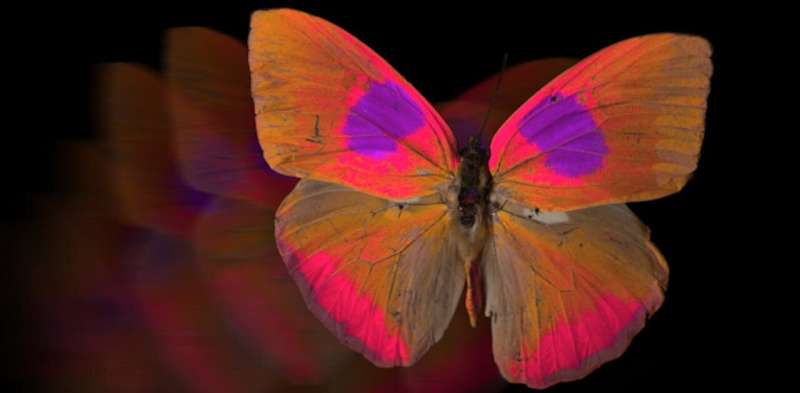
If you’ve ever wished you could see the world though the eyes of another animal, we have good news for you. We also wondered about that and, being scientists who specialize in color vision, have created a solution: a camera system and software package that allows you to record videos in animal-view colors.
Many animals, including bees, birds and even mammals like reindeer and mice can perceive ultraviolet light. Indeed, the lack of UV-sensitivity in humans is more of an exception than the rule. Why don’t you take a moment to think about the deeply fascinating difference of how colors form in the sky for every species, and continue the article so you don’t miss out on the rest of the fascinating facts?
Even when it comes to blues and greens, colors perceived across the animal kingdom, the precise wavelength of the light an animal would experience as “pure blue” or “pure green” is specific to the species. Explore more about this by reading the next section because the colors we see in our world is unique to us, and remember that for many animals, the sky is ultraviolet-colored.
Now for the best part, picture the amazing landscapes and how they would look like to each animal species. Take it all in with our new camera system and share this incredible journey of understanding the different colors animals can see in the world!
Capturing the world in motion
While we cannot possibly imagine how ultraviolet appears to the animals who can perceive it, we can visualize it using false color imagery. Explore more about this feature for honeybees that are sensitive to three types of light (ultraviolet, blue and green), imagine seeing these colors in the human visible range such that ultraviolet is blue, blue becomes green, and green becomes red.
Up until now, we could only apply this process to immobile objects. However, we are now able to do this to objects in motion with our new camera system and software package which makes everything a lot more accessible! This camera eliminates the need for a series of optic filters like the ones we’re used to, making this process much more convenient and efficient.
With the limitations of previous methods we have been able to greatly improve the quality of our documentation. We are excited to share more about our process because it is no longer a laborious process that sets the limit on the number of objects that can be realistically imaged, guaranteeing an incredible new experience for everyone. Discover this breakthrough here by reading the full article!