


Get ready to change the way you think about your feet! A research collaboration between Griffith University and The University of Queensland is reshaping our understanding of human biomechanics, specifically through the interplay of foot form and function.
Griffith’s Dr. Robert Schuster and Associate Professor Luke Kelly, alongside Professor Andrew Cresswell from UQ’s School of Human Movement and Nutrition Sciences went beyond historical examination of foot components in isolation, highlighting the foot’s complex morphology, variability, and movement capability.
Dr. Schuster said the long-held idea that the foot is a stiff structure is limiting in its scope.
“As we walk and run, we use our foot to push off the ground, and there’s been this assumption that to do that effectively without wasting a lot of energy, the foot is very rigid, and doesn’t move a lot,” he said.
“But the foot has 33 joints, it’s a very complex structure.”
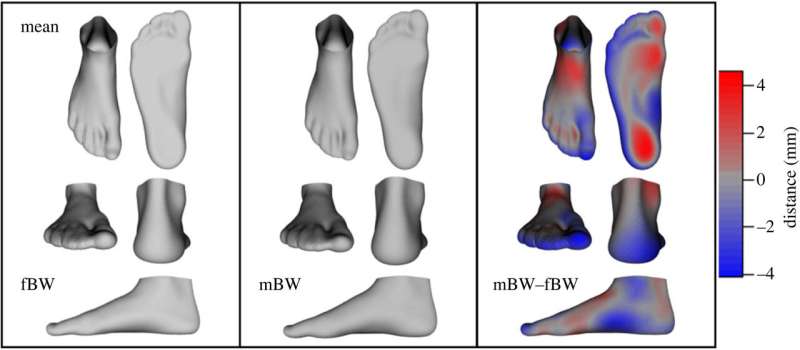
Using the data of 100 healthy participants aged 18–40, collected using novel measurement and analysis techniques that defy ‘standard’ foot measures used in many practices, the team not only confirmed how different our feet are, but also developed a shape-function model (SFM).
This SFM evolved from statistics identifying patterns in the combined shape and function data without making any prior assumptions about how they might relate to each other.
The model proved remarkably accurate in predicting how the joints of a novel foot move and the forces they experience, based solely on its shape.
Dr. Schuster said by taking a more holistic approach and dramatically expanding typical sample size for the study, researchers were able to better understand shape variability and the intricate dance of joint mechanics in motion.
“Whether it was a high arch, stiff foot, low arch, or more compliant foot, we did see some relationship between type and function, but those relationships only account for a very small percentage of what’s going on in the foot,” he said.
“What people often do is look for clues in the way something looks, a biological structure like our foot or hand, to understand what it’s good at doing or what injuries you might be prone to.
“For instance, when you think of a marathon athlete, the typical body shape that comes to mind is a short, very light build, with very thin limbs.”
“Whereas if you think of a sprinter, you’d imagine a more muscular type, and that’s the idea behind the form and function relationship.” » …
Read More