


Skip to content
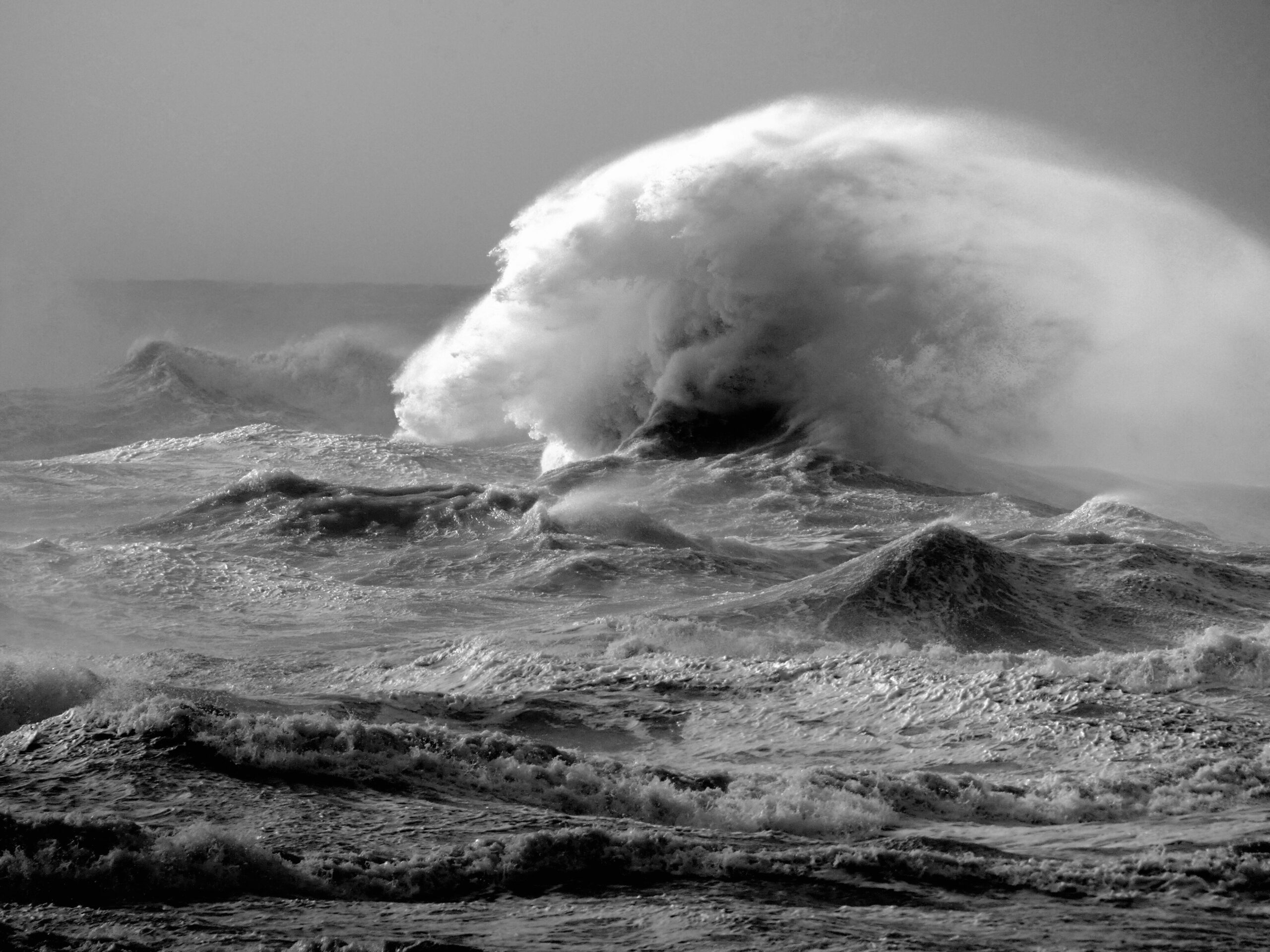
In late November, countries bordering the Black Sea including Romania, Bulgaria, Moldova, Ukraine, Türkiye and Russia, witnessed exceptionally high rainfall and snowfall, and hurricane-force winds due to Storm Bettina.
It was a devastating storm that caused severe impacts across multiple countries in the region. Lives were lost, and millions affected.
To assess to what extent human-induced climate change altered the likelihood and intensity of the heavy precipitation and high wind speeds that caused these impacts researchers from the World Weather Attribution initiative undertook an attribution study on the event.
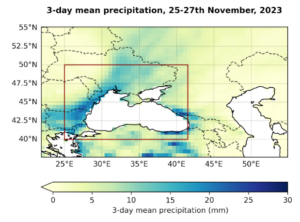
 Figure 1: Observed annual (July-June) maximum 3-day mean rainfall (Rx3day) recorded during Storm Bettina, on 25-27 November, 2023, in the region around the Black Sea. The study region is highlighted by the red box.
 Figure 2: Observed annual (July-June) maximum 3-day mean windspeed (WSx3day) recorded during Storm Bettina, on 26-28 November, 2023, in the region around the Black Sea.
Main findings
- Storm Bettina hit the Crimean peninsula in the midst of the active Russia-Ukraine war adding to wide-ranging vulnerabilities across the storm affected areas.
- Storms like Bettina are fairly common in the region at this time of year, which is reflected in the return periods of the event which, in the current climate, are 1 in 3 years for the wind speeds and 1 in 20 years for the associated precipitation (which combines snow and rain).
- Because of human-induced warming, an increasingly larger proportion of precipitation associated with storms like this falls as rain instead of snow, leading to larger flood damages.
- We use observations-based data products and climate models to estimate the role of human-induced climate change in storms like this. The results are very different for rainfall compared to wind speeds.