

Welcome to the story of Abdullahi Hassan, a farmer from Beledweyne, a flood-prone town in the central Hirshabelle region of Somalia, as he prepares for the heavy rainfall in late October. In Somalia, more than 100 people have lost their lives to the flooding and more than one million people have been displaced. Photo by Eric Chege for the Red Cross.
After years of drought, the short rainy season (October to December, OND) in the Horn of Africa brought exceptionally heavy rains, especially in November, leading to severe flooding in the South of Ethiopia, Eastern Kenya, and many regions in southern and central Somalia.
The ongoing floods are hitting vulnerable communities that were already suffering from a loss of livelihoods, malnutrition, and hunger due to livestock deaths and crop failures in the context of the drought that only ended with the ongoing heavy rains. The floods have led to more than 300 reported deaths so far and displaced over a million people in Kenya and Somalia alone.
Researchers from Kenya, Ethiopia, South Africa, the United States of America, the Netherlands, Germany, and the United Kingdom collaborated to assess to what extent human-induced climate change altered the likelihood and intensity of the heavy rainfall. Historically, drought and recent flooding have compounded the exposure and vulnerability of populations and population subgroups to the severity of flood-related impacts.
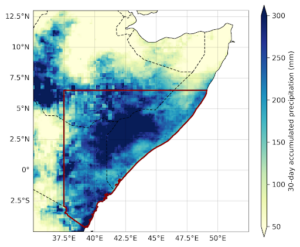
From the end of October throughout the rainy season up until now, rainfall over the region was very heavy, leading to exceptional amounts of precipitation accumulated on several time scales from 1-day to 30-day, with 2023 showing either the highest or second-highest events on record.
The OND rainy season is known to be influenced by modes of natural variability, including the El Nino Southern Oscillation (ENSO) and the Indian Ocean Dipole (IOD) as the dominant modes of variability. Both ENSO and IOD are in a positive phase which has been shown to increase the likelihood of heavy rainfall in the wider Horn of Africa OND season. For more information, you can read more.