

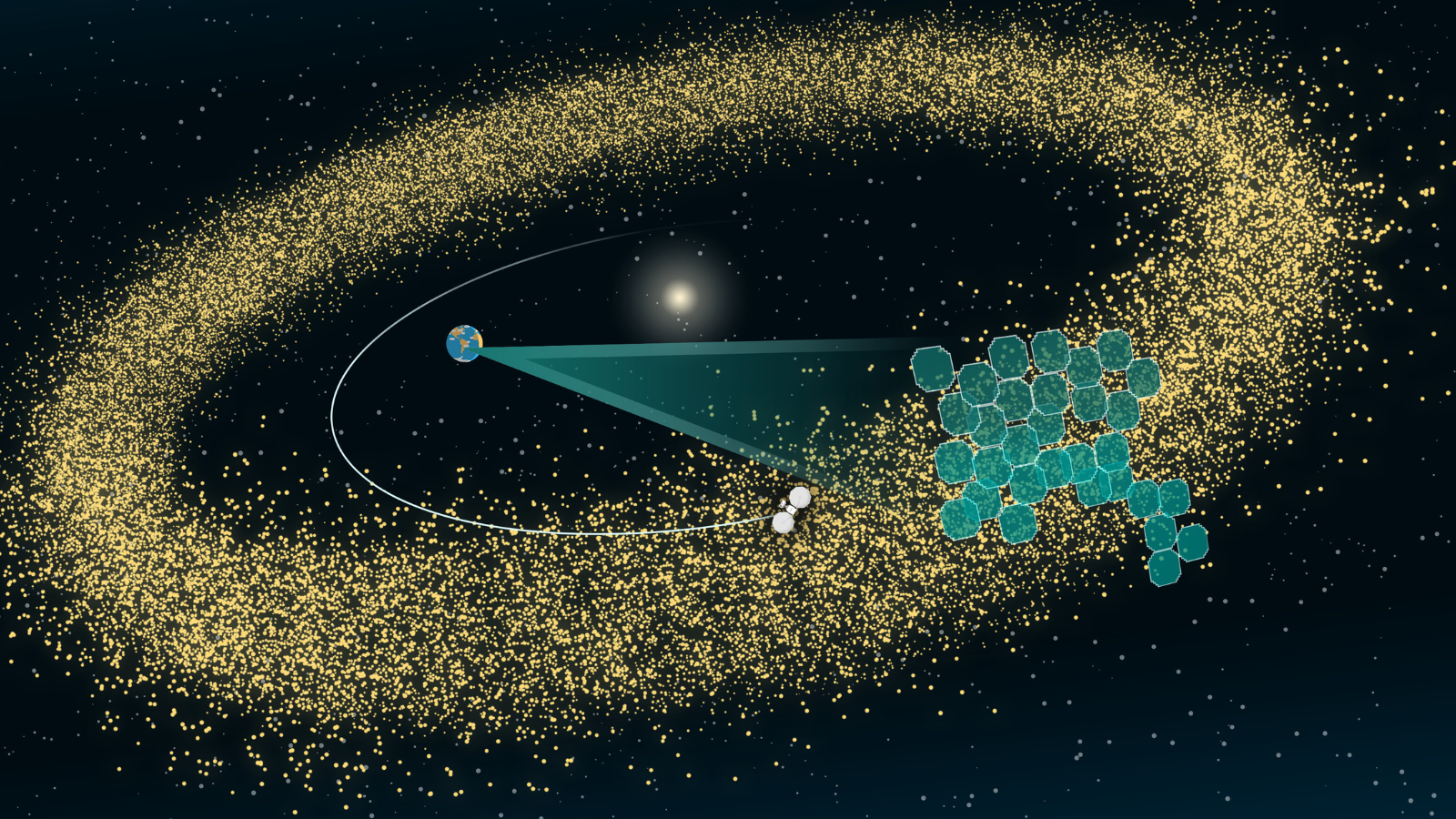

An illustration depicts hexagonal footprints projecting onto a band of asteroids, showcasing the perspective of the Rubin Observatory.
The Vera C. Rubin Observatory, set to debut in 2025, will not physically venture beyond Earth. However, its comprehensive view of the universe is poised to revolutionize space exploration.
Within our solar system resides myriad small rocky and icy celestial bodies, remnants of its formation over 4.5 billion years ago. Recent space missions such as NASA’s OSIRIS-REx, Lucy, and Psyche have made significant strides in studying these ancient solar system objects, capturing images and even collecting samples for further analysis here on Earth, guided by data gathered by observatories worldwide.
The Rubin Observatory’s potential to detect millions of previously unknown asteroids, comets, and potentially interstellar objects passing through our cosmic neighborhood is groundbreaking. Notably, discoveries like Oumuamua, first observed in 2017, highlight the significance of Rubin’s upcoming role in tracking and studying these celestial bodies as they traverse the solar system, including those within the asteroid belt between Mars and Jupiter.
“Picking out asteroid muses”
Through its decade-long Legacy Survey of Space and Time (LSST), the Rubin Observatory will surveil a multitude of solar system bodies and cosmic entities extending beyond the confines of our solar system and even the Milky Way galaxy.
Employing an innovative approach of scanning the southern hemisphere sky every few nights with a cutting-edge 8.4-meter telescope and the world’s largest digital camera, Rubin aims to expand our solar system object database, accumulated over two centuries, by at least fivefold, according to scientific projections.
Furthermore, construction of the Rubin Observatory atop Cerro Pachón in Chile anticipates not only the identification of numerous new solar system objects but also a wealth of information that could illuminate uncharted regions within our cosmic neighborhood, potentially identifying novel targets for future space missions.