


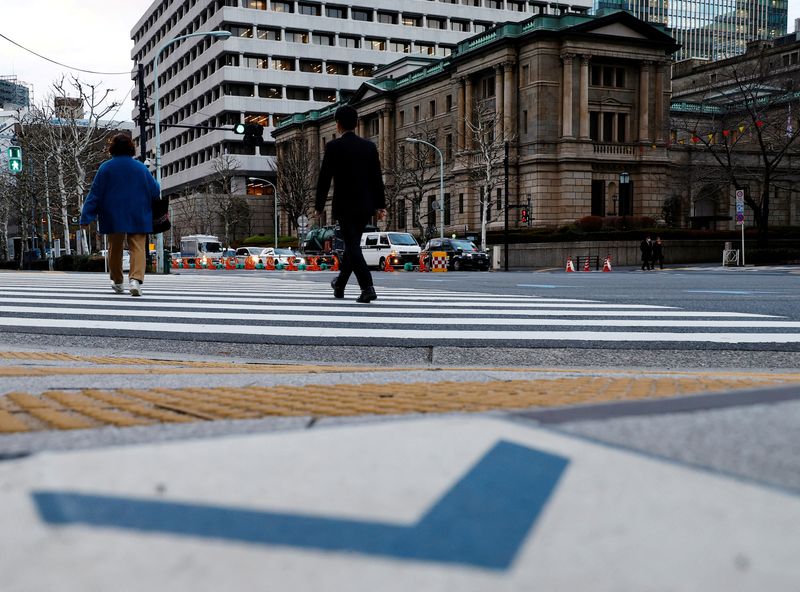
 © Reuters. People walk in front of the Bank of Japan building in Tokyo, Japan, January 23, 2024. REUTERS/Kim Kyung-Hoon/File Photo
(This Feb. 16 story has been corrected to fix the end date of wage negotiations to March 13, not March 15, in paragraph 17)
By Leika Kihara
TOKYO (Reuters) – Despite the recent economic downturn, the Bank of Japan remains committed to ending negative interest rates in the near future, according to sources who are familiar with the bank’s plans. However, due to a lack of strong domestic demand, they are considering seeking more information on wage growth before making any decisions.
Japan surprised many analysts with the release of data showing a contraction in gross domestic product for two consecutive quarters, officially entering into a recession and losing its ranking as the world’s third-largest economy to Germany.
While the GDP decline was concerning, the focus for BOJ policymakers lies in the wage negotiations scheduled for 2025, which will be a crucial indicator of the country’s economic recovery potential. The central bank believes that substantial wage increases are essential for reviving Japan’s stagnant household consumption that has persisted for decades.
Therefore, the upcoming wage talks that determine pay levels for the next year hold more significance for the BOJ than the fourth-quarter GDP data, which reflects past economic performance.
Given the weakness in the consumer sector evident from the GDP numbers, it is now more probable that the BOJ will end negative rates at its meeting in April rather than in March, allowing for a more accurate assessment of the economy’s health.
“While domestic demand may seem sluggish, GDP is just one of the factors considered by the BOJ,” said one insider. Another source added, “The focus should be on the broader economic trends and future prospects,” a sentiment shared by a third source.
BOJ governor Kazuo Ueda, who assumed office recently, has been working towards moving away from the aggressive monetary policies introduced by his predecessor, Haruhiko Kuroda, which have been criticized for creating significant distortions in financial markets.
Despite the recent GDP figures, Ueda reiterated on Friday that adjustments to various monetary measures, including negative rates, are still on the table.
Considerations for Delay
The rising labor shortages have prompted many companies to indicate substantial wage increases, raising hopes for widespread salary hikes that could boost household purchasing power to withstand continual price hikes.
The BOJ anticipates that higher wages and diminishing cost pressures will support consumer spending and overall economic growth, thereby maintaining inflation around its target of 2% and enabling the normalization of monetary policy.
In a detailed explanation last week, Deputy Governor Shinichi Uchida outlined the BOJ’s strategy for unwinding its complex policies, emphasizing a gradual approach to avoiding sudden spikes in borrowing costs once negative rates are lifted.
These carefully communicated signals have led the majority of market participants to predict the end of negative rates either during the BOJ’s policy meeting scheduled for March 18-19 or April 25-26.