

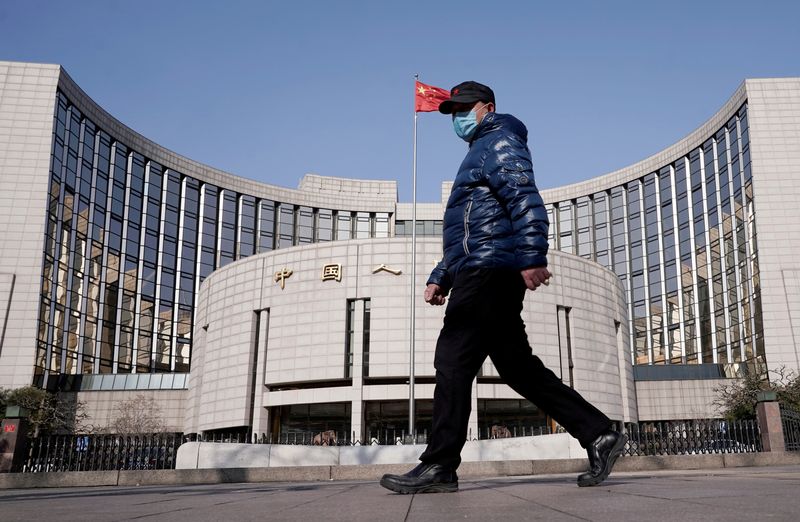
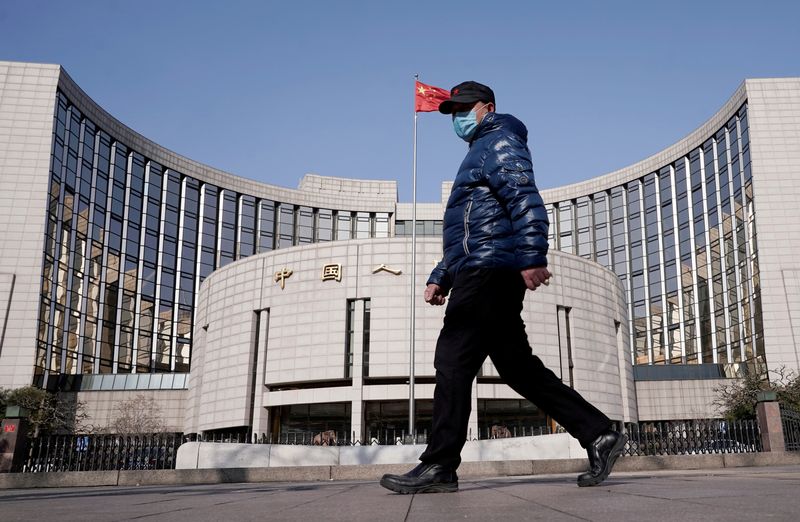
© Reuters. A person wearing a face covering walks past the headquarters of the People’s Bank of China, the central bank, in Beijing, China, amidst the COVID-19 pandemic, February 3, 2020. REUTERS/Jason Lee/ File Photo
China Central Bank Strategy Amidst Federal Reserve Uncertainty
Amidst uncertainties surrounding the Federal Reserve’s monetary policy, China’s central bank maintained its key policy rate unchanged on Sunday while renewing maturing medium-term loans. This decision reflects Beijing’s cautious approach to supporting its economy while facing deflationary pressures that demand more stimulus measures. However, taking aggressive monetary action could trigger currency depreciation and capital outflows.
Investors now anticipate the Federal Reserve to delay easing until mid-year, leading to expectations that China may postpone imminent stimulus measures. The People’s Bank of China (PBOC) announced that the one-year medium-term lending facility (MLF) rate of 500 billion yuan would remain at 2.50%, aiming to sustain ample liquidity in the banking system.
A Reuters survey revealed that the majority of analysts predicted the central bank would maintain the MLF loan rate on February 18. With 499 billion yuan of MLF loans set to mature, the operation resulted in a net 1 billion yuan injection into the banking system.
Market analysts suggest that the steady MLF rate aligns with policymakers’ efforts to stabilize the Chinese yuan and minimize negative rate differentials compared to the U.S. dollar. Despite this, there are growing expectations for further monetary easing measures in the coming months following a recent deep cut in bank reserves.
The PBOC reiterated its commitment to flexible policies to enhance domestic demand while ensuring price stability. Analysts predict two rounds of rate cuts in the first and second quarters of the year, expecting reductions in open market operations (OMO) and MLF rates. However, recent easing measures, including an unexpected cut in the reserve requirement ratio (RRR), failed to restore market confidence.
Financial News, supported by the central bank, suggested that the benchmark loan prime rate (LPR) may decrease soon, with a potential reduction in the five-year tenor. This indicates China’s readiness to adjust its monetary policies in response to economic conditions and global factors.