

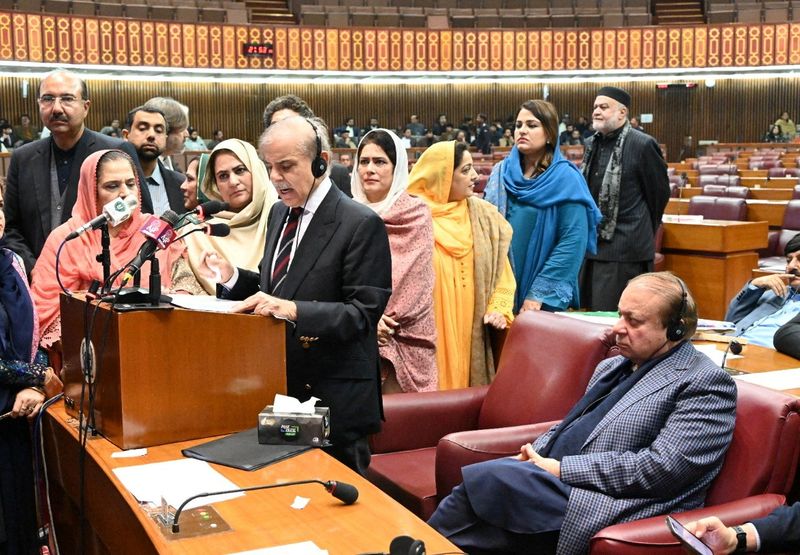

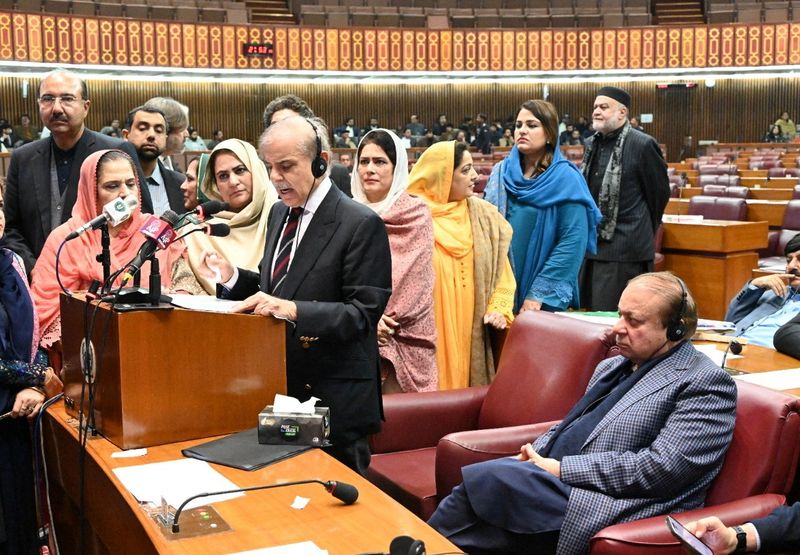
 © Reuters. Shehbaz Sharif, Pakistan’s recently elected Prime Minister, delivers an address after being elected for a second term in the National Assembly building in Islamabad, Pakistan, on March 3, 2024. Pakistan National Assembly/Handout via REUTERS
Economic Priorities and IMF talks
In a significant development for Pakistan, Shehbaz Sharif was sworn in as Prime Minister for a second term, following a delayed coalition government formation due to uncertainties surrounding the national election. His inauguration ceremony took place at the presidential office in Islamabad, where he emphasized the importance of economic stability. Sharif wasted no time and immediately directed his finance team to initiate discussions with the International Monetary Fund (IMF) regarding an extended funding facility, given that the current agreement is set to expire in April.
Focus on Economic Improvement
Sharif stressed the mandate given to his government to enhance the country’s economy as the top priority. This signals a strong commitment to addressing economic challenges and promoting growth to benefit the nation as a whole.
Political Landscape and Coalition Formation
The national election, held on February 8, faced various controversies, including disruptions in communication channels and allegations of irregularities. Despite this, the Pakistan Muslim League-Nawaz (PML-N) and the Pakistan People’s Party (PPP) decided to join forces and establish a coalition government. Despite his party’s victory, Shehbaz Sharif, following in his brother Nawaz Sharif’s footsteps, assumed the mantle of Prime Minister.
Appointment of Finance Minister
One of the crucial decisions awaiting Sharif is the appointment of a new Finance Minister. This role will be paramount in navigating negotiations with the IMF for a substantial funding agreement. Speculations suggest that former finance minister Ishaq Dar is a prime candidate for the position, although other contenders are also under consideration.
Anticipated Economic Policies
Economists, investors, and international stakeholders are keenly observing Sharif’s forthcoming policies, particularly in the economic domain. The announcement of the cabinet, along with key positions like the finance portfolio, will provide insights into the government’s strategies for steering the economy towards stability and growth.