

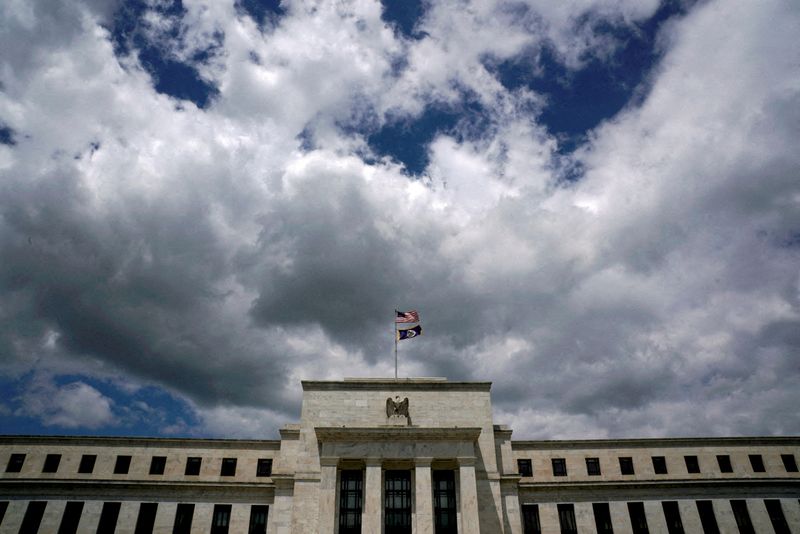

 © Reuters. FILE PHOTO: Flags fly over the Federal Reserve building on a windy day in Washington, U.S., May 26, 2017. REUTERS/Kevin Lamarque/File Photo
By Davide Barbuscia and Shankar Ramakrishnan
In the United States, the current high demand for top-rated corporate debt has sparked concern among certain investors who anticipate a potential market downturn if liquidity conditions deteriorate later in the year.
The optimism surrounding the U.S. economy, despite elevated interest rates, has driven a quest for higher yields and bolstered the demand for credit. So far in the year, companies with investment-grade ratings have issued record amounts of debt. The credit spreads, representing the premium companies pay over U.S. Treasuries to issue bonds, are at historically narrow levels.
However, there are market participants who believe that the positive sentiment toward this asset class could leave it exposed to correction once the Federal Reserve’s measures to tighten financial conditions have an impact on bank reserves, which have remained relatively untouched due to excess liquidity in the financial sector.
The inflows into the Fed’s overnight reverse repo facility, serving as an indicator of surplus cash in the financial system, have significantly decreased over the past year.
As the cash outflow from the reverse repo facility accelerates, bank reserves held at the Fed are anticipated to decline, leading to a tightening of overall liquidity in the financial system. This could potentially diminish the demand for risk assets such as stocks and credit.
Daniel Krieter, BMO Capital Markets’ director of fixed income strategy, noted a strong correlation between excess bank reserves and investment-grade credit spreads, which tend to narrow when reserves increase.
“The level of excess reserves in the system is crucial for risk,” said Matt Smith, a fund manager at Ruffer. “Liquidity will diminish from this point onwards, and in addition to that, everything is highly priced… we anticipate a substantial market correction and have positioned ourselves accordingly,” he added.
Forecasts differ on when the reverse repo facility will be depleted. Some analysts predict this event to occur between May and July this year, despite the recent favorable market conditions in U.S. funding markets suggesting the process may extend beyond that timeframe.
‘BUBBLY’ MARKETS
It should be noted that the anticipations of reduced credit demand have been proven incorrect in recent years, with corporate debt default risks diminishing as the economy exhibited surprising resilience despite historically high interest rates.
Year-to-date, investment-grade companies have raised a staggering $395 billion so far, with new bond offerings typically receiving three to four times oversubscriptions. This allows companies to issue new bonds with minimal or no spread premium, as per data from Informa Global Markets.
“The combination of still relatively elevated Treasury yields and prudently managed corporate balance sheets is enticing liquidity into high-quality bonds,” stated Jonathan Fine, head of investment-grade syndicate at Goldman Sachs.
» …
rnrn