


The Legacy of the Verona Astrolabe: A Historical Exchange between Cultures
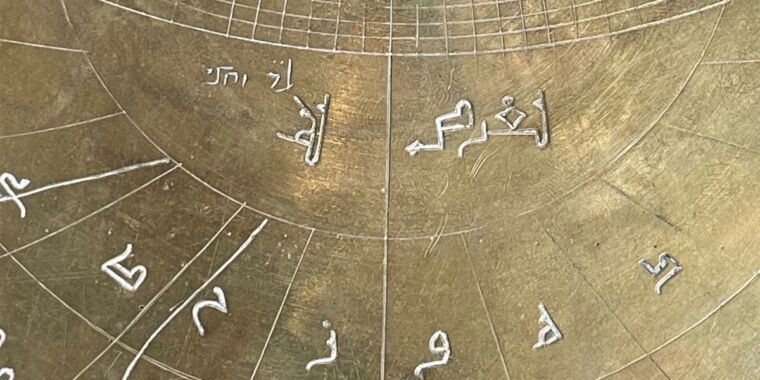
In the realm of Islamic astrolabes, historian Federica Gigante, a scholar at Cambridge University, recently came across a fascinating discovery. While investigating an astrolabe displayed at the Fondazione Museo Miniscalchi-Erizzo in Verona, Italy, Gigante realized she was in the presence of an authentic 11th-century instrument, adorned with inscriptions in both Arabic and Hebrew. Contrary to initial suspicions of forgery, the Verona astrolabe turned out to be one of the oldest examples of its kind, shedding light on a rich history of scientific collaboration between Arabs, Jews, and Christians spanning centuries.
Gigante’s research unveiled a remarkable narrative behind the Verona astrolabe. The object had undergone numerous modifications and additions as it changed hands over time. Notably, at least three different users felt compelled to include translations and corrections on the astrolabe, with two utilizing Hebrew and one opting for a Western language. This intricate web of cultural exchanges and contributions underscores the profound significance of the Verona astrolabe as a testament to cross-cultural scientific dialogue.
Astrolabes, ancient instruments possibly dating back to the second century BCE, held pivotal roles in celestial navigation and astronomical observations. While originally utilized for tracking stars’ positions and time, astrolabes also proved invaluable for various terrestrial applications, such as land navigation, seasonal tracking, and timekeeping. Particularly in religious contexts, astrolabes aided in determining daily prayer schedules, the direction of Mecca, and the observance of Ramadan within the Islamic calendar.
As seafaring technologies evolved, the mariner’s astrolabe emerged as a pivotal instrument for navigating the high seas. Featuring a simplified design marked with degree measurements for celestial altitudes, mariner’s astrolabes facilitated navigation in challenging maritime environments. Ultimately, the advent of the sextant in the 18th century supplanted the astrolabe as the preferred tool for precise seafaring navigation.
In the realm of maritime history, the discovery of mariner’s astrolabes from shipwrecks has provided invaluable insights into early navigation practices. One notable example is the recovery of the Sodré astrolabe from Portuguese explorer Vasco da Gama’s shipwreck, the Esmeralda, off the coast of Oman in 2014. With only a limited number of mariner’s astrolabes cataloged worldwide, these artifacts hold great historical significance in mapping the evolution of seafaring technology.
The composition of an astrolabe typically consists of a disk engraved with hour markings and arc degrees, known as the mater. This disk is complemented by flat plates called tympans, which depict azimuth and altitude measurements corresponding to specific latitudes. Through its intricate design and multifaceted utility, the astrolabe stands as a timeless symbol of scientific ingenuity and cultural exchange.