


Exploration of Distant Galaxies Uncovers Ancient Secrets
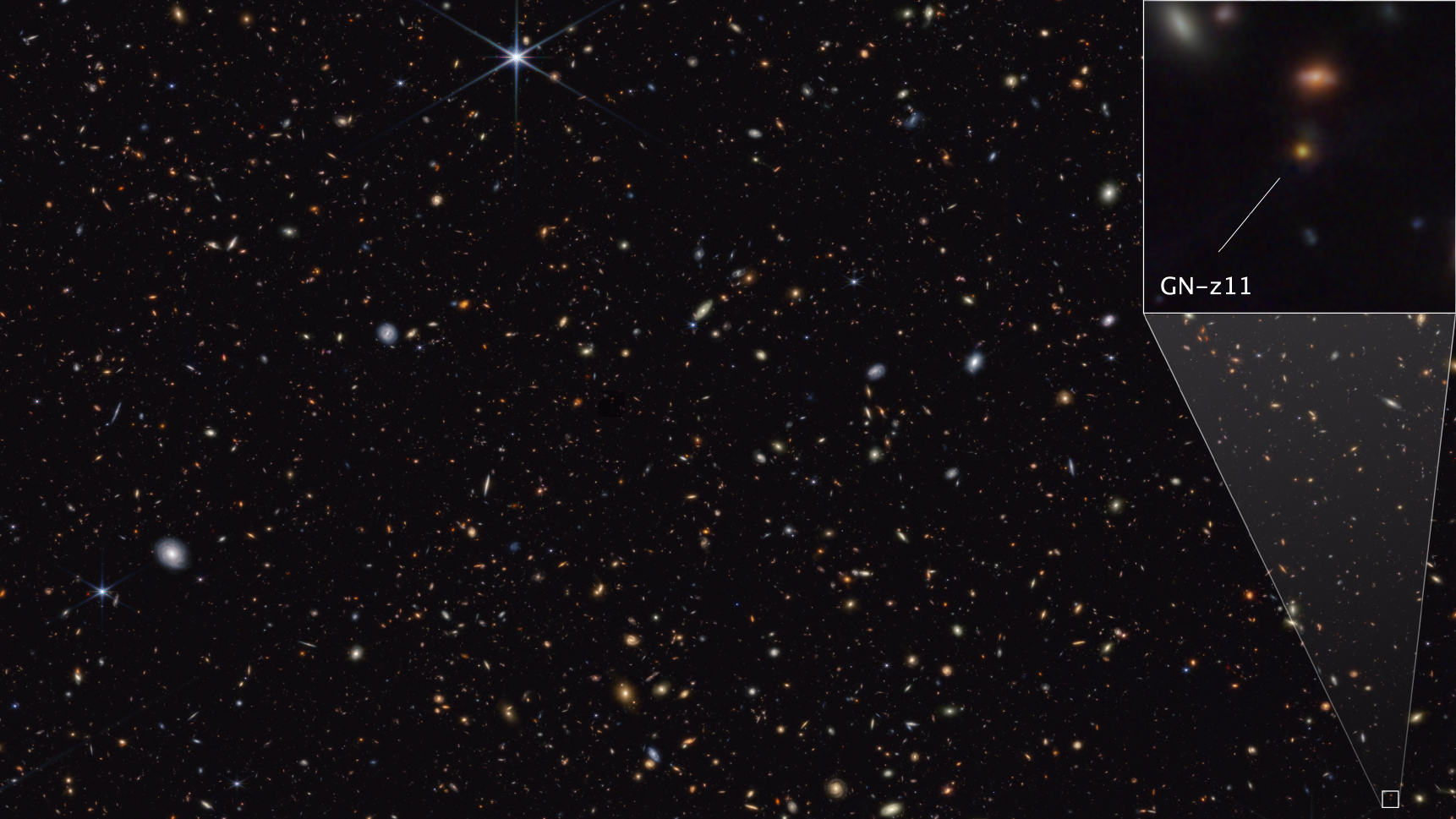
A remarkable discovery has been made by the James Webb Space Telescope (JWST), shedding light on the existence of the first generation of stars in the universe. This groundbreaking evidence is found in GN-z11, one of the most remote galaxies known to humanity.
History of GN-z11
The galaxy GN-z11 was first spotted by the Hubble Space Telescope in 2015 and held the title of being the farthest galaxy observed until the launch of the James Webb Space Telescope. Situated in the Ursa Major constellation, this galaxy has a redshift of 10.6, indicating its ancient origins just 430 million years after the Big Bang. To put this into perspective, the universe as we know it today is 13.8 billion years old.
Recent JWST Discoveries
Notable progress has been made through the JWST’s observations of GN-z11, revealing significant insight into the growth patterns of galaxies in the early universe. Researchers have uncovered mesmerizing details about this luminous galaxy, challenging previous models of galaxy formation based on the standard cosmological framework.
Insights from JWST Observations
Led by Roberto Maiolino of the University of Cambridge, an astronomy team utilized the JWST’s advanced instruments to delve into GN-z11. Their investigations unveiled evidence of Population III stars, the first generation of stars in the universe, alongside a supermassive black hole rapidly consuming vast amounts of matter.
Stellar Evolution
The abundance of heavy elements in a star allows scientists to determine its age, as these elements are produced by previous generations of stars and recycled in star-forming regions. Population I stars, like our sun, are the youngest and richest in heavy elements, while Population II stars are older and possess fewer heavy elements due to fewer preceding generations.
In conclusion, the recent JWST observations of GN-z11 have provided a unique window into the ancient past, offering valuable insights into the evolution of galaxies and stars in the early universe. Explore further in this detailed article from Space.com.