

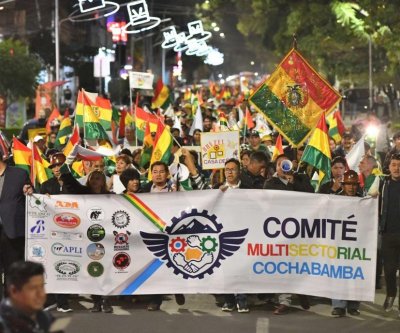

Members of unions that represent merchants, transport workers, local producers and neighborhood associations march Tuesday in Cochabamba, in central Bolivia, “in defense of democracy” and to demand an end to the roadblocks set up by farmers from the Altiplano who are calling for the resignation of President Rodrigo Paz. Photo by Jorge Abrego/EPA
May 20 (UPI) — Bolivia is facing one of its most severe political and social crises in recent years as President Rodrigo Paz’s government and U.S. officials warned of what they described as “a coup attempt underway” amid violent protests, prolonged road blockades and widespread shortages.
Authorities accuse allies of former President Evo Morales, along with armed groups and organized crime networks, of attempting to destabilize the democratically elected government.
In an interview Wednesday with Radio Mitre in Buenos Aires, Bolivia’s foreign minister warned that the country faces an attempted coup by those seeking to remove Paz’s government. Paz took office less than a year ago following a disputed transition process.
Foreign Minister Aramayo alleged the existence of armed factions and accused Morales of resisting judicial proceedings and encouraging political destabilization.
The demonstrations, concentrated mainly in La Paz, have led to clashes, attacks on public buildings, looting and highway blockades that disrupted supplies of fuel, food and medical oxygen.
“What is taking shape in Bolivia is clearly a coup attempt. There is no other name for it. Someone wants to overthrow a democratically elected government by force,” Aramayo said.
On Tuesday, U.S. Deputy Secretary of State Christopher Landau reiterated White House support for the Bolivian government and argued the crisis extends beyond an internal political dispute.
“This is a coup attempt that is underway,” Landau said, adding that political actors and criminal networks have formed an alliance to weaken Bolivia’s democratic institutions.
Landau criticized violent mobilizations against an elected government and said the crisis reflects a broader regional problem involving weak institutions and the expansion of organized crime.
In an interview with UPI, former Hydrocarbons Minister Álvaro Ríos Roca linked the conflict to the political objectives of Morales, who remains in a coca-growing region outside the reach of authorities.
“That is why Morales has led these marches,” Ríos Roca said, contending the former president seeks to preserve political influence and avoid judicial proceedings.
Ríos Roca also said organizations historically tied to the ruling Movement Toward Socialism party, known as MAS, had been mobilized with expectations of regaining lost state benefits.
“They used to receive money, vehicles and housing. Those privileges were cut off,” he said.
He added that fear and uncertainty surrounding Morales’ political and legal future continue to fuel tensions, particularly over potential actions involving foreign intelligence agencies, including the U.S. Drug Enforcement Administration.
Bolivian political analyst Franklin Pareja agreed that the protests are backed by organized structures with illicit interests. He described the unrest not as a genuine social conflict,