


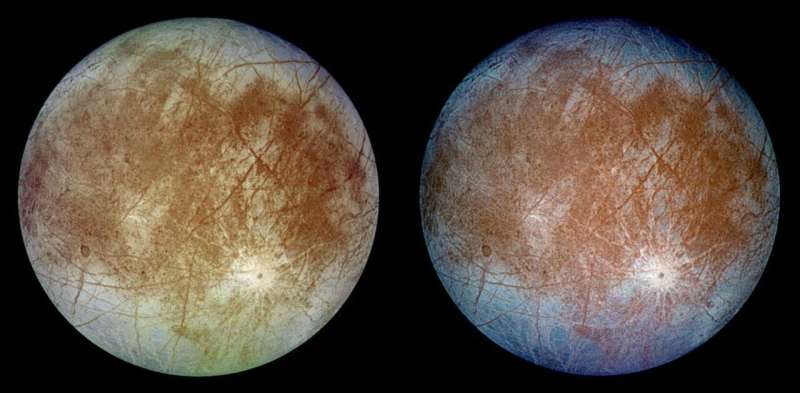
Europa, Jupiter’s icy moon, has been considered a potential habitat for life within our Solar System. The recent examination of Europa’s atmosphere during the Juno mission to Jupiter has provided new insights. The findings, detailed in a publication in Nature Astronomy, indicate that Europa’s icy surface generates less oxygen than originally believed.
Excitement surrounds the prospect of discovering microbial life on Europa. Investigations from the Galileo mission have uncovered an ocean beneath Europa’s icy exterior, holding twice as much water as Earth’s oceans. Moreover, data analysis indicates that Europa’s ocean floor interacts with rock, creating chemical reactions that produce energy, making it a promising environment for potential life forms.
Observations from telescopes have unveiled a thin, oxygen-rich atmosphere enveloping Europa. Additionally, intermittent water plumes emerging from the ocean have been detected. Basic chemical elements crucial for life on Earth, such as carbon, hydrogen, nitrogen, oxygen, phosphorus, and sulfur, are also believed to exist on Europa’s surface. These elements could potentially permeate the water from the atmosphere and surface.
The heating of Europa and its ocean is primarily due to the moon’s orbit around Jupiter, generating tidal forces that warm the otherwise cold environment. Despite Europa possessing the essential components for life – water, requisite chemical elements, and a heat source – the duration required for life to evolve remains uncertain.
Mars stands as another potential contender for hosting life, with the Rosalind Franklin rover scheduled to explore the planet in 2028. While life may have initially emerged on Mars concurrently with Earth, climate change is speculated to have hindered its progression.
Enceladus, a moon of Saturn, has surfaced as another candidate after the Cassini-Huygens mission unearthed water plumes from a subsurface salty ocean, also in contact with rock at the ocean’s base.
Titan, Saturn’s moon, follows as a fourth contender, boasting a dense atmosphere packed with organic compounds like hydrocarbon and tholins, originating in the upper atmosphere and settling on the surface, creating a conducive environment for life.
Losing Oxygen
The Juno mission presents cutting-edge charged particle instruments, yielding valuable data on the energy, direction, and composition of charged particles on Jupiter’s moons. These instruments have pointed towards the presence of pickup ions, particles indicating ionized atmospheres. Such findings provide valuable insights into the atmospheric composition of various celestial bodies.