


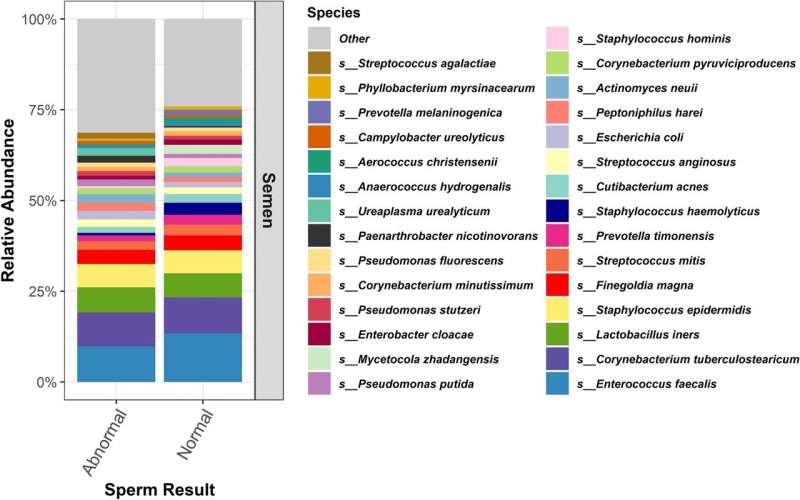
 nRelative Abundance, Group 1. Relative abundance of the top 30 species of participants with normal sperm concentration and motility on SA versus participants with at least one abnormality in sperm concentration or motility on SA. Credit: Scientific Reports (2024). DOI: 10.1038/s41598-024-51686-4
You may have heard about the gut microbiome and its influence on a person’s overall health and well-being. However, did you know the same may hold true for the semen microbiome?
According to researchers from the Department of Urology at UCLA, the semen microbiota might play a crucial role in influencing sperm parameters and enhancing male fertility.
Considering recent studies highlighting the microbiome’s significance in overall human health, this investigation could potentially pave the way for developing treatments targeted at rectifying any issues with sperm parameters.
Published in Scientific Reports, the study found that one microbe in particular, Lactobacillus iners, may have a direct negative impact on male fertility. Researchers found that men with more of this microbe were more likely to have issues with sperm motility.
Previous research revealed that Lactobacillus iners can preferentially produce L-lactic acid, potentially leading to a pro-inflammatory environment locally, which could adversely affect sperm motility. The study authors point out that existing research has hinted at the link between this microbe and fertility, but most of the literature pertains to the vaginal microbiome and female factors.
This is the first study to report a negative association between the microbe and male-factor fertility.
Researchers also discovered that three types of bacteria in the Pseudomonas group were present in patients with both normal and abnormal sperm concentrations. Microbes called Pseudomonas fluorescens and Pseudomonas stutzeri were more common in patients with abnormal sperm concentrations, while Pseudomonas putida was less common in samples with abnormal sperm concentrations.
However, the findings indicate that not every member of the same closely related group may affect fertility in the same way, whether positively or negatively. In other words, even closely related microbes may not always have the same direct correlation to fertility.
“There is much more to explore regarding the microbiome and its connection to male infertility,” said Vadim Osadchiy, a resident in the Department of Urology at UCLA and the lead author of the study. “However, these findings provide valuable insights that can lead us in the right direction for a deeper understanding of this correlation. Our research aligns with evidence from smaller studies and will pave the way for future, more comprehensive investigations to unravel the complex relationship between the semen microbiome and fertility.”
For more information: Vadim Osadchiy et al, Semen microbiota are dramatically altered in men with abnormal sperm parameters, Scientific Reports (2024). DOI: 10.1038/s41598-024-51686-4
Citation:
Semen microbiome health may impact male fertility (2024, January 18)
Retrieved 18 January 2024 from https://phys.org/news/2024-01-semen-microbiome-health-impact-male.html
This document is subject to copyright.