

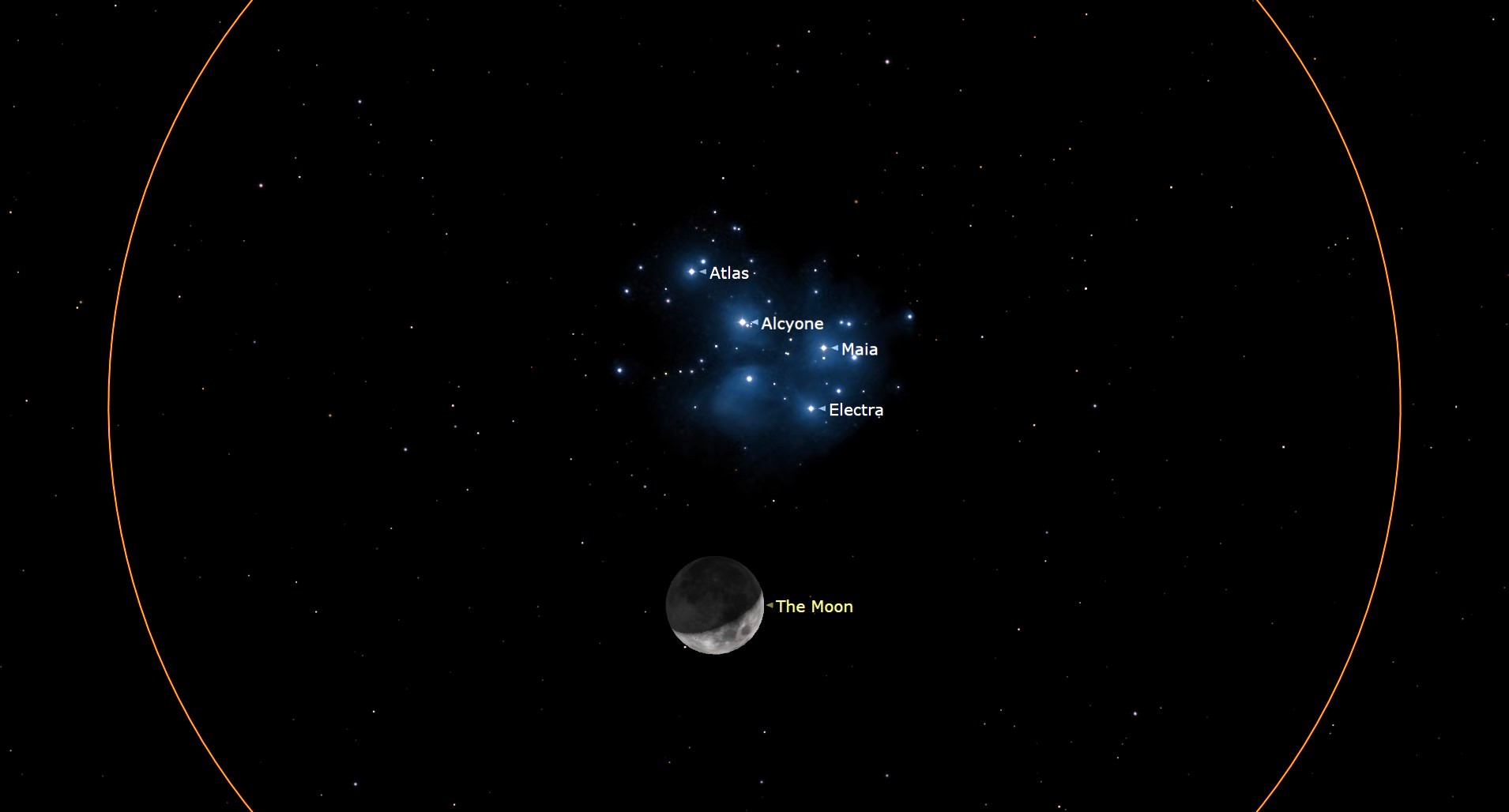

Experience the Celestial Ballet: The Moon and Pleiades Star Cluster Dance in the Night Sky
A stunning celestial event is set to unfold tonight as two of the most captivating sights in the night sky come together in a spectacular ballet. The crescent moon, only four days old, will be positioned just beneath the Pleiades star cluster, a celestial gem also known as Messier 45 or M45. The moon and the Pleiades will be separated by just 3 degrees, which is equivalent to a few finger widths when viewed with an outstretched arm. This close proximity allows for the pair to be observed together through binoculars or a telescope with a low-magnification eyepiece.
The magical encounter between the crescent moon and the Pleiades will be visible right after sunset and will continue to charm observers until shortly after midnight local time, at which point the moon will have drifted in front of the sparkling stars of the Pleiades.
The Pleiades, residing in the constellation Taurus, the Bull, is a popular asterism that enchants stargazers with its beauty. Although only the brightest stars in the cluster are visible to the naked eye, there are more than 1,000 stars in total within the Pleiades. This open star cluster, characterized by a loose grouping of stars that are approximately the same age, boasts an estimated age of 75 to 150 million years. Open star clusters typically contain hundreds to thousands of stars, in contrast to globular clusters that can house thousands to millions of stars.
The Pleiades, often referred to as the “Seven Sisters,” draws its name from a Greek myth in which the seven daughters of the ocean nymph Pleione and Atlas were transformed into doves to soar into the heavens and evade the hunter Orion.
Adding to the celestial spectacle tonight, positioned slightly above the moon and the Pleiades at about the width of a fist at arm’s length, Jupiter will radiate a bright pale yellow hue near the horns of Aries, the Ram.
Currently in its waxing phase, the moon’s illuminated section is expanding as it approaches its first quarter phase on March 17. Subsequently, on March 25, the moon will attain its full phase with the Full Worm Moon, coinciding with a penumbral lunar eclipse.
For those eager to witness the enchanting alignment of the crescent moon and the Pleiades, or any other celestial wonders in the night sky, resources like the best telescopes and binoculars offer a great starting point. To capture stunning images of the night sky, explore guides on photographing the moon, along with recommendations for the best cameras and lenses for astrophotography. Take advantage of this celestial ballet between the moon and the Pleiades to immerse yourself in the marvels of the night sky.