

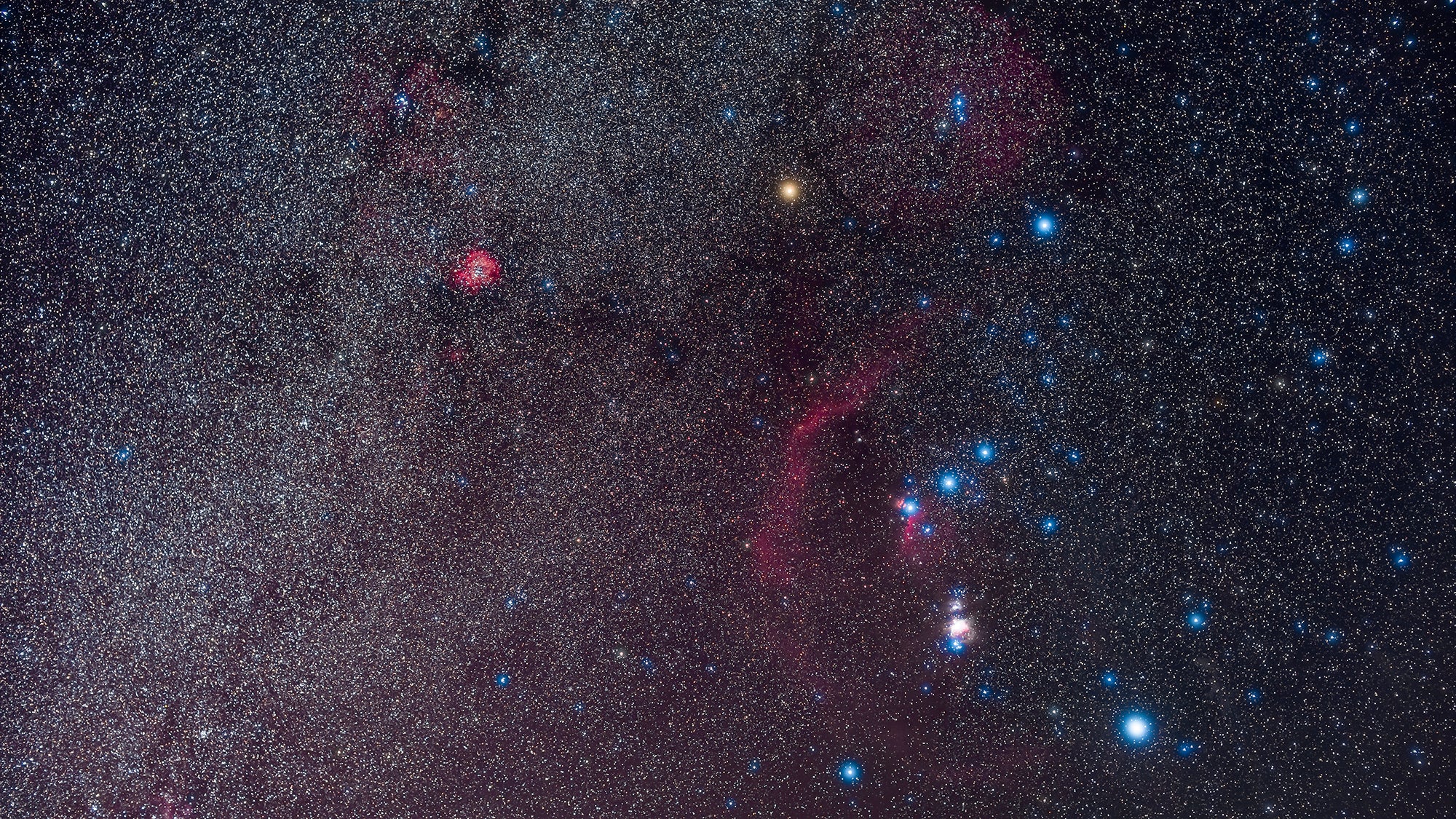

February brings with it weather-forecasting rodents and romance, but a Valentine’s Day comet and Leap Day makes February 2024 even more exciting. The shortest month of every year has a few solid opportunities for looking up at the night sky and catching unique celestial bodies. If you’re in the Northern Hemisphere, that winter chill makes the sky a little easier to see due to colder and less-hazy air. Here are some of the cosmic events to keep your eye on with your Valentine (or groundhog).
[Related: Why we turn stars into constellations.]
February 1 through 29–Orion, the Hunter dominates the night sky
One of the brightest constellations in the sky will be dominant this month. Orion, the Hunter will be most visible in the sky towards the south after midnight local time. It’s best to look for the three stars that make up Orion’s Belt. These three stars form a straight line at the midsection of the Hunter.
Over a dozen stars make up this constellation, but there are two particularly bright spots named Betelgeuse and Rigel. The red supergiant Betelgeuse shines on Orion’s right shoulder. Betelgeuse is only about 10 million years old, making it a baby compared to our nearly 5 billion-year old sun. The constellation’s brightest star is the blue supergiant Rigel, located towards The Hunter’s left foot. Rigel is about 8 million years old and is 36,000 degrees Fahrenheit at its surface.
February 14–Comet C/2021 S3 (PanSTARRS) closest approach to the sun
This comet C/2021 S3 (PanSTARRS) will reach its closest point to the sun–or perihelion–on Valentine’s Day. It will shine at very bright magnitude (7.3), it should be fairly visible if it’s a clear night. If you are in the northeastern United States, look towards the southeastern horizon at least two hours before dawn. The comet will reach its closest (but not dangerous) approach to Earth this year on March 14th.
[Related: Why leap years exist.]
February 24–Full Snow Moon
February’s full moon will reach its peak illumination at 7:30 a.m. EST on Saturday, February 24. It will still appear full Friday night. It will drift above the horizon towards the east around sunset and should reach its highest point in the sky at about midnight on Saturday.
The name snow moon is pretty straightforward, as February is known for heavy snowfall. It is also called the When the Bear Cubs are Born Moon or Makoonsag-gaa-nitaawaadi-giizis in Anishinaabemowin (Ojibwe), Midwinter Moon, or Tsha’tekohselha in Oneida, and the Little Sister of the Waning Moon or Tahch’awɛka Tehekuma in Tunica.
February 29–Leap Day
It’s not something you can see from Earth, but Leap Day is technically an astronomical event.
Read More rnrn