

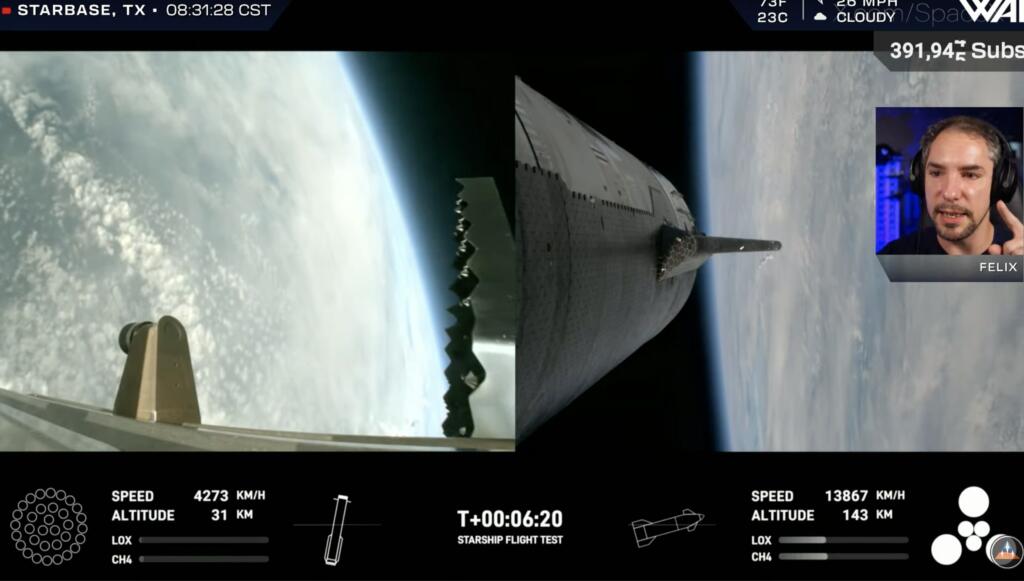

Exploration Update: Starship Fails to Land Safely Due to Booster Malfunction
In a recent space mission, the Starship faced a setback during its landing burn, as the booster failed to relight fully, resulting in the Starship being lost during re-entry. This unexpected turn of events highlights the challenges and risks involved in space exploration.
Technical Difficulties Lead to Unsuccessful Landing
The Starship, a cutting-edge spacecraft designed for deep-space exploration, encountered a critical issue with its booster during the landing phase. The booster’s engines did not all relight as intended, impairing the Starship’s ability to make a controlled descent.
As a result, the Starship was unable to land safely and was lost during re-entry into the Earth’s atmosphere. This incident serves as a sobering reminder of the complexities and uncertainties inherent in space travel, despite advances in technology.
Implications for Future Missions
The failure of the Starship’s landing burn raises questions about the reliability and robustness of space exploration systems. It underscores the need for continuous improvement and innovation to mitigate risks and enhance the safety of missions.
Moving forward, space agencies and private companies must learn from this experience to prevent similar mishaps in future missions. By conducting thorough analyses and implementing corrective measures, they can strengthen the resilience of space vehicles and ensure a higher probability of mission success.
Lessons Learned from Setbacks
While the loss of the Starship is undoubtedly disappointing, setbacks and failures are an inevitable part of the space exploration journey. They provide valuable lessons and opportunities for growth, prompting engineers and scientists to refine their designs and strategies.
By embracing challenges and learning from mistakes, the space exploration community can pave the way for more ambitious and successful missions in the future. Each setback serves as a stepping stone towards greater achievements and breakthroughs in our understanding of the cosmos.
Looking Ahead: Towards a Safer and More Resilient Spacefaring Future
As we reflect on the recent incident involving the Starship, we are reminded of the inherent risks and uncertainties of venturing into space. However, our unwavering commitment to exploration and discovery drives us to overcome obstacles and push the boundaries of what is possible.
By leveraging our collective knowledge and ingenuity, we can address the technical challenges and operational complexities of space travel. Together, we will continue to pursue our quest for knowledge and exploration, inspiring generations to come with our boundless curiosity and determination.
In conclusion, the failed landing of the Starship serves as a poignant reminder of the inherent risks of space exploration. While setbacks are inevitable, they also present opportunities for growth and improvement. By learning from our mistakes and striving for excellence, we can progress towards a safer and more resilient future in space travel.The Successful Launch of Starship: A Detailed Analysis
On the recent test flight of Starship, several key events unfolded with varying degrees of success. Let’s break down the sequence of events and evaluate the outcomes.
Launch Success and Separation: The launch and separation processes were executed flawlessly, setting the stage for what was hoped to be a successful mission.
Boost Back and Booster Engine Re-light: While the boost back maneuver went smoothly, unfortunately, the re-light of the booster engine for landing did not go as planned, posing a challenge for future missions.
Super Heavy Hover and Achieving Orbit: The attempt at a Super Heavy hover was not successful, but achieving orbit was a monumental success, showcasing the capabilities of Starship.
Door Operations and Prop Transfer: The operation of opening and closing the doors was successful, as was the propellant transfer process, demonstrating the versatility of the spacecraft.
Re-entry and Upper Stage Maneuvers: The re-entry of the upper stage was only partially successful, while the upper stage hover did not meet expectations, indicating areas for improvement in future missions.
Brian Wang: A Leading Figure in Futurist Thinking
Brian Wang, a prominent Futurist Thought Leader and renowned Science blogger, draws in a vast audience of 1 million readers per month on his blog Nextbigfuture.com, leading it to be recognized as the top Science News Blog.
With a keen eye for cutting-edge technologies, Wang has co-founded a startup and actively fundraises for early-stage companies with high potential. In addition, he serves as the Head of Research for Allocations in deep technology investments and participates as an Angel Investor at Space Angels.
A sought-after speaker, Wang has presented at TEDx and Singularity University events, as well as various radio and podcast interviews. His expertise is widely respected, making him a valuable asset for public speaking engagements and advisory roles.