


The Namibian genocide was one of the first genocides of the 20th century. Between 1904 and 1908, tens of thousands of Ovaherero and Nama people were killed under German colonial rule.
Despite the scale of these events, the material and human legacy of this genocide remains less understood than later atrocities. Historical accounts exist, but are often incomplete or shaped by the perspectives and priorities of the colonial period in which they were produced.
The landscapes of Namibia that testify to this violence still survive, but are under increasing pressure from urban expansion, infrastructure development and environmental change. Archaeological research is playing a key role in documenting and protecting this heritage.
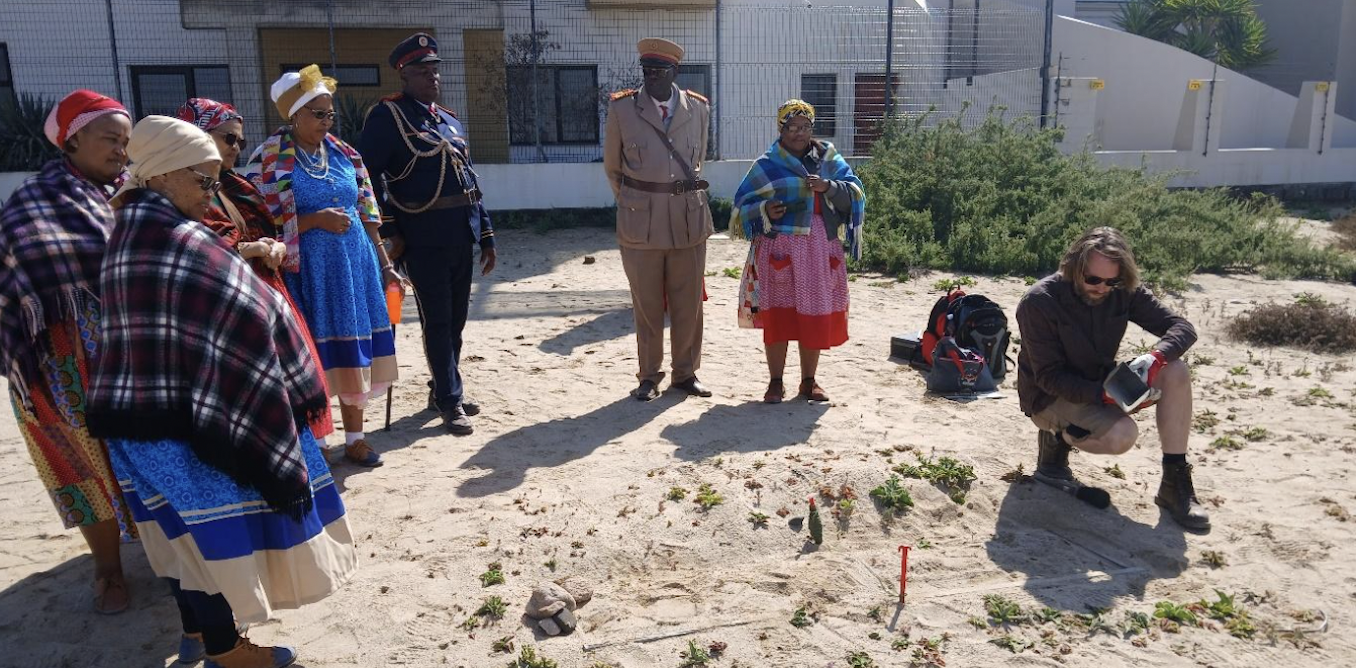
The Centre of Archaeology at the University of Huddersfield has, in conjunction with community representatives, the research groups Forensic Architecture and Forensis and the Swakopmund Genocide Museum, conducted fieldwork in Namibia across two seasons (2023 and 2025). Our work has focused on sites linked to German colonial concentration camps in Swakopmund and Lüderitz.
Using forensic methods, our project seeks to locate, document and protect burial sites associated with the genocide. We aim to demonstrate how archaeology can confirm historical events, provide physical evidence, support commemoration and strengthen claims for reparations.
The research combines archival study with field methods including: GIS mapping (computer-based spatial mapping and analysis of archaeological data), walkover survey (systematic on-the-ground inspection of visible archaeological features), Ground Penetrating Radar (a geophysical technique that uses radar waves to detect buried structures without excavation), GPS survey, drone imagery and targeted excavation.
Crucially, it involves close collaboration with Ovaherero and Nama communities. Their priorities have shaped the research and discussions around site protection.
The sites under threat
Between 1905 and 1907, German colonial authorities established several concentration camps in Lüderitz, including the notorious Shark Island camp. Ovaherero and Nama prisoners were forced into slave labour to build railway lines and an extension to the harbour under the harshest of conditions.
For many, this was effectively a death sentence. Historical sources suggest that as many as 4,000 prisoners died at Shark Island, yet the final resting places of most victims remain uncertain. Written records and oral histories indicate that many bodies were never formally buried. Instead, they were disposed of in the Atlantic Ocean.
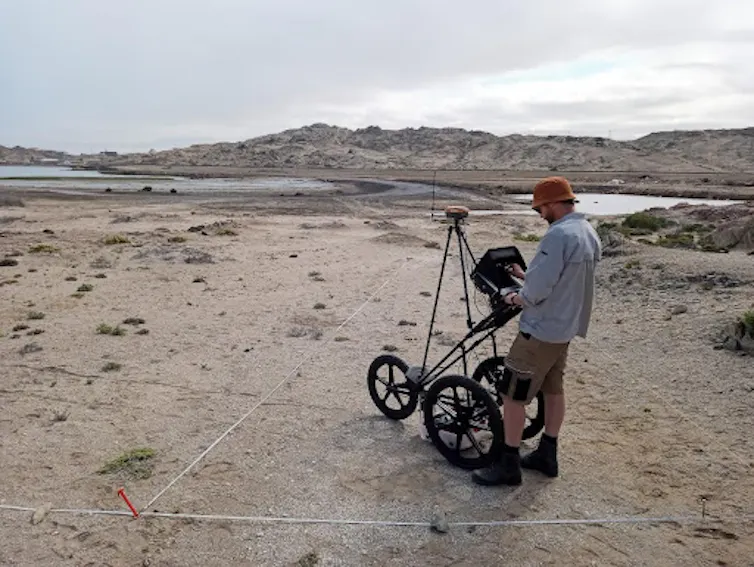
GPR survey being undertaken on the cemetery at Radford Bay, Luderitz.
Centre of Archaeology, Author provided (no reuse)
At Radford Bay, near a memorial to the victims, several sand mounds are believed to mark graves linked to the camps, some of which are thought to conceal mass burials. In collaboration with Forensic Architecture, using photo mapping techniques in conjunction and forensic methods, we have identified subsurface anomalies consistent with graves beneath a number of these features. At least one anomaly strongly suggests the presence of a mass grave.
The results provide the first scientific evidence supporting oral accounts of burial practices at Lüderitz. However,