

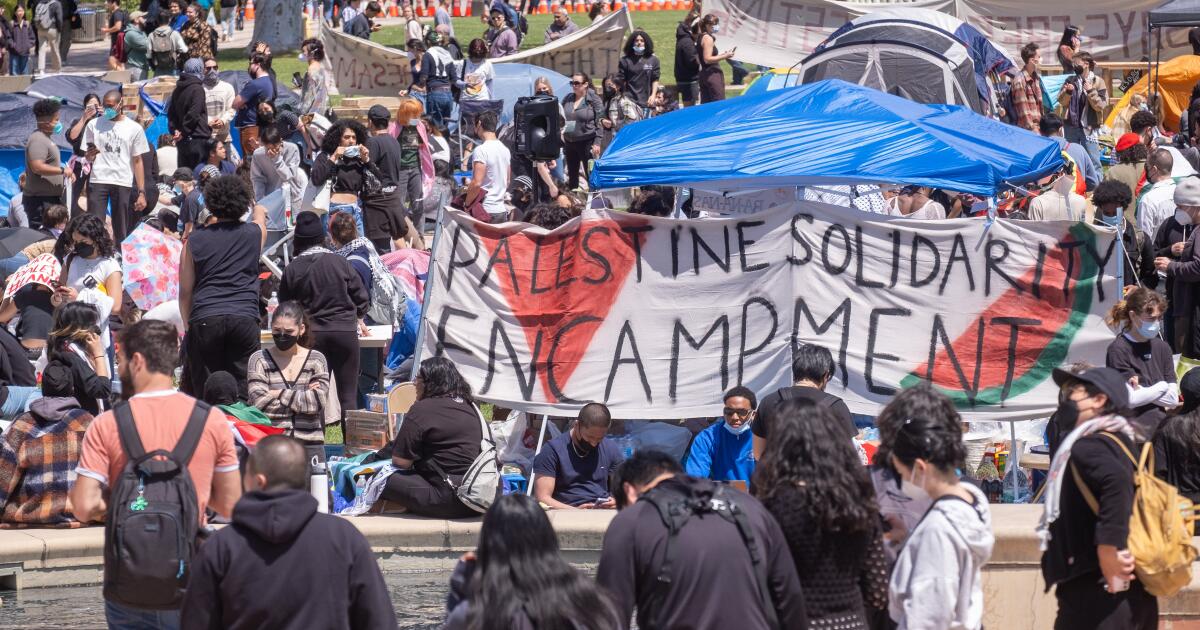

The University of California won’t divest from firms that do business with Israel or boycott academic exchanges with the country, rejecting demands that are driving the pro-Palestinian protests sweeping campuses across the nation.
“The University of California has consistently opposed calls for boycott against and divestment from Israel,” UC said in a statement posted Friday. “While the University affirms the right of our community members to express diverse viewpoints, a boycott of this sort impinges on the academic freedom of our students and faculty and the unfettered exchange of ideas on our campuses.”
UC also said that no tuition or fee revenue is used for investment purposes. Instead, tuition and fees serve as the “primary funding sources for the University’s core operations,” according to the statement.
That appeared to address a central demand of the UC Divest Coalition: that student tuition dollars not be used to make investments that support war and weapons manufacturing — including firms that supply arms and services to Israel.
The university’s $169-billion investment portfolio includes funds for its retirement plan, endowment and working capital. No estimate was available for how much of that portfolio is invested in firms that do business with Israel.
Divestment proponents have taken particular aim at BlackRock, the world’s largest asset manager. Others have targeted Amazon and Google for their $1.2-billion artificial intelligence and cloud-computing services contract with the Israeli government. Sit-ins at a number of Google offices led the company to fire 28 employees who participated in the protests this month.
Student organizers of the divestment campaign against UC said the university’s position would not deter them from continuing to organize. The UC Divest Coalition includes chapters at UCLA, UC Berkeley, UC Irvine, UC Santa Barbara and UC Santa Cruz.
“We understand these investments are profitable for UC. War is profitable,” said one UCLA divestment campaign organizer, who asked for anonymity to protect their personal safety. “It just means we have to keep organizing.”
The organizer said the campaign’s goal was to redirect UC investment dollars from firms that promote “mass violence being perpetrated against people all over the world” through weapons manufacturing, for instance, or surveillance technology. Instead, UC funds should better support students, staff and faculty battered by unaffordable housing, low wages, college debt and other financial hardships.
In 2020, UC became the nation’s largest university to divest from fossil fuels, a five-year effort undertaken to fight climate change by shifting funds into more environmentally sustainable investments, such as wind and solar energy. UC sold more than $1 billion in fossil fuel assets from its pension, endowment and working capital pools and surpassed its five-year goal of investing $1 billion in clean energy projects.
UC also joined the anti-apartheid divestment campaign against South Africa in the 1980s, after thousands of student protesters boycotted classes, erected shantytowns to dramatize the plight of Black South Africans and prompted a police crackdown and arrests at UC Berkeley.