

World
/
October 9, 2024
The leveling of Lebanese border towns is the continuation of Israel’s Gaza policy: total destruction and ill-defined objectives.
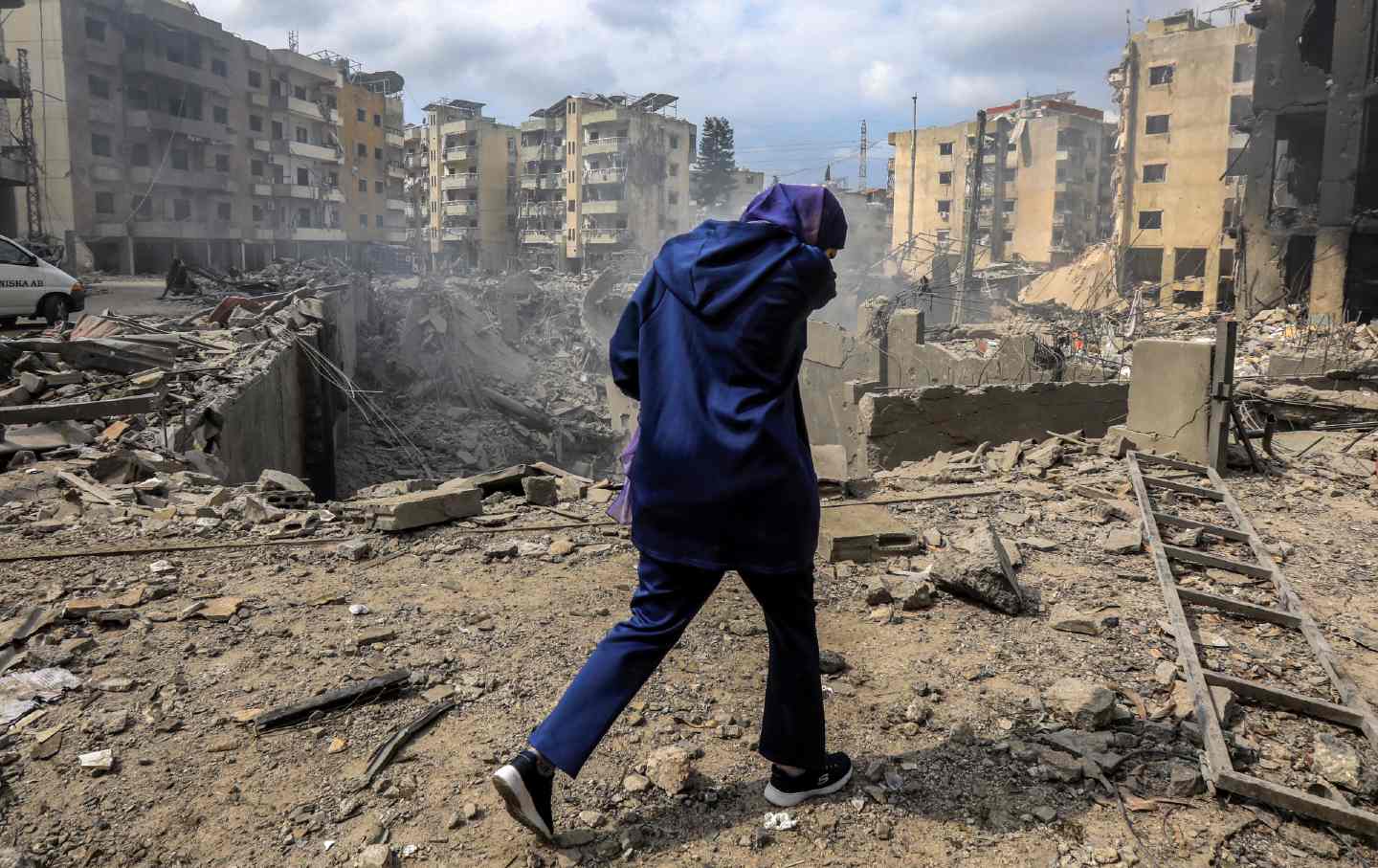
A woman walks past a crater where a collapsed building stood following an Israeli air strike in Beirut’s southern suburbs, on October 7, 2024.
(AFP via Getty Images)
The threats had come so often, in so many different forms, that its start came without much fanfare or outside attention—which is surely how Israel preferred it. There was no massive movement across the Lebanese border, no simultaneous assault from air, land, and sea that blockaded all corners of the Lebanese state at once. Instead, Israel ramped up its air strikes on south Beirut, issuing pinprick building-by-building evacuation orders. Then the announcement came through Israel Defense Force channels: Israel wasn’t invading Lebanon, no; the Israeli army would be launching “limited, localized, and targeted ground raids based on precise intelligence” against Hezbollah in southern Lebanon. No need to fear. Israel was engaging in careful, legitimate self-defense by sending its troops into a sovereign state.
Despite Israel’s insistences that it has been pursuing only something limited and precise, the actual invasion has been anything but.
On September 27, Israel dropped more bunker-buster bombs in one assassination operation in south Beirut, a densely packed suburb, to kill Hassan Nasrallah than were dropped during the entirety of the Iraq War. Supposedly ultra-specific evacuation orders for buildings in the Beirut suburbs have led to mass displacement. Thousands are now seeking shelter on the streets in the capital, and that’s in addition to the hundreds of thousands already displaced by Israeli bombs in the country’s south. The UN estimates that 1.2 million people have been forced to leave their homes. Indeed, what was once an operation supposedly designed to push Hezbollah behind the Litani River may now be an operation to push Hezbollah behind the Awali River, about 20 miles farther north. In addition, Israeli air strikes are now hitting cities farther north than the Awali, farther north than Beirut, hitting Palestinian refugee camps near Tripoli.
Despite the destruction it has wrought, the Israeli invasion has produced few tangible results. The Israeli army’s first engagement with Hezbollah in combat was a disaster, with an attempted crossing into the village of Odaisseh resulting in the deaths of six IDF soldiers. While the IDF has claimed gigantic (so far unsubstantiated) results in the alleged killings of more than 400 Hezbollah fighters, many of its videos of its soldiers moving through Lebanon are of empty mountain ranges, with some videos having been outed as months-old and some images of seized Hezbollah weaponry revealed to have been taken elsewhere. A photo op of the Israeli flag being raised over the Lebanese town of Maroun el-Ras has since been revealed to have been taken at the southern edge, a little over 400 yards from the border, with UN sources saying the soldiers who raised the flag retreated shortly afterward.