

Abortion has become more common despite bans or deep restrictions in most Republican-controlled states, and the legal and political fights over its future are not over yet.
It’s now been two and a half years since the U.S. Supreme Court overturned Roe v. Wade and opened the door for states to implement bans.
The policies and their impact have been in flux ever since the ruling in Dobbs v. Jackson Women’s Health Organization.
Here’s a look at data on where things stand:
Abortions are more common than before Dobbs
Overturning Roe and enforcing abortion bans has changed how woman obtain abortions in the United States.
One thing it hasn’t done is put a dent in the number of abortions being obtained.
There have been slightly more monthly abortions across the country recently than there were in the months leading up to the June 2022 ruling, even as the number in states with bans dropped to near zero.
“Abortion bans don’t actually prevent abortions from happening,” said Ushma Upadhyay, a public health social scientist at the University of California San Francisco.
For women in some states, there are major obstacles to getting abortions — and advocates say that low-income, minority and immigrant women are least likely to be able to get them when they want.
For those living in states with bans, the ways to access abortion are through travel or abortion pills.
Pills become bigger part of equation — and legal questions
As the bans happened, abortion pills became a bigger part of the equation.
They were involved in about half the abortions before Dobbs. More recently, it’s been closer to two-thirds of them, according to research by the Guttmacher Institute.
The uptick of that kind of abortion, usually involving a combination of two drugs, was underway before the ruling.
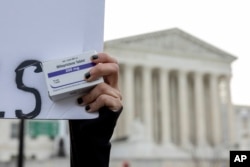
FILE – An abortion- rights activist holds a box of mifepristone pills as demonstrators from both anti-abortion and abortion-rights groups rally outside the Supreme Court in Washington, March 26, 2024.
But now, it’s become more common for pill prescriptions to be made by telehealth. By the summer of 2024, about 1 in 10 abortions were via pills prescribed via telehealth to patients in states where abortion is banned.
As a result, the pills are now at the center of battles over abortion access.
This month, Texas sued a New York doctor for prescribing pills to a Texas woman via telemedicine. There’s also an effort by Idaho, Kansas and Missouri to roll back their federal approvals and treat them as “controlled dangerous substances,” and a push for the federal government to start enforcing a 19th-century federal law to ban mailing them.
chief strategy officer for Stanton Healthcare, an Idaho-based pregnancy center that does not provide abortions, read the text of a Supreme Court decision outside the court in Washington, June 27, 2024.” src=”https://gdb.voanews.com/297f0499-7d1c-4bb9-9cf6-2c11333759a0_w250_r0_s.jpg”/>
FILE – Katie Mahoney, left, and the Rev. Patrick Mahoney, chief strategy officer for Stanton Healthcare, an Idaho-based pregnancy center that does not provide abortions, » …