

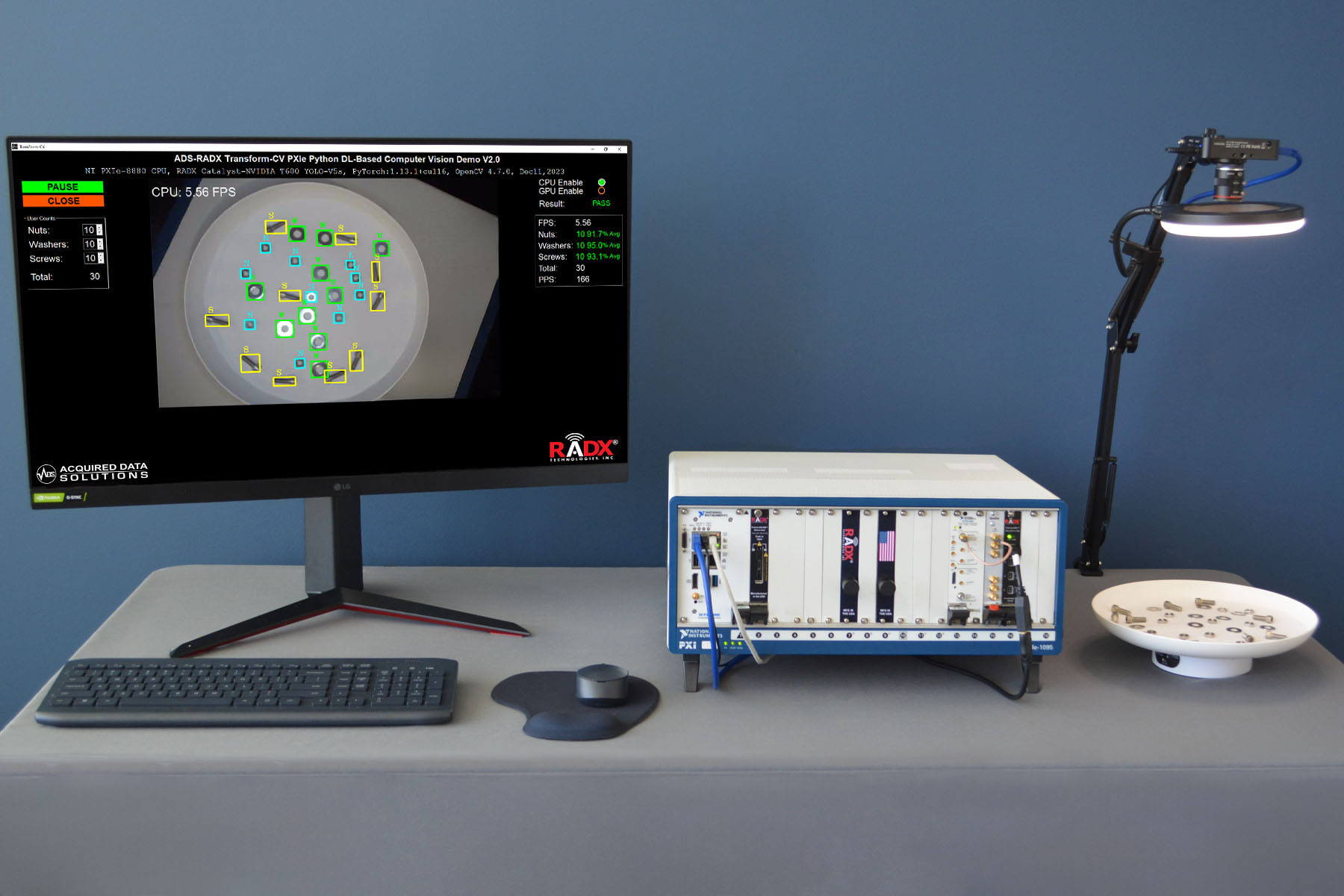
Rockville, MD, January 17, 2025 –(PR.com)– Acquired Data Solutions (ADS) is pleased to announce Transƒorm-CV, a COTS, deep learning-enabled Computer Vision (CV) system for visual quality inspection. Designed in partnership with RADX Technologies, Transƒorm-CV provides a modular, low-cost, flexible, and easy-to-tailor platform that manufacturers, distributors, and integrators of all sizes and industries can leverage to enhance their component and subsystem Quality Assurance (Q/A) accuracy, throughput and reliability.
Most small to medium sized manufacturers rely on manual inspection processes for Q/A. Such processes are often personnel-dependent and therefore constrained by limited repeatability, reproducibility, and scalability. Conventional, logic-based CV systems are often too expensive for SMB manufacturers, especially for high-mix, low volume applications. Traditional CV systems also typically employ proprietary components and are fairly inflexible, requiring initial programming by CV experts, and reprogramming as new “devices under test” (DUTs) and/or features or defects to be detected are added. This exacting process for initial deployment and updates is often both expensive and time consuming.
Conversely, Transƒorm-CV is based on COTS components and employs deep-learning, leveraging NVIDIA GPUs to greatly accelerate the training process and real-time inference operations. This results in cost-optimized, high-performance solution that may be “trained” on images or drawings of customer DUTs and their relevant features or defects (provided by customer Q/A or assembly personnel). Once trained, Transƒorm-CV can run in real-time via an intuitive GUI that greatly enhances the repeatability, reproducibility, throughput and scalability of almost any Q/A operation. Another key aspect of Transƒorm-CV is support for customer-enabled training. By collecting and annotating their own images, users can “teach” Transform-CV to operate on new DUTs or recognize new features or defects without requiring additional programming or consulting by ADS or third parties, which dramatically reduces Total Cost of Ownership (TCO). Additionally, Because Transƒorm-CV employs COTS components, it may operate on existing or upgraded customer PXIe or PCIe systems, which can further reduce acquisition costs and TCO.
Transƒorm-CV is written in Python and PyTorch and is designed to operate on both Linux and Windows-based PXle Systems or PCs. It can also readily interface to MATLAB, LabVIEW, and other popular application frameworks. Transƒorm-CV supports a variety of inspection types, including macro and microscopic dimensional analysis, workmanship inspection, sorting and classification, and defect detection. ADS is currently developing Transƒorm-CV systems for microelectronics, cable manufacturing, kitting, CNC machining, and additive manufacturing applications.
A typical Transƒorm-CV system consists of the following elements:
· The Transƒorm-CV Base License includes a tailorable framework for training, inference and GUI.
· A PXle or PCle-based embedded computer vision system equipped with an appropriate NVIDIA GPU and other essential components or a GPU Kit for existing PXle or PCle systems.
· One or more application-specific camera(s) with appropriate optical training include magnification, filters, and illuminators.
· A manual, semi-manual or automated fixture for holding the DUTs (if robotic or handheld operation is not employed).
· Application specific tailoring including system training on images and/or drawings and incorporating pass-fail criteria appropriate for the required DUTs.