



LOS ANGELES — A federal judge on Friday ruled that immigration officers in Southern California can’t rely solely on someone’s race or the fact that they’re speaking Spanish to stop and detain them.
U.S. District Judge Maame Ewusi-Mensah Frimpong issued a temporary restraining order after a lawsuit was filed by three men who were arrested as they waited to be picked up at a Pasadena bus stop for jobs on June 18, and after two others were stopped and questioned despite saying they are U.S. citizens.
Frimpong’s order bars the detention of people unless the officer or agent “has reasonable suspicion that the person to be stopped is within the United States in violation of U.S. immigration law.”
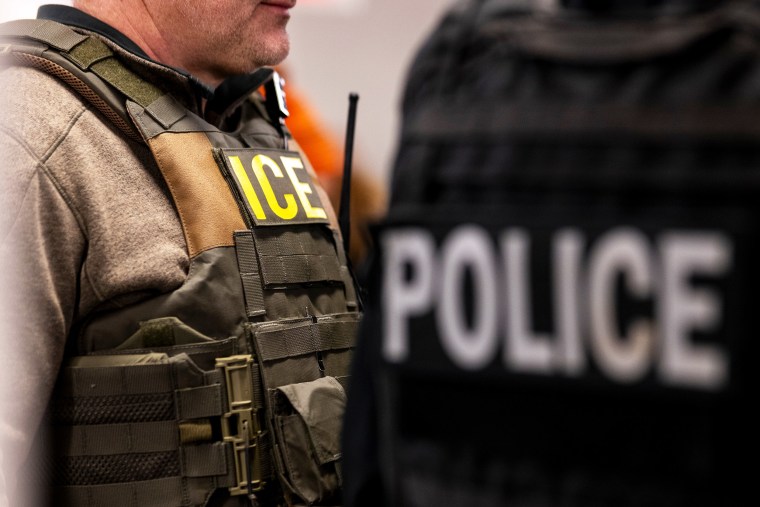 ICE agents, along with other federal law enforcement agencies, attend a pre-enforcement meeting in Chicago on Jan. 26.Christopher Dilts / Bloomberg via Getty Images file
It says they may not base that suspicion solely on a person’s apparent race or ethnicity; the fact that they’re speaking Spanish or English with an accent; their presence at a particular location like a bus stop or a day laborer pickup site; or the type of work one does.
Frimpong wrote in the ruling that most of the questions before her were “simple and non-controversial.”
“Do all individuals — regardless of immigration status — share in the rights guaranteed by the Fourth and Fifth Amendments to the Constitution? Yes, they do,” she wrote.
“Is it illegal to conduct roving patrols which identify people based upon race alone, aggressively question them, and then detain them without a warrant, without their consent, and without reasonable suspicion that they are without status? Yes, it is,” she wrote.
Frimpong issued another order that lawyers be granted access to an area in a federal building in Los Angeles where those detained by immigration authorities are held, and to allow those detained phone access with legal counsel.
The lawsuit, filed against Homeland Security Secretary Kristi Noem, the head of Immigration and Customs Enforcement and others, was filed as President Donald Trump’s administration has aggressively been making immigration arrests in Los Angeles and other parts of Southern California.
The American Civil Liberties Union of Southern California called the restraining order a victory for rights guaranteed under the U.S. Constitution.
“No matter the color of their skin, what language they speak, or where they work, everyone is guaranteed constitutional rights to protect them from unlawful stops,” Mohammad Tajsar, senior staff attorney with the ACLU Foundation of Southern California, said in a statement.
“While it does not take a federal judge to recognize that marauding bands of masked, rifle-toting goons have been violating ordinary people’s rights throughout Southern California, we are hopeful that today’s ruling will be a step toward accountability for the federal government’s flagrant lawlessness that we have all been witnessing,” Tajsar said.
Two of the people who sued said they were stopped and questioned by immigration officers despite explaining that they are U.S.