


Published December 6, 2023
12 min read
In another stellar year for science, astronomers unveiled new discoveries about the cosmos, biologists etched out a clearer map of our planet’s creatures, and paleontologists painted a richer picture of the dinosaurs that roamed Earth millions of years ago. The latest compendium of humanity’s scientific research continues to intrigue and reveal new mysteries to solve.
Here are some of National Geographic’s top picks for 2023’s most fascinating breakthroughs.
1. Astronomers detect immense ripples in the fabric of space-time
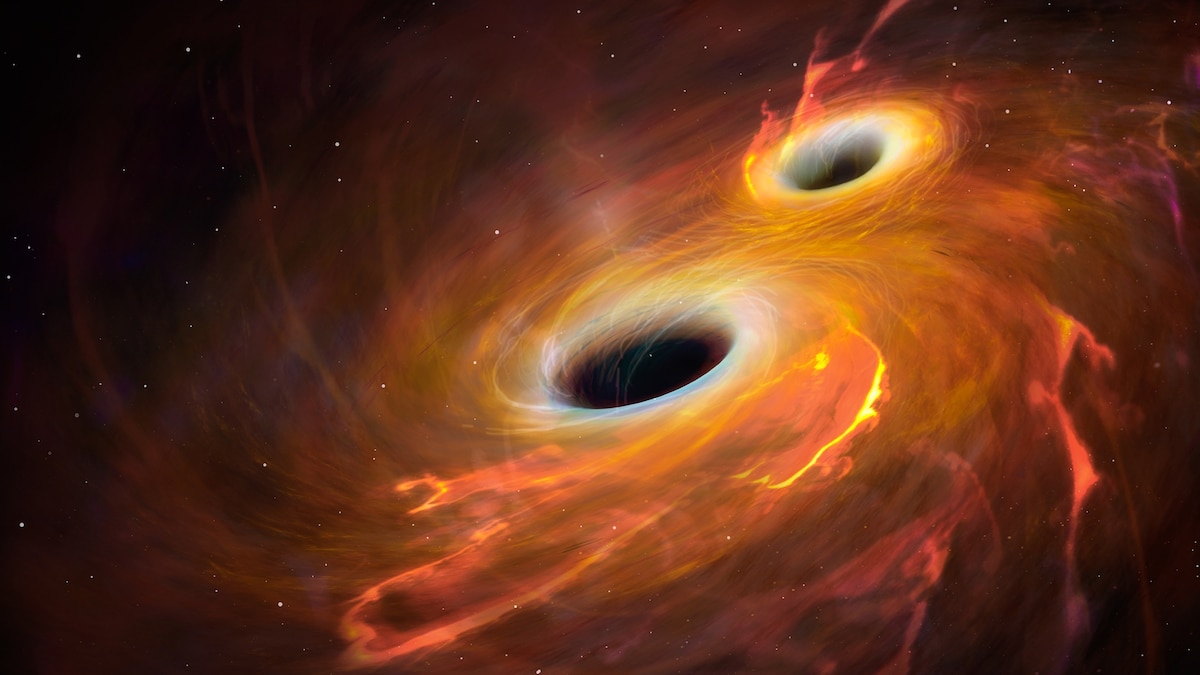
For the first time, scientists detected low-frequency gravitational waves moving through the galaxy. These cosmic ripples are likely the distant echoes of supermassive black holes interacting and merging many billions of light-years away. A consortium of international researchers discovered these cosmic waves by measuring tiny time variations in radio signals from pulsar stars. The findings suggest that there were far more behemoth black holes in the early universe than previously thought, and continuing to study this new type of gravitational wave could help unravel details about the origins of our universe and better explain the unseen substances and forces that power the cosmos.
2. Brain decoder translates human thoughts—providing hope for those who’ve lost speech
Though it’s not technically a “mind reading” device, University of Texas at Austin researchers reported revolutionary work with their new AI-based system—translating a person’s brain activity into a continuous stream of text in the lab. This semantic decoder doesn’t require a surgical implant, but instead it relies on functional MRI scans to pick up brain activity in response to things like podcasts or images. Rather than provide word-for-word transcripts, the brain decoding system essentially creates a dictionary of brain activity patterns based on how an individual responds to certain words or images and then uses that dictionary to cross-reference brain activity to other things that the person is thinking about. This tech, which relies on AI language generation algorithms, is currently in its early days, though it’s already raised thorny questions about mental privacy and ethics in non-voluntary situations. For the families of people with communication impairment, however, the work provides new hope.
3. Ancient whale might be largest animal ever
Move over blue whale—an ancient cetacean appropriately named the Perucetus colossus may have been the largest animal ever. A new analysis of fossil bones from the ancient whale that plied the waters along the coast of Peru more than 37 million years ago suggests that the animal may have weighed more than 300 tons and measured around 60 feet. If it was truly as heavy as scientists suspect, then it would have been the largest known animal to ever live. Blue whales, although still longer at around 100 feet, only weigh around 200 tons.
4. T. rex had lips, changing our picture of this dinosaur
» …
Read More