

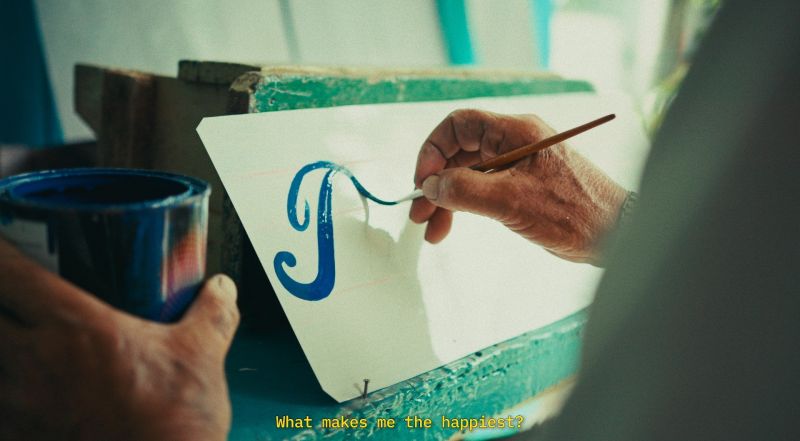

Sometimes the most profound stories emerge from the simplest encounters. In 2019, creatives Santiago Carrasquilla and Danaé Gosset—both former apprentices of design legends Stefan Sagmeister and Paula Scher—embarked on what seemed like a straightforward documentary project.
Armed with a borrowed camera and fuelled by curiosity, they travelled to Argentina to film Luis Benz, a self-taught sign painter with five decades of experience working entirely by hand.
What they captured over five days would sit dormant in hard drives for nearly eight years before emerging as Luis Benz: Happiness is Achieved With Very Simple Things.
It’s a deeply moving portrait that transcends its craft-focused premise to become something far more universal. If you can, I’d urge you to take five minutes out of your day and watch it now. You won’t regret it.
The genesis of connection
The partnership between Santiago and Danaé began both professionally and personally: they were romantically involved at the time and had just completed American singer-songwriter Mitski’s music video for A Pearl, with Saad Moosajee and Art Camp. But rather than taking a break after their successful collaboration, they felt compelled to pursue another creative venture.
“We were both in this work-driven phase where we just wanted to keep making things,” explains Danaé. “So instead of resting, we jumped into another project.”

The idea for the Luis Benz film had been percolating in Santiago’s mind for years. “I met him years before,” he recalls. “And it was even in my ten-year plan when I graduated from the School of Visual Arts in New York, from Debbie Millman’s class. I’d already bought a bunch of his signs for our house, and I told Danaé the idea. She pushed us to make it happen.”
And they didn’t wait around. “I remember we were literally in a taxi on the way to the airport, still figuring out the concept,” recalls Danaé. “By the time we landed, we had settled on the idea of asking Luis to paint 50 signs for himself.”
The poetry of personal words
This concept proved to be a stroke of creative genius. Rather than documenting Luis’s commercial work, the pair invited him to turn inward and select words that carried personal meaning.
“I thought it would be interesting to have him paint words he normally didn’t get asked to paint,” explains Santiago. “Not ‘ice cream’ or ‘soda’, but something else. I was surprised by his choices. He pulled out an old dictionary and selected his favourite words, including some ancient Spanish words that are no longer in common use. On the back of each sign, he wrote the definitions.”
This inventive framework transformed what could have been a straightforward craft documentary into something far more intimate and engaging. “It came from wanting to give him a chance to make something for himself,” explains Danaé. “His work was usually for fruit shops or boats.