

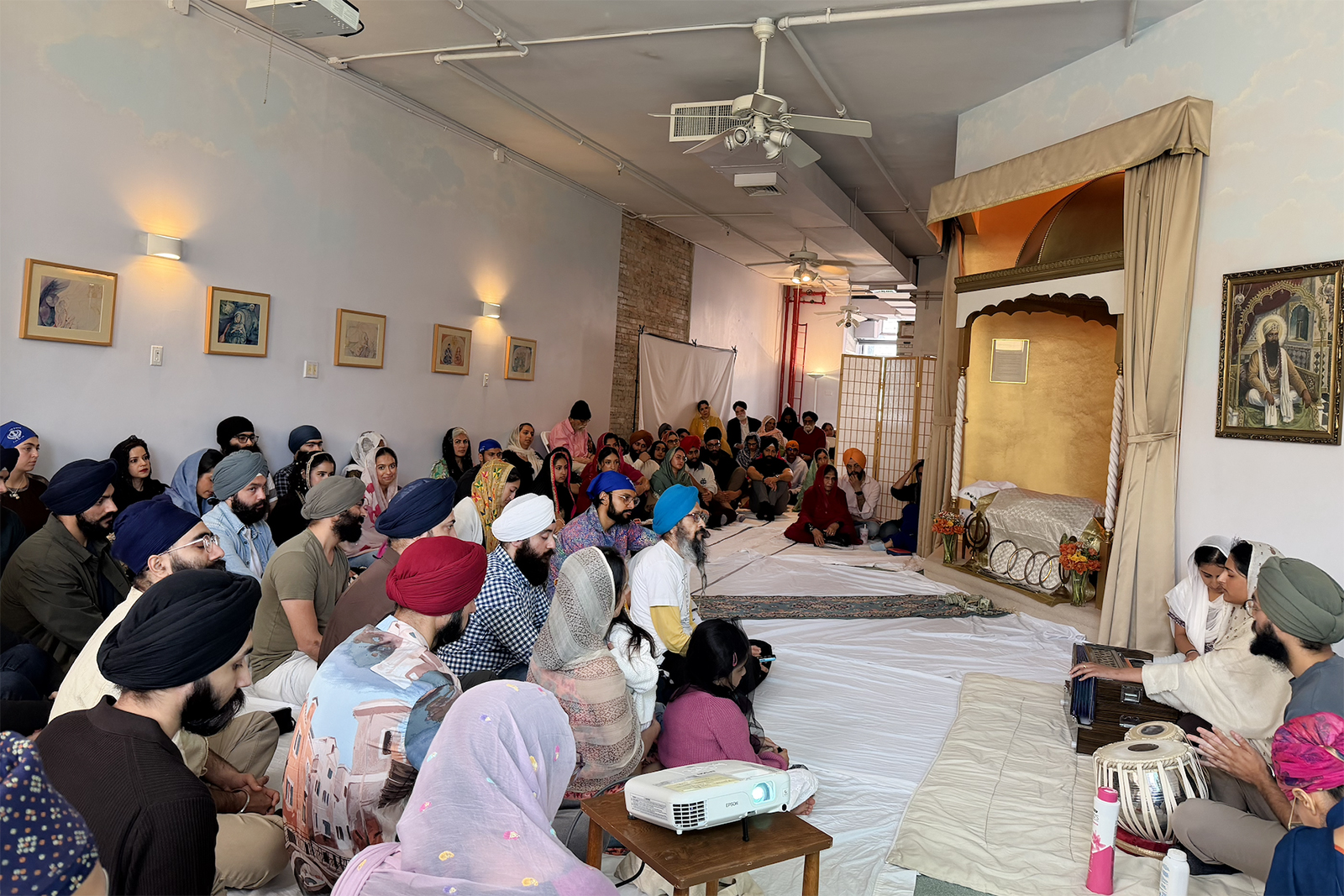

NEW YORK (RNS) — In 1675, Sikh Guru Tegh Bahadur completed a revolutionary act of selflessness that would change the faith’s trajectory and moral demands, according to Sikh martyrology.
At the time, the Mughal Empire in South Asia mandated conversion to Islam. Sikh tradition holds that Bahadur, the ninth of 10 Sikh gurus, chose to defend the religious freedom of Hindus in Kashmir, who had appealed to him for help, said Amandeep Singh Sandhu, a United Kingdom-based educator from Everythings 13, a Sikh educational organization. He and his disciples advocated on behalf of the Hindus in court, and as a result, they were executed.
His martyrdom and Sikhs’ two-fold desire to defend themselves from persecution and stand with others in need ultimately led to the establishment of the faith’s Khalsa, a community of ritually initiated Sikhs who commit to both rigorous spiritual devotion and martial courage.
In that vein, the origins of the spring Sikh festival of Vaisakhi lay in the guru’s radical decision to be in solidarity with the oppressed, said Harmeet Kaur Kamboj, an attendee at the Manhattan Sikh Association’s Vaisakhi celebration on Saturday (April 18). About 150 people gathered on the sixth floor of a West Village building to attend the community event.

A lay woman from the Manhattan Sikh Association waves the Chaur Sahib, a ceremonial fan, often made of yak hair, over the Guru Granth Sahib sacred Scriptures to show reverence and respect, Saturday, April 18, 2026, at Infinite Space NYC in Manhattan. (Photo by Vishavjit Singh)
“For me, Vaisakhi is about recognizing the momentum that radical social movements have gained in the past, remembering our roots and the responsibility we have now, hundreds of years later, to carry on that work, to continue to abolish the caste system to continue to build a truly equitable society,” Kaur Kamboj said.
While Vaisakhi officially takes place annually on April 13 or 14, the gathering was moved to the weekend to accommodate the schedules of busy families and working people, said Vishavjit Singh, a lay leader of the gender-egalitarian Manhattan sangat, or congregation.
The diwan, or religious event, reflected the festival’s commemoration of the institution of the Khalsa. The prayers and Scriptural readings referred to the tradition of selfless service, of the oneness of God and the need to live courageously and justly. Over about three hours, the community sang excerpts of the sacred Scripture, the Guru Granth Sahib, as some came to the front to play instruments and share reflections.
While much of New York’s Sikh population is concentrated in Queens, where there are larger and longer-established gurdwaras, or Sikh houses of worship, the Manhattan Sikh Association has aimed to establish itself as a place for those who live in or commute into the city for work. Such organizational events are open to Sikhs who are initiated into the Khalsa order as well as others,