


Active Citizens, Asia-Pacific, Civil Society, Crime & Justice, Economy & Trade, Education, Energy, Headlines, Health, Labour, Poverty & SDGs, Religion, TerraViva United Nations
Opinion
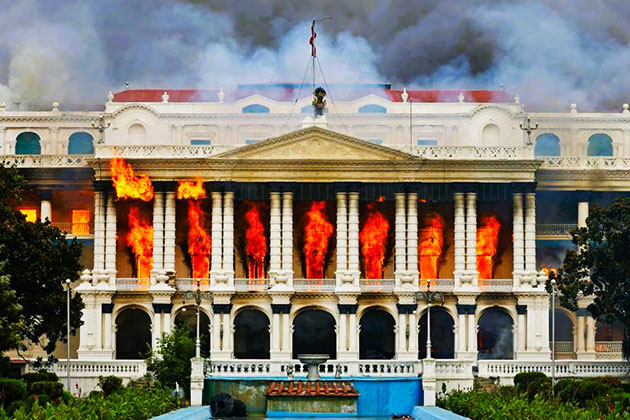
Kathmandu’s Singha Durbar in flames
ROME, Oct 2 2025 (IPS) – In the Global South, where people under the age of 18 comprise more than 50 percent of the population, youth activism is increasing rapidly. Youngsters are more agile and volatile than older people, less restrained by family, prestige and work. However, many suffer from marginalisation, lack of employment, and poverty. Furthermore, insecurity and limited life experience make young people an easy target for manipulating and unscrupulous politicians, criminal networks, and religious fanatics.
Students and young citizens come together by using social media to make their presence felt and mount protests in public spaces. The role of new media technologies as an organising tool has led besieged authorities to ban online platforms, though imposed restrictions have rather than contain protests accelerated them.
Rebellious youth generally belong to the Gen Z, which refers to “digital native”, the first generation fully immersed in a digital world, with constant access to internet and social media. An upbringing that has shaped their world view, making them independent, pragmatic and focused on social impact.
South Asia has recently experienced massive protest movements involving crowds of young people. In July 2022, after an economic collapse in Sri Lanka, a rebellion forced its president to flee the country. In July 2024, upheavals ended the long rule of Sheikh Hasina in Bangladesh, and in September this year, violent protests in Nepal forced Prime Minister Khadga Oli’s government to resign.
Even though specific incidents triggered these upheavals, they were all due to long-term, shared grievances evolving from stark wealth gaps, rampant nepotism, and unlimited corruption. Above all, youngsters protested against members of powerful dynasties, favouring a wealthy and discredited political elite.
Sri Lankans were in 2022 faced with a galloping inflation, daily blackouts, as well as shortages of fuel, domestic gas, food, medicines, and essential imports. Amid massive desperation, huge crowds of mostly young people did on 25 March take to the streets under the slogan Aragalya, Struggle.
Political power had by then become embedded within the Rajapaksa dynasty. From 2005 to 2022, two brothers – Mahinda and Gotabaya Rajapaksa, had alternately shared the presidency and prime minister post, while another brother headed their political party; a fourth was speaker of the parliament, and other relatives occupied influential political positions.
While Gotabaya Rajapaksa served as defence minister, he was credited with ending the twenty-six-year-long civil war with the Liberation Tigers of Tamil Eelam. After churches and luxury hotels in April 2019 had been targeted by ISIS-related suicide bombers, killing 270 people, Mahinda and Gotabaya Rajapaksa, who at the time were in opposition, accused the current government of leniency. When Gotabaya ran for the presidency the same year,