


For many in Venezuela, the question is no longer whether tensions with Washington will reach a boiling point – they already have. Rather, the big unknown now is whether the U.S. will follow up on threats and the sinking of drug boats with something more drastic: direct military engagement or even regime change.
Certainly, Venezuelan President Nicolás Maduro is preparing for all eventualities. On Sept. 29, 2025, the leftist leader signed a decree granting him additional powers. The following day, Maduro threatened a “state of emergency.” Already, Caracas has carried out military drills amid talk of being a “republic in arms.”
It follows a month in which Washington has positioned warships, an attack submarine and aircraft in the Caribbean and destroyed at least four suspected “go-fast” drug boats. At the United Nations General Assembly on Sept. 23, U.S. President Donald Trump warned of more to come, vowing to blow drug traffickers “out of existence” while repeating his assertion that Maduro was behind the trafficking networks.
Maduro and his generals deny that charge. Nonetheless, Washington has set a US$50 million dollar bounty on Maduro’s arrest and has rejected Venezuela’s appeals for talks.
As an expert on international security and U.S.-Latin American relations, I believe the U.S. position appears to be inching toward regime change from a prior position of ambiguity that has fallen short of an outright pledge to remove Maduro.
But Washington will be aware that any direct military engagement in Venezuela will be a messy affair. Despite increasing international isolation, Maduro still has friends in Moscow and Beijing, as well as closer to home in Havana. And such factors may force the Trump administration to continue to walk a fine line between maximum pressure on the Maduro government without full commitment to armed conflict.
US ramps up pressure
Recent deployments by the U.S. Southern Command demonstrate a shift in posture by the U.S. administration.
The USS Stockdale became the ninth U.S. Navy vessel and third destroyer – alongside USS Gravely and USS Jason Dunham – to join the USS Iwo Jima Amphibious Ready Group maneuvering between Puerto Rico and the Lesser and Leeward Antilles, and the waters north of Venezuela. In all, at least 4,500 Marines and sailors are positioned in the area.
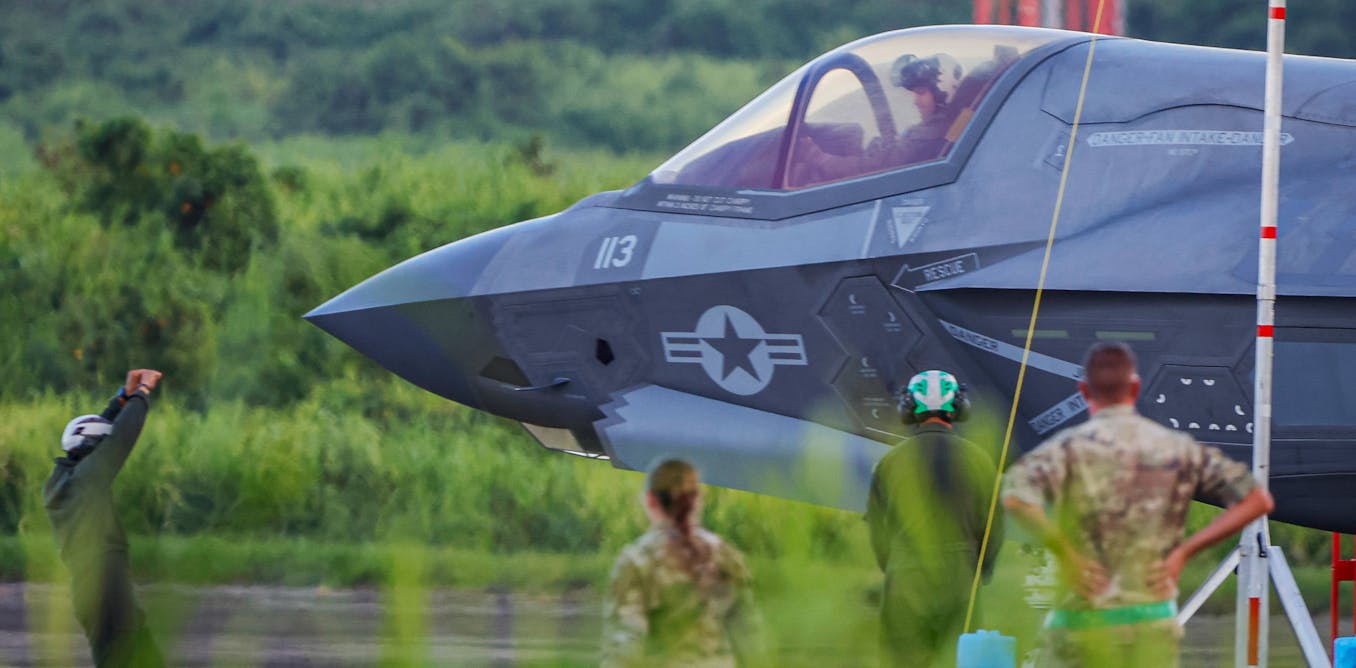
Meanwhile, at least 10 F-35 fighters and multiple MQ-9 drones are reportedly operating from Aguadilla and Ceiba airports in Puerto Rico, offering the capacity for persistent surveillance and strike options.
These forces are more powerful than the entire Venezuelan navy but reportedly fall short of the forces needed for a full-scale invasion.
For the moment, SouthCom is framing the campaign as enhanced counternarcotics operations, rather than a prelude to a blockade or invasion. Statements have highlighted joint patrols and interdiction efforts with the Royal Netherlands Navy, Canada, the Dominican Republic and the United Kingdom, and the humanitarian or information-sharing nature of missions.
SouthCom has described its position as one of readiness,