


Crime & Justice, Education, Gender Violence, Headlines, Health, Human Rights, Latin America & the Caribbean, Migration & Refugees, TerraViva United Nations

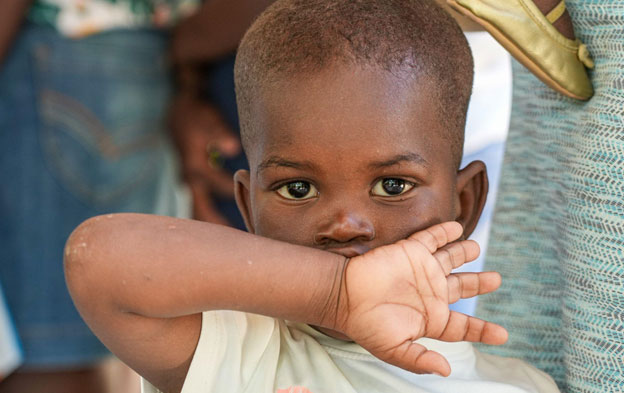
A child gazes to the camera as he waits for his turn at a UNICEF-supported mobile clinic in Boucan Carré, Haiti. Credit: UNICEF/Herold Joseph
UNITED NATIONS, Oct 14 2025 (IPS) – New figures from the United Nations Children’s Fund (UNICEF) show that displacement has surged significantly in Haiti, deepening existing security and humanitarian crises in a country where nearly 90 percent of the capital is controlled by armed gangs.
“Children in Haiti are experiencing violence and displacement at a terrifying scale,” said Catherine Russell, UNICEF Executive Director. “Each time they are forced to flee, they lose not only their homes but also their chance to go to school, and simply to be children.”
More than 1.3 million people have been displaced due to rising insecurity, including over 680,000 children—twice as many as last year—who have been forced from their homes by violence. The report notes that the scale of displacement in 2025 has reached “unprecedented” levels, with the number of displacement sites having soared to 246 nationwide. Thousands of children have been displaced multiple times as a result of heightened violence from armed gangs.
UNICEF’s latest Child Alert report highlights the fragile state of displacement shelters in Haiti as roughly 33 percent displacement shelters lack basic protection infrastructure. Women and children bear the brunt of this crisis, facing disproportionate levels of violence, exploitation, and abuse. Additionally, the UN notes that violations of children’s rights are a daily occurrence, especially in areas that are under the control of armed gangs.
It is estimated that over 2.7 million people, 1.6 million of whom are women and children, live under the control of armed gangs. The security situation in the vast majority of Haitian displacement shelters is dire, with the UN noting that gender-based violence is widespread and fear is particularly pervasive among an entire generation of children and adolescents.
“More children are being subjected to trafficking, exploitation and forced recruitment by the gangs,” said Volker Turk, UN High Commissioner for Human Rights (UNHCR).“We can only imagine the long-term impact, for the children of Haiti, and for society as a whole.”
With most schools being used as displacement shelters, education in Haiti has been severely disrupted, affecting roughly half a million students. Over 1,600 schools were closed, and dozens were occupied by armed groups during the 2024–2025 school year. The education sector is also grappling with acute shortages of textbooks, learning materials, and qualified teachers.
“Nearly 1,600 schools have been attacked, occupied, or closed as a result of unrelenting violence, leaving more than one in four children out of the classroom,” said Giacomo Colarullo, UNICEF’s Emergencies Communications Officer. “ School is not only a place to learn, but a safe haven. When that disappears, we are risking the development and future of an entire generation.”
UNICEF estimates that more than 3.3 million children in Haiti are in urgent need of humanitarian assistance,