

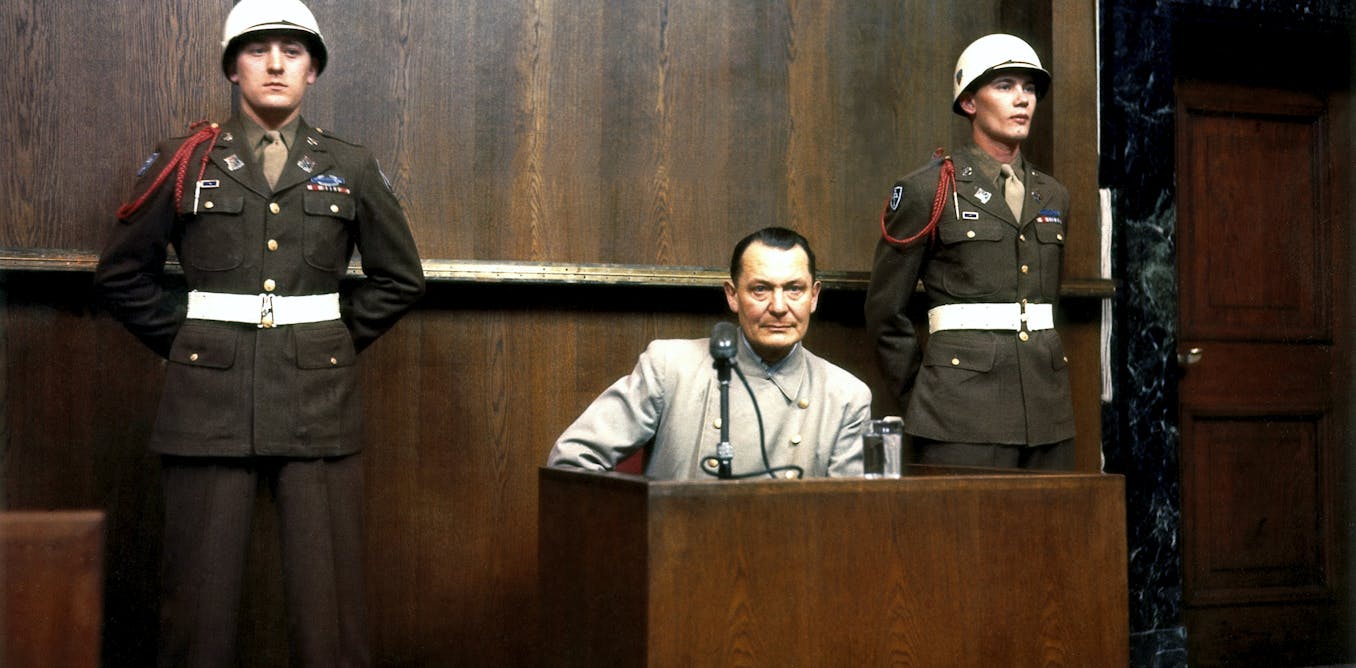

In November 2025, cinemas worldwide will release Nuremberg, a courtroom drama directed by James Vanderbilt. The film focuses on the International Military Tribunal against 24 major Nazi war criminals (though two were ultimately not tried) and seven Nazi organisations – including the SS, the Gestapo and the general staff of the army – at the end of the second world war.
Its release coincides with the 80th anniversary of the Nuremberg Trials, which officially opened on October 18 1945. The film explores our desire to see justice and reckoning for those who committed war crimes against civilian populations in the past and present.
The plot centres on the confrontation between Hermann Göring (played by Russell Crowe), a leading Nazi on trial, and psychiatrist Douglas M. Kelley (played by Rami Malek). Kelley’s task was to examine whether the top Nazis were fit to stand trial.
Nuremberg is often called “history’s greatest trial”. It was the first international trial that held senior governmental officials accountable for war crimes and crimes against humanity committed across Europe. It also established individual responsibility for committing war crimes, rejecting the defence of following the orders of superiors.
The indictment covered Nazi crimes before and during the war, against both soldiers and civilians. Nuremberg happened in a unique moment in time, when a country that triggered a major war was completely crushed by a military alliance willing to enforce its “unconditional surrender”.
It was also during the short time before the outbreak of the Cold War, when the wartime alliance between the East and West still held together. Such a trial seems unlikely to be repeated in our current historical moment.
What were the Nuremberg trials?
The International Military Tribunal, which held its hearings in Nuremberg, Germany, lasted for almost a year, until October 1946. It was the first in a series of 13 trials that brought to justice representatives of all the Nazi political, military and business elites, as well as mid-ranking representatives of the army, medical professionals and other Nazi agencies.
The reckoning was comprehensive, even though with the developing Cold War, the Western allies soon lost their appetite for further trials.
The Allies chose Nuremberg as the place for the trials for both political and practical reasons. Nuremberg was one of the centres of the Nazi movement. Numerous political rallies and parades took place there during Hitler’s rule. Also, the Palace of Justice in Nuremberg was one of the few suitable buildings that survived the near total destruction of Germany. It had the facilities needed for a major international tribunal.
Besides Göring, the defendants at the first trial included the Nazi foreign minister Joachim von Ribbentrop, military commanders Wilhelm Keitel and Alfred Jodl and armament minister Albert Speer. It also included the vicious antisemite Julius Streicher, and head of the Reich Security Main Office, Ernst Kaltenbrunner – the man in charge of the Nazi policies of persecution.