

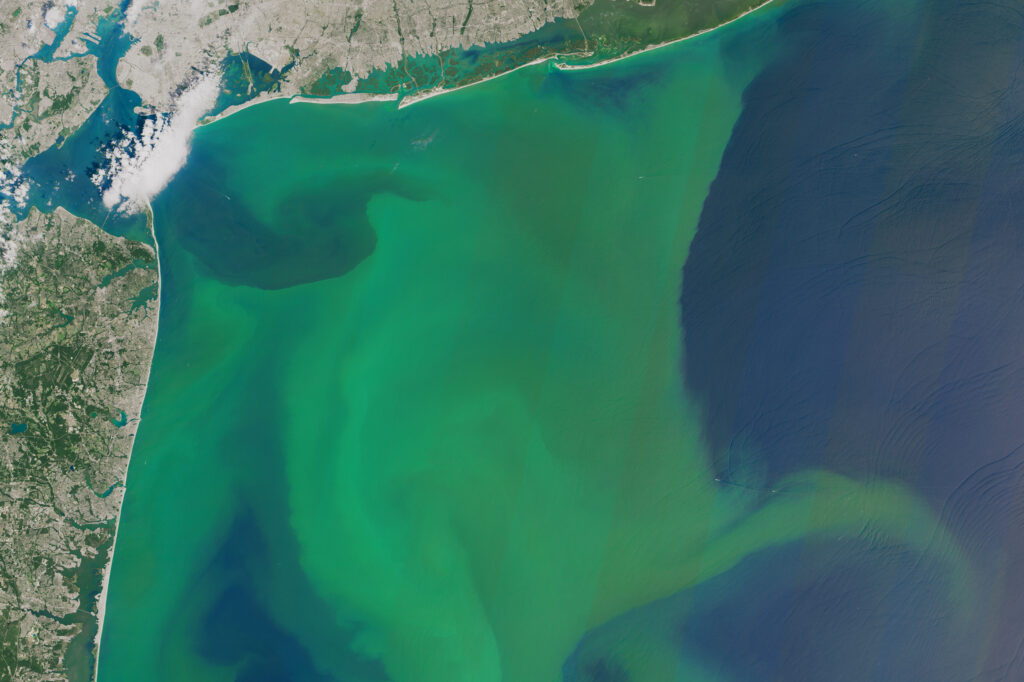

Pictures of Earth from outer space often show the planet as a gaudy quilt. Shimmering aquamarine water covers more than 70 percent of its surface and those hues often seem to signify life against the vast darkness of the universe. But new research analyzing satellite images of the planet over a span of more than 20 years found that one shade of ocean green, representing chlorophyll produced by phytoplankton, is fading.
The fading ocean green, a sign of phytoplankton decline, is a red flag for key ocean systems that sustain food chains and regulate the climate. Phytoplankton, microscopic organisms that have been creating a breathable atmosphere for the planet for more than 2 billion years, are under threat.
The decline in phytoplankton, or even significant shifts in their populations, threaten ecosystems and hundreds of species, from sea turtles and birds to giant marine mammals. Coastal and nearshore fisheries on nearly every continent, which are a crucial food source for an estimated 3 billion people, are also at risk.
To this day, they produce oxygen needed by nearly all other life and regulate the climate by removing carbon dioxide from the atmosphere and storing it in ocean-bottom sediments.
Iestyn Woolway, an ocean researcher at Bangor University in Wales and study co-author, said via email that the research reveals a long-term decline of ocean greenness and phytoplankton bloom frequency across low- and mid-latitude oceans between 2001 and 2023. The scale and consistency of the decline were especially concerning, he added.
It’s a “clear sign” that global warming is already weakening the ocean’s biological carbon pump, one of Earth’s fundamental life-support systems, he said. “A less green ocean not only affects marine food webs but also weakens the ocean’s ability to absorb carbon dioxide—a key buffer against climate change.” Biological carbon pumps cycle carbon dioxide from the atmosphere into deep ocean sediments, where it doesn’t affect the climate.
With the changes visible across vast swaths of ocean and intensifying in coastal zones, the findings suggest “that we’re not just seeing natural variability but a systemic shift,” Woolway said.
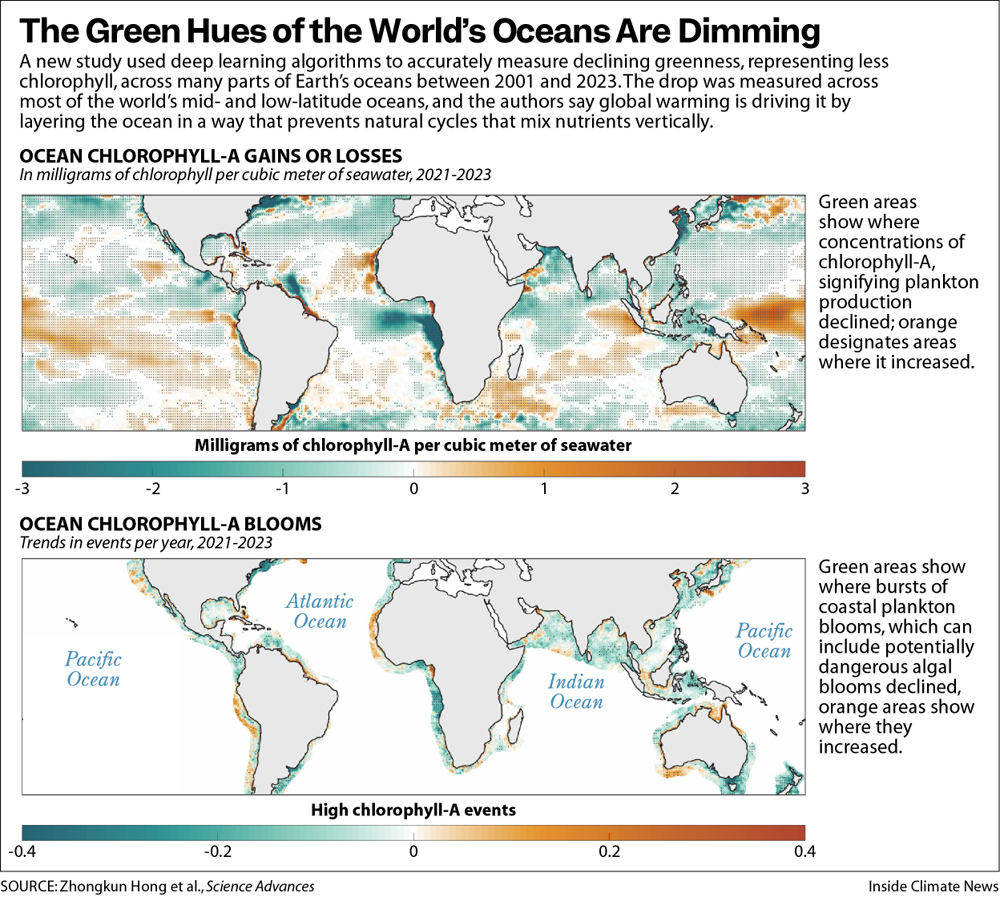
The oceans cover 71 percent of the planet’s surface, and they have absorbed about 93 percent of the heat trapped in the atmosphere by greenhouse gases during the fossil-powered industrial era. As the ocean’s surfaces heat up, the water becomes lighter and more buoyant, forming a stable layer that resists mixing with the colder, denser water below. This stratification blocks nutrient-rich, cooler deep water from reaching the surface and starving the phytoplankton that give oceans their greenish tint.
“What worries me most is that these changes are largely invisible to the public,” Woolway said. “Unlike melting glaciers or extreme weather, declining ocean productivity is subtle, slow-moving, and hard to visualize — but it’s no less critical.”
Lead author Di Long, a professor in the Department of Hydraulic Engineering at Tsinghua University in Beijing, said the study results exceeded the team’s expectations.