


In Bram Stoker’s novel Dracula (1887), an English solicitor (Jonathan Harker) is sent to Transylvania to assist Count Dracula, an aristocrat, in his move to England. When Harker discovers Dracula lying in a coffin after feeding on blood, he understands the threat that Dracula poses to England.
Vampires have long represented our political and social attitudes to race, immigration and the threat of foreign invasion – reflecting the prejudices of their times.
My research explores how comic books and graphic novels interrogate political, social and cultural issues. Dracula became a 20th-century pop culture phenomenon, appearing in several films and TV programs. But American comic books were relatively slow to feature vampires.
In 1954, the US Senate Subcommittee on Juvenile Delinquency investigated the comic book industry. Hearings were held to testify about the perceived harm caused by crime and horror comics. To allay threats to their business, publishers banded together to form the Comics Magazine Association of America and established The Comics Code of 1954, which banned crime and horror content, including stories featuring vampires. A revision and relaxation of the code in 1971 enabled vampires to be used when “handled in the classic tradition” of novels such as Dracula “and other high calibre literary works written by Edgar Allen Poe, Saki, Conan Doyle and other respected authors whose works are read in schools around the world”.
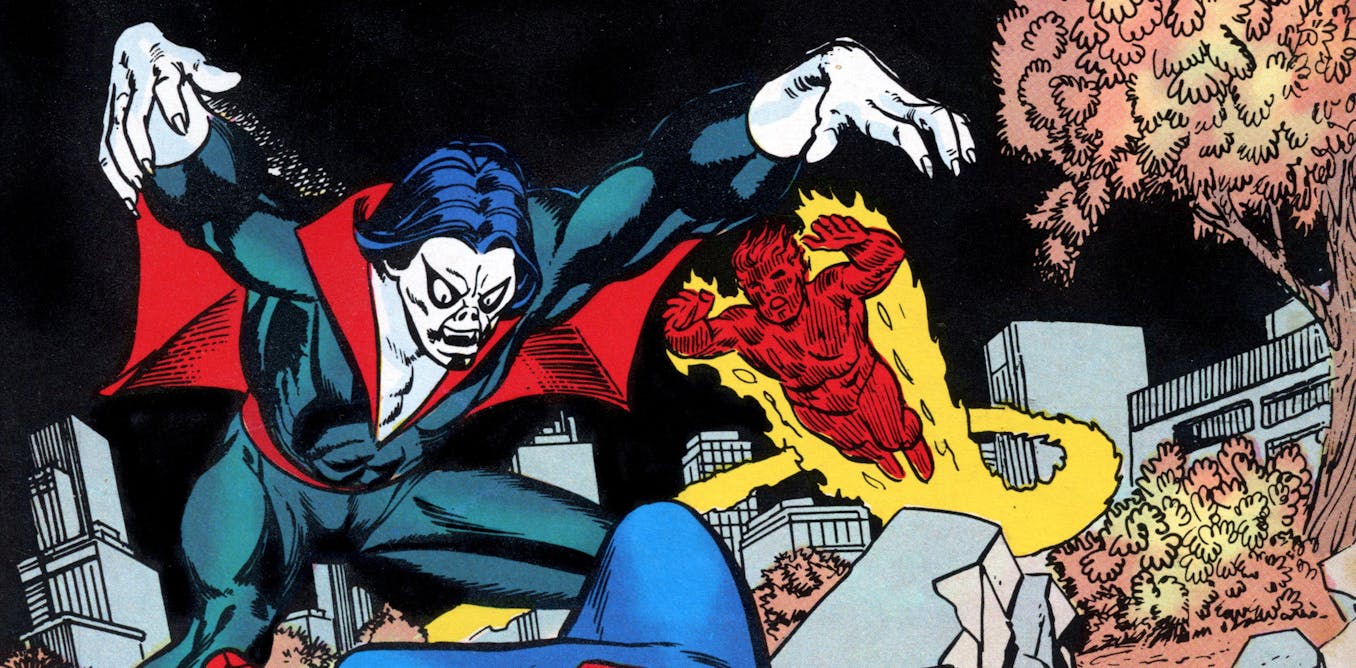
This led to the creation of the character Morbius the Living Vampire, who debuted in Amazing Spider-Man #101 in July 1971. Morbius was a scientist with a blood disease whose experimental cure using vampire bats led to his transformation.
Dracula appeared in the animated series Avengers Assemble (2013).
Soon after, Dracula himself joined the Marvel comic universe in Tomb of Dracula #1 (November 1971), a series that ran until 1979. Writer Marv Wolfman and artist Gene Colan had to work within the limitations of the code by ensuring that they adhered to a traditional depiction of Dracula in line with Stoker’s original version. This could have limited the style and content of their stories, which were set in the modern era, but the inclusion of a newly created supporting cast kept the narrative fresh and engaging.
Vampires in American comic books retained this outsider status – invariably they were European immigrants like Morbius, who was born in Nafplio, Greece. In this way, comic vampires continue the literary vampire tradition of tapping into the fear of foreigners.
Doctor Doom: anti-immigrant populist politician
Comic book writer Ryan North explored a variation of this theme with Doctor Doom, the Marvel Comics’ super-villain, in issues of Fantastic Four released this year. Doom will be played by Robert Downey Jr. in the new film Avengers: Doomsday, due in 2026.
Doom rules Latveria, a fictional European country. He has recently declared himself Emperor of the World, supported by leaders of nations across the globe. Doom also uses Trump-style populism by propagating prejudice and fear-mongering against vampires.