

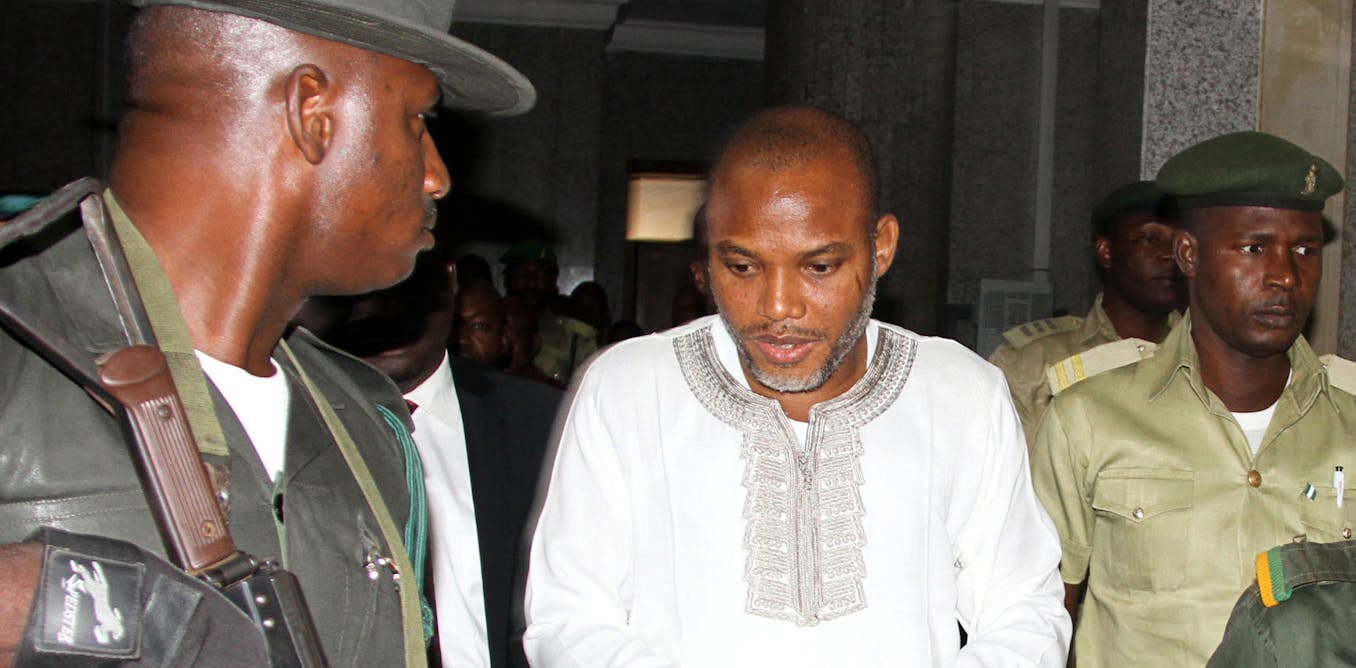

The terrorism conviction and life sentence handed down by the Federal High Court in Abuja on Nnamdi Kanu, leader of the Indigenous People of Biafra, brings an end to a ten-year legal battle. But it opens up a larger political and security question for Nigeria.
Kanu has long championed the secession of Nigeria’s south-east region, a demand the Nigerian constitution forbids. The last major attempt at secession, in 1967, triggered a 30-month civil war that killed over one million people, mostly Igbo civilians.
Kanu’s campaign for Biafra as an independent Igbo state is rooted in decades of perceived political marginalisation and unresolved historical grievances of the Igbo.
The Igbo are one of Nigeria’s three largest ethnic groups – the other two are the Hausa and the Yoruba. Yet no Igbo person has held the presidency or vice presidency since 1999.
Additionally, Igbos feel marginalised because of the way in which Nigeria has organised its regional political groups. The south-east geopolitical zone that the Igbo live in encompasses only five states. The Hausa and the Yoruba have geopolitical zones that are made up of at least six states each. This structural imbalance is widely seen to weaken the south-east region’s political influence and reduce its share of federal resources and representation.
Such perceived marginalisation is what has driven the Biafra separatist movement.
Read more:
What drives the Indigenous People of Biafra’s relentless efforts for secession
In protest against Kanu’s arrest in 2021, armed groups linked to the movement have imposed and violently enforced “sit-at-home” orders. A report shows that between 2021 and 2025 over 770 lives, including civilians and security personnel, have died in the subsequent violence.
This has contributed to the region’s transformation from one of Nigeria’s most peaceful zones into a centre of insecurity.
As a scholar researching security and separatist conflicts in Nigeria, I argue that a court judgement cannot resolve the political, economic and psychological grievances that underpin the Biafra separatist sentiment in Nigeria.
The region’s demands extend beyond any single personality. They include calls for greater political inclusion, equitable federal representation, improved infrastructure, economic revitalisation, and a national reckoning with the legacy of the civil war.
Until these issues are addressed, the ideology of Biafra will continue to resonate.
In fact, Kanu’s life sentence is more likely to escalate than de-escalate the Biafra agitation, for three reasons. Firstly, by providing an opening for more extremist leaders to emerge. Secondly, by turning Kanu into a martyr for the Biafran cause; and lastly, by potentially opening the door to greater violence.
Leadership removal rarely ends insurgencies
The expectation that harsh punishment will end the Biafra agitation misunderstands how separatist or insurgent movements behave. Decades of global research show that removing a charismatic leader, whether through imprisonment, exile or execution, does not necessarily weaken a movement. In many cases, it produces the opposite effect.