

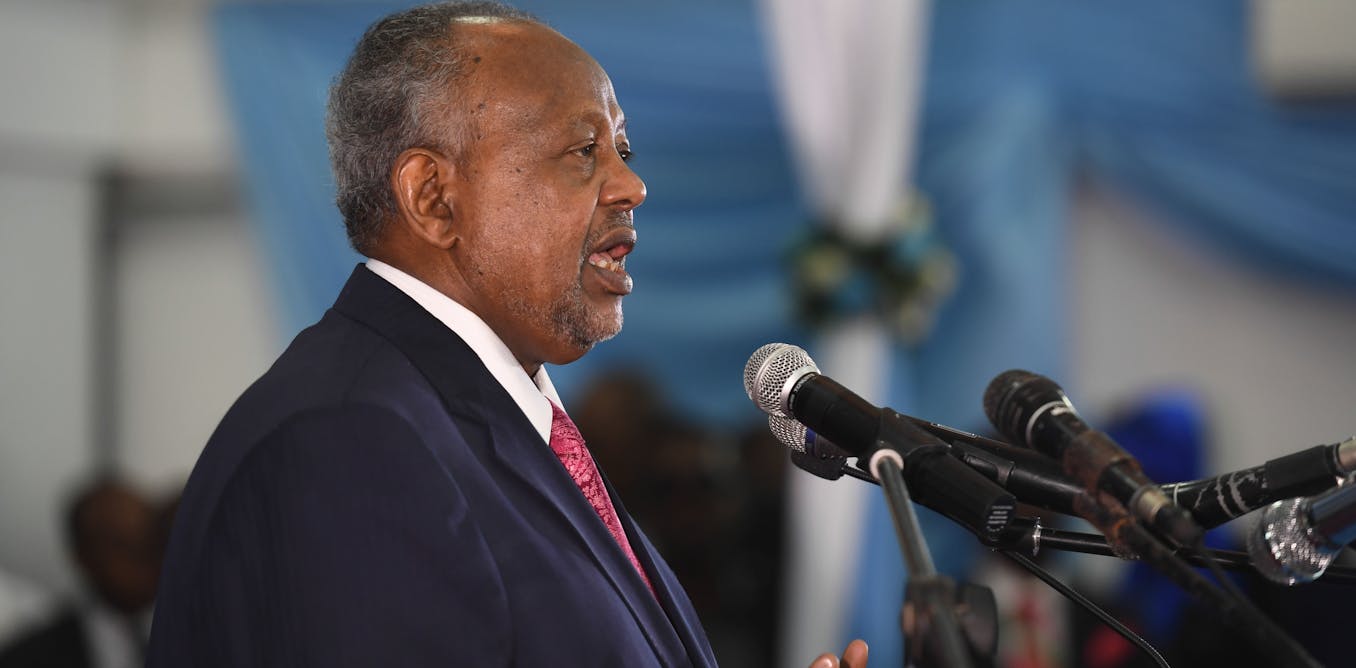

Djibouti’s president, Ismaïl Omar Guelleh, pushed through constitutional changes removing presidential age limits in October 2025. The changes enable him to remain in power beyond 2026. He has already ruled for 26 years and is a shoo-in at elections in April 2026. Guelleh leads a country on the Horn of Africa where the Red Sea meets the Indian Ocean – one of the world’s most strategically important locations. Federico Donelli, who has studied Djibouti’s political landscape, unpacks the dynamics that have kept him in power.
Who is Ismaïl Omar Guelleh and what is his governance style?
Ismaïl Omar Guelleh, commonly known as IOG, has been the president of Djibouti since 1999. He succeeded the country’s first president, Hassan Gouled Aptidon, whom he served as chief of staff for more than two decades.
Now aged 77, Guelleh is one of the longest-serving leaders in east Africa.
He belongs to the majority Issa-Somali ethnic group, which has monopolised power since the country gained independence from France in 1977. Djibouti’s population is largely composed of two main groups – the Issa-Somali and the Afar. This demographic mirrors the context in Afar regional state of neighbouring Ethiopia. It’s mirrored even more closely in the de facto state of Somaliland due to clan and family ties.
Consequently, political dynamics in Djibouti frequently intertwine with developments in these neighbouring states. This is particularly true when it comes to security, cross-border mobility and clan-based networks.
In theory, Djibouti is a presidential republic with a multiparty system. In practice, however, political authority remains highly centralised, leaving little room for genuine political competition.
The ruling Popular Rally for Progress (RPP) party dominates parliament, holding 45 of the 65 seats. The broader pro-presidential coalition, the Union for the Presidential Majority (UPM), controls 58 seats in total, consolidating the executive’s influence over the legislative arena.
Opposition coalitions such as the Union for Democratic Change (UAD) and the Union for Democratic Movements (UMD) face significant constraints. They have occasionally boycotted elections. There have been five presidential elections and five legislative elections since 1999.
International organisations frequently highlight restrictions on the media and public dissent, with the majority of outlets being state-controlled.
Read more:
Media freedom and democracy: Africans in four countries weigh up thorny questions about state control
Guelleh also owes his longevity to a close-knit network of officials, family members and political allies who occupy key roles in government and business. The coalition around him is not always entirely harmonious. Subtle rivalries have emerged among political figures and members of his inner circle from time to time. But these dynamics do not pose a political threat.
What accounts for his longevity?
Guelleh’s tenure can be attributed to a combination of institutional changes, geopolitical factors and elite dynamics.
Read more:
From Algeria to Zimbabwe: how Africa’s autocratic elites cycle in and out of power
One such element is constitutional reform.