

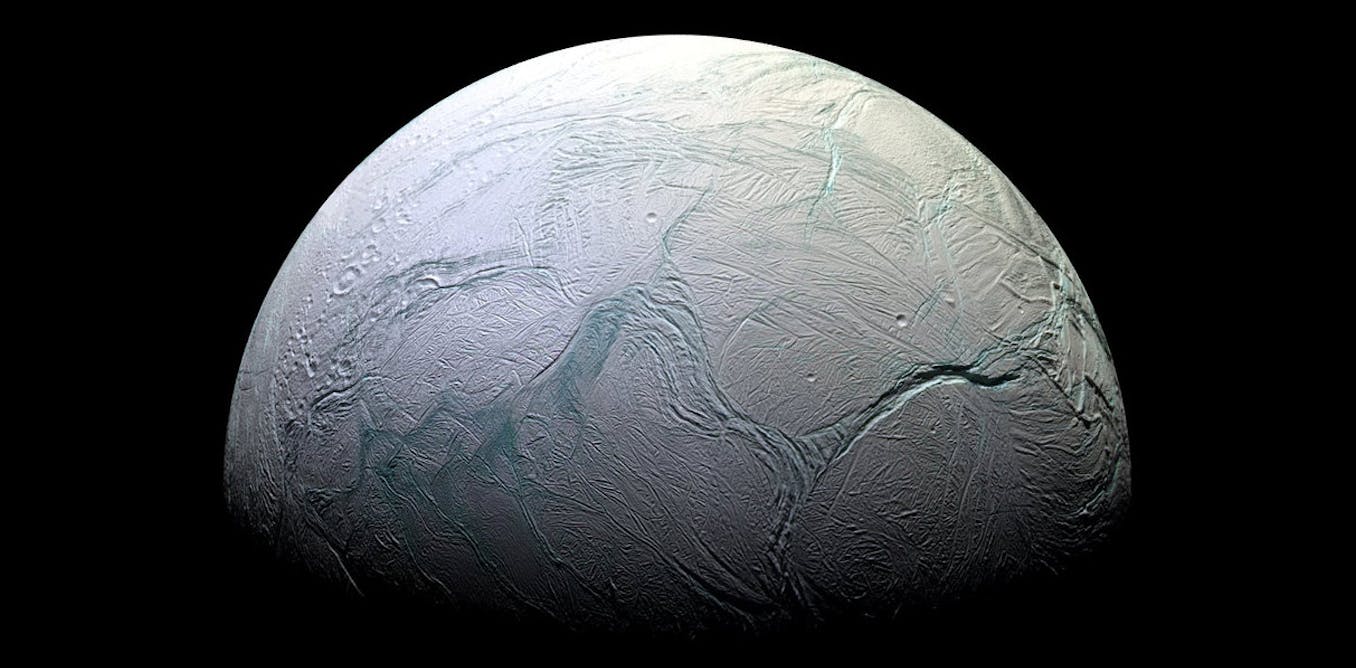

A small, icy moon of Saturn called Enceladus is one of the prime targets in the search for life elsewhere in the solar system. A new study strengthens the case for Enceladus being a habitable world.
The data for those new research findings comes from the Cassini spacecraft, which orbited Saturn from 2004-2017. In 2005, Cassini discovered geyser-like plumes of water vapour and ice grains erupting continuously out of cracks in Enceladus’ icy shell.
In the latest study, Nozair Khawaja, from the Free University of Berlin, and his team set out to re-analyse a Cassini sample of material from Enceladus’ south pole.
Most analyses of solid particles from Enceladus’ plumes had been done on Saturn’s E-ring. The E-ring is an outer diffuse ring in the majestic ring system that surrounds the planet. It is continuously replenished with material from Enceladus’ plumes. But this material is not fresh – and exposure to radiation in space can alter its characteristics.
The younger material analysed by Khawaja and colleagues was sampled by Cassini during a particularly fast flyby over Enceladus’ south pole. The use of freshly ejected plume material guaranteed the removal of any possible interference from radiation.
So what do these and other analyses of plume samples tell us about Enceladus? Early Cassini samples were found to contain sodium salts, suggesting the plumes are fed by an underground liquid water ocean in contact with a rocky bottom. Later observations of Enceladus’ “wobble” (slight shifts in its rotation) relative to Saturn demonstrated that its icy exterior shell is probably completely detached from the rocky core below.
This means that Enceladus’ underground ocean (sandwiched between the ice and rock) is global, extending across the entire moon. The ocean is likely sustained by tidal flexing, where the varying gravitational tug of Saturn on Enceladus stretches and squeezes it, causing Enceladus to heat up and preventing the ocean from freezing and preventing the ocean from freezing.
The ability to (albeit, indirectly) sample the ocean has permitted a more comprehensive investigation of Enceladus’ habitability – that is, whether Enceladus contains the necessary ingredients for life as we know it (namely a suitable energy source and mix of chemical elements).
Sampling the plumes
Analysis of Cassini’s plume samples was made possible by a technique called “mass spectrometry”. The process began with the high velocity impact between Cassini (flying at speeds of kilometres per second) and the solid plume material it collected.
This broke up the material smaller, charged fragments. After impact, an instrument exposed the fragments to an electric field which moved them towards a detector.
The timing of impact of the chemical fragments with the detector was then used to determine their mass and charge. Scientists could then “piece the jigsaw” back together to figure out the identity of the molecules that the fragments once formed.
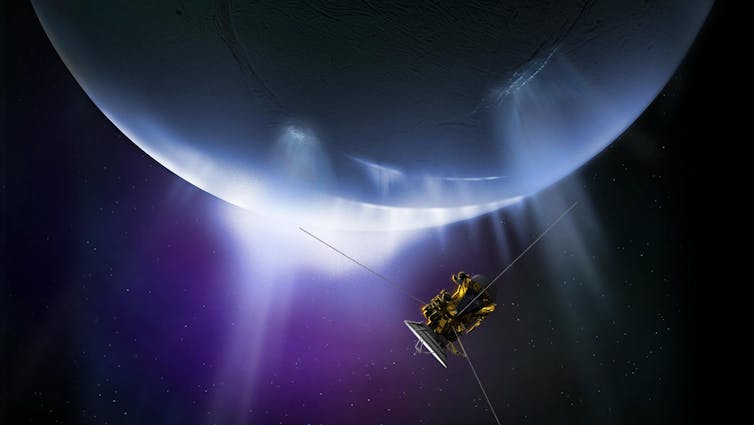
Artist’s impression of Cassini sampling one of Enceladus’ plumes. » …