

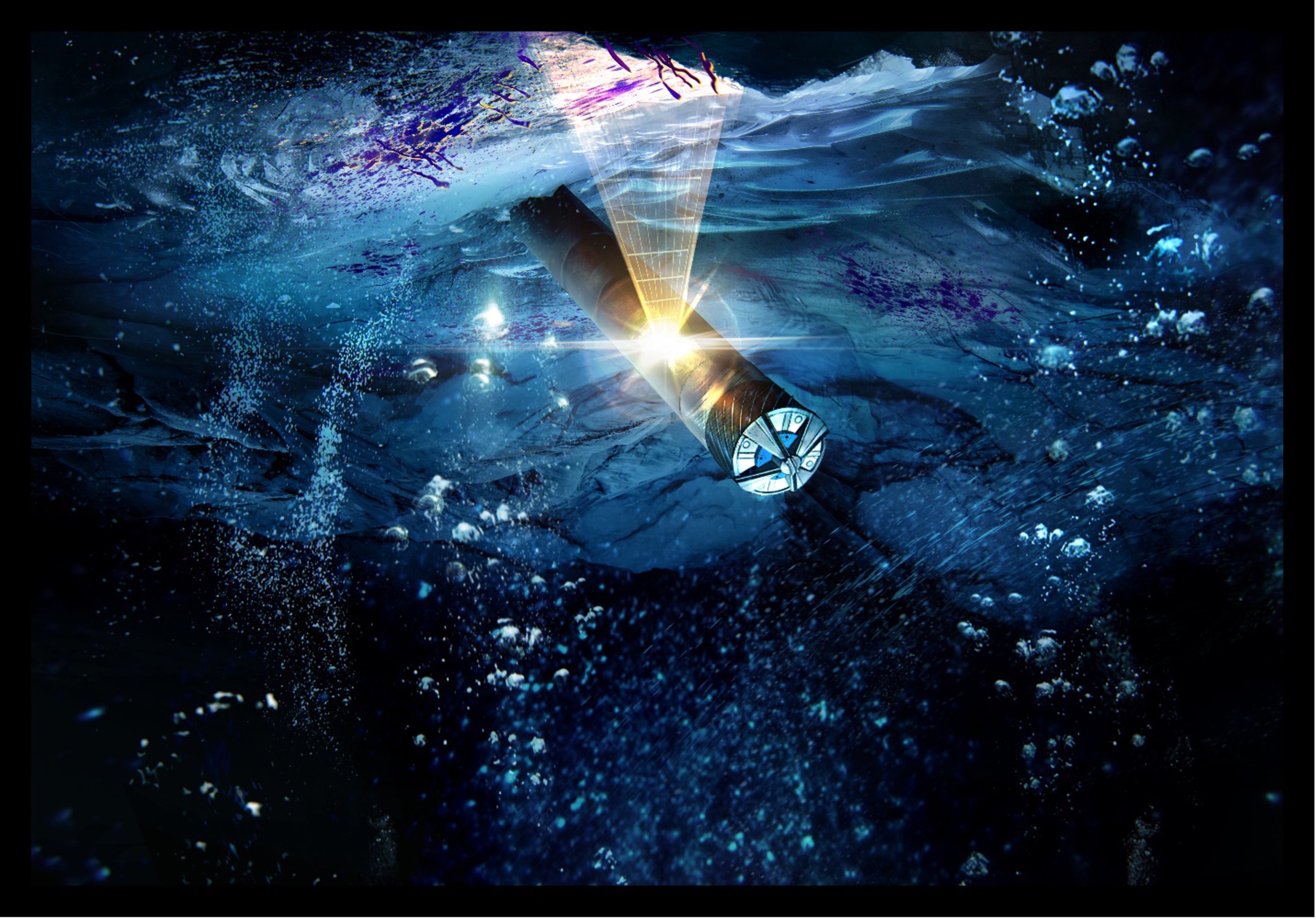


Conceptual image of a Cryobot mission lander.
Credits: NASA/JPL-Caltech
In February 2023, researchers gathered at a NASA-sponsored workshop to discuss a roadmap for a cryobot mission concept to explore Europa and Enceladus and search for life.
“Follow the water” has been the mantra of the astrobiology community in search of alien life in the universe. Water is a fundamental building block of all terrestrial life as we know it and—as discovered by various space missions—water is abundant throughout the solar system, and perhaps, the universe. Ancient eroded features on Mars show clear evidence of a wet history, and the ongoing quest of the Perseverance rover aims to uncover clues as to whether or not Mars once hosted a population of microbes. However, there is only so much we can learn from the fossil record. To truly understand the nature of possible alien life, we must directly investigate the source—the liquid water.
Enter “Ocean Worlds.” Scientists have discovered that a vast number of icy moons orbit the outer giant planets in our solar system. Many of these moons show strong evidence for harboring global oceans beneath their icy crusts. In fact, these moons likely have far more liquid water than all of Earth’s oceans combined, and some may even have the right conditions to foster life. Two moons, in particular, have captured the imaginations of astrobiologists due to their amenable conditions for life and their relative ease of interrogation: Jupiter’s moon, Europa and Saturn’s moon, Enceladus. Both show strong evidence of a global subsurface ocean beneath a kilometers-thick water-ice crust—but how can we access this liquid water?
Various concepts for ocean access have been investigated over the past decades, ranging from robots that descend through crevasses to drills of varying types. One concept that has emerged as a leading candidate is the cryobot. A cryobot is a self-contained cylindrical probe that uses heat to melt the ice beneath it. The melted water then flows around the probe before refreezing behind it.
This dilemma has been a core focus of researchers—many of whom are supported by NASA’s Scientific Exploration Subsurface Access Mechanism for Europa (SESAME) and Concepts for Ocean worlds Life Detection Technology (COLDTech) programs—for the past several years. In February 2023, NASA’s Planetary Exploration Science Technology Office (PESTO) convened a workshop at the California Institute of Technology, which brought together nearly 40 top researchers from diverse fields and institutions around the country to discuss progress in maturing this technology and to assess the challenges that remain.