


What’s the value of one animal? When a wild animal is found badly injured, the most humane option is often euthanasia to prevent further suffering. That’s what usually happens, and often for good reason. Even when the resources to rescue one animal are available, a rehabilitated animal brought back into the wild might be rejected by its group, or struggle to find food or escape predators. If it does survive, it may fail to reproduce, and leave no lasting mark on the population.
But every so often a single case comes along where one animal becomes evidence that intervention can do more than save a life on the spot. It can also change what we think is possible.
Read more:
Battling to save the Ethiopian wolf – Africa’s rarest carnivore
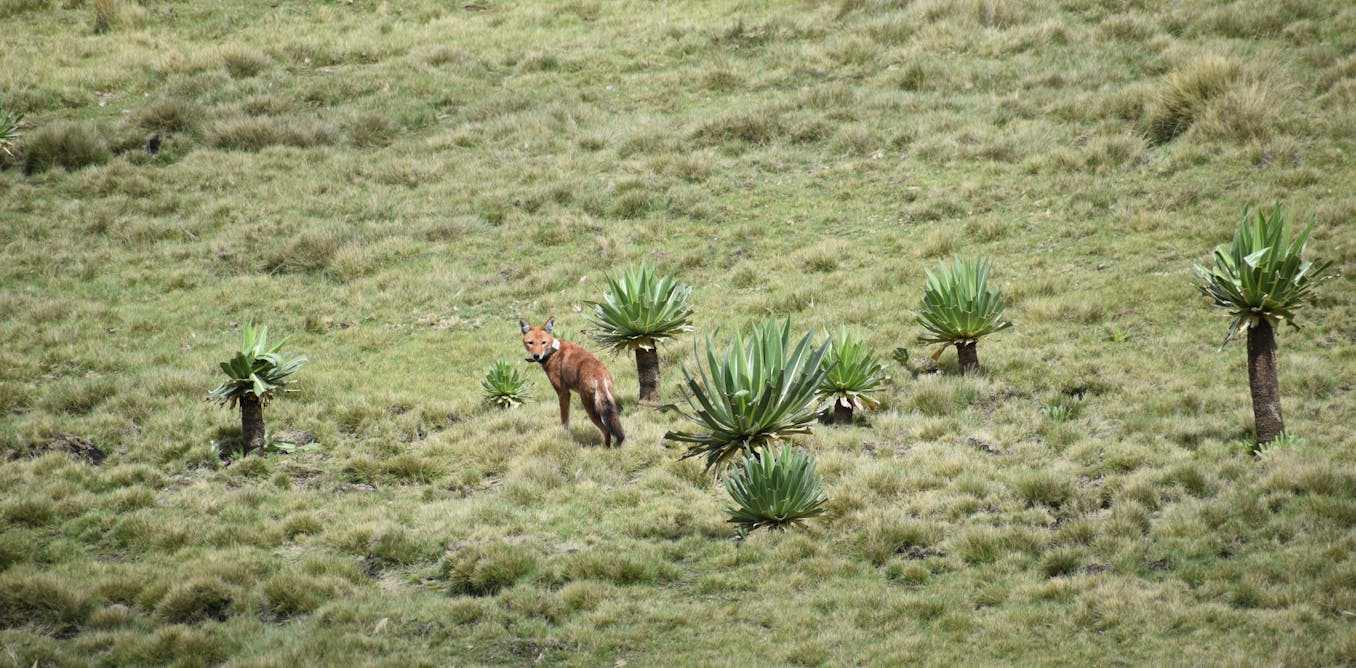
This is a story of a second chance that played out in the Simien Mountains, Ethiopia. The air is thin there at 3,000 metres above sea level, the nights are cold, and life offers very little mercy. This is the home of the Ethiopian wolf (Canis simensis), the top predator in this habitat and also the most endangered carnivore in Africa. Fewer than 500 adult wolves are left in the Ethiopian highlands, with about 60-70 in the Simien Mountains.
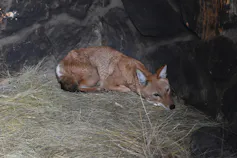
Terefe, just before his release.
Fasika N, Wildlife Conservation Network
In early May 2020, a male Ethiopian wolf sustained a severe injury, a fractured femur, from a gunshot. He was unable to keep up with his pack in a place as unforgiving as the highlands, and that would usually be the end of the story. But this time, it wasn’t.
I’m a postdoctoral researcher in the Ethiopian Wolf Conservation Programme, a 30-year-old programme committed to safeguarding the Ethiopian wolf and its mountain home. I was honoured to be part of a team who documented the first ever case of an Ethiopian wolf being rescued, clinically treated in captivity, and successfully released back into the wild following rehabilitation.
Terefe, the lucky survivor

Simien Mountains wolf monitoring team, Andualem, Getachew and Jejaw (from left)
Courtesy Sandra Lai
Park scouts discovered the wolf lying under a bridge and alerted Getachew Assefa, the wolf monitor team leader of the Ethiopian Wolf Conservation Programme in the Simien Mountains National Park.
It’s unusual for an Ethiopian wolf to be shot in the park. So, Ethiopian wildlife authorities and the Ethiopian Wolf Conservation Programme decided to capture and save the frightened animal.
Read more:
Simply returning rescued wildlife back to the wild may not be in their best interest
This was an unprecedented step, as there was no previous record of an Ethiopian wolf ever being held in captivity before. The decision to save him was driven both by the fact that his injury was human-made and by the small number of Simien wolves left.
A small mountain shelter was quickly converted into a makeshift enclosure for the wolf.