

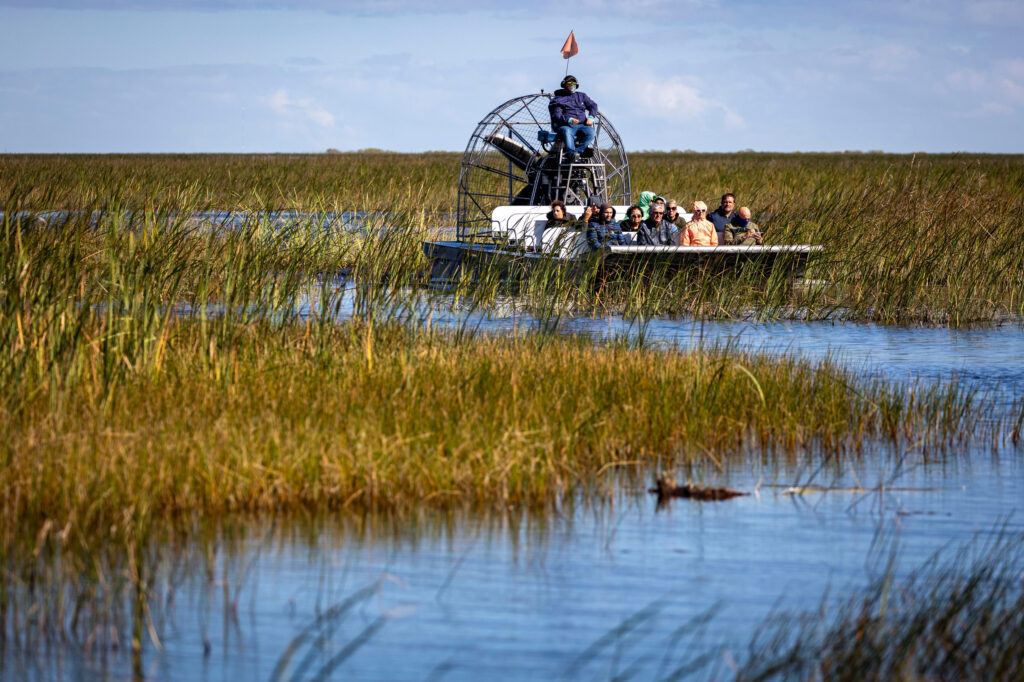

There is a place in the world, one that is among the most vulnerable as the global climate warms, where an extraordinary gesture of hope has endured for a quarter century.
The scope of the effort is almost incomprehensible, both for its sheer size and persistence on a low-lying peninsula, where the delineation between land and sea has always been somewhat unclear and is becoming less so. Here, sea level rise is accelerating at some of the most extreme rates on Earth, while hurricanes increasingly are swirling ashore with an unprecedented ferociousness.
The focal point for all this hope—and work—is the Florida Everglades, where a $27 billion restoration effort is among the most ambitious of its kind in human history. More is at stake than preserving the singular beauty of the sawgrass prairies of Everglades National Park or cypress swamps of the Big Cypress National Preserve. Or the many other protected lands here, including the Everglades Headwaters National Wildlife Refuge, Arthur R. Marshall Loxahatchee National Wildlife Refuge or Fakahatchee Strand Preserve State Park. Or the more than 70 endangered and threatened species that reside within the watershed.
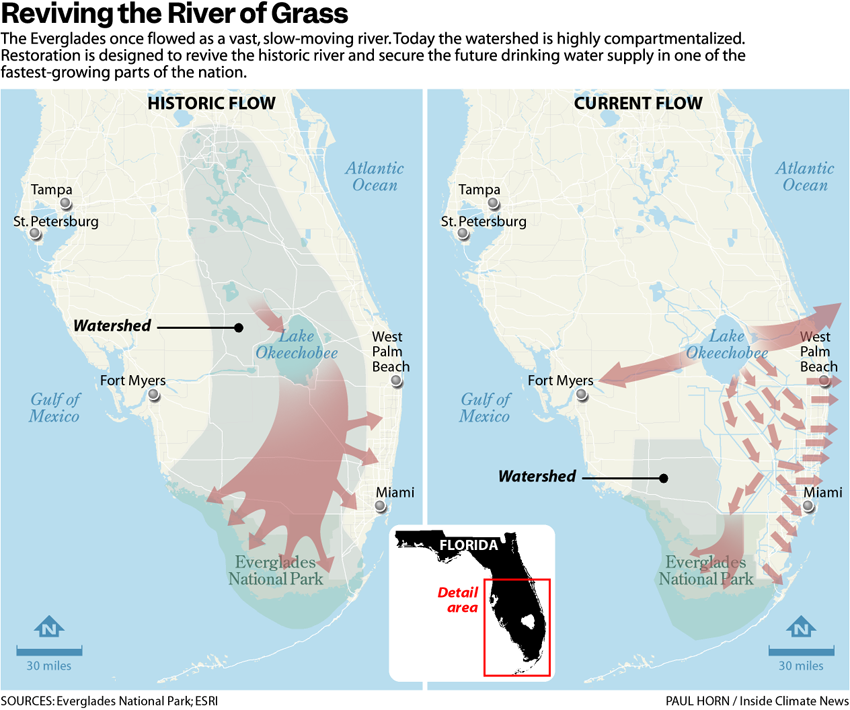
At the heart of the vast effort is the Everglades’ lifeblood water. In a state bounded on three sides by seawater, where water courses through underground aquifers and some 50 inches of rain falls annually, a series of historic efforts to drain the Everglades have made modern Florida possible. They have also pushed the state’s most important freshwater resource to the brink.
Every day, some 1.7 billion gallons of freshwater that once spilled over the southern shore of Lake Okeechobee and eventually flowed into the sawgrass marshes of the river of grass instead are carried through a series of canals and out to sea. That amount exceeds what is consumed in South Florida daily, and during times of high water the state’s flood control procedures require that even more freshwater be discharged to the coasts. The waste of so much freshwater would be problem enough. But the discharges also can overwhelm the delicate estuaries east and west of the state’s largest lake and, during the warm summer months, spread blooms of toxic algae, an issue that has become more persistent in recent years.
Everglades restoration is designed to recapture this freshwater and revive the watershed where it once flowed, with the overarching goal of securing the future drinking water supply in one of the fastest-growing parts of the nation. In this sense, the effort represents a remarkable investment in the future in a place where the future can feel less certain because of climate change.
“You can’t have a failure of imagination when you’re trying to address these issues. You’ve got to be operating at an appropriate scale,” said Shannon Estenoz, chief policy officer at the Everglades Foundation, an advocacy group.
“Don’t look at infrastructure as permanent,” she said. “The worst failure is you can’t imagine a landscape re-engineered.