

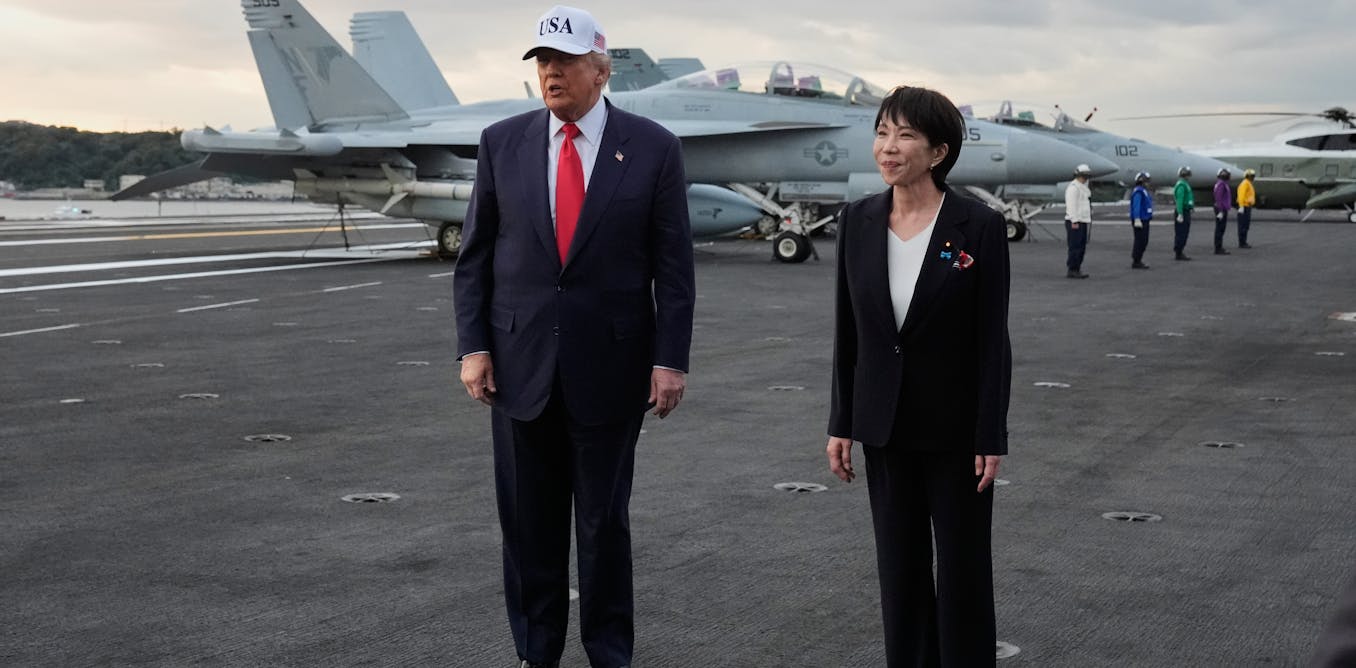

Japanese Prime Minister Sanae Takaichi and her ruling Liberal Democratic Party (LDP) got a historic landslide victory in last week’s parliamentary elections.
This marks the first time since its founding in 1955 that the conservative LDP controls a two-thirds supermajority in the lower house. If necessary, Takaichi’s cabinet could also overrule any opposition in the upper house of the Diet (Japan’s parliament), where her coalition still lacks a majority.
Given this, Takaichi now has a massive mandate to push her agenda. This includes boosting defence spending, strengthening the military and even potentially revising Japan’s pacifist constitution, which constrains the role of the Self-Defence Forces and forbids going to war.
So, does this mean Japan could become a more militarised state under Takaichi? And if so, what are the implications for regional security?
Countering China’s rise
Takaichi has portrayed herself as Japan’s Margaret Thatcher and the standard-bearer of former Prime Minister Shinzo Abe’s legacy.
Abe, who led the LDP back to power in 2012, had pledged to “restore a strong Japan”. During his eight-year rule, Japan adopted a so-called “proactive pacifism”. Under this new security strategy, Japan began to depart from its
postwar pacifism through a number of ways:
- strengthening the military
- lifting bans on arms exports
- building new security partnerships (including with NATO, the European Union and the Quad)
- consolidating its alliance with the United States.
In 2014, a new interpretation of the constitution also permitted Japan to engage in “collective self defence”, or aid an ally under attack.
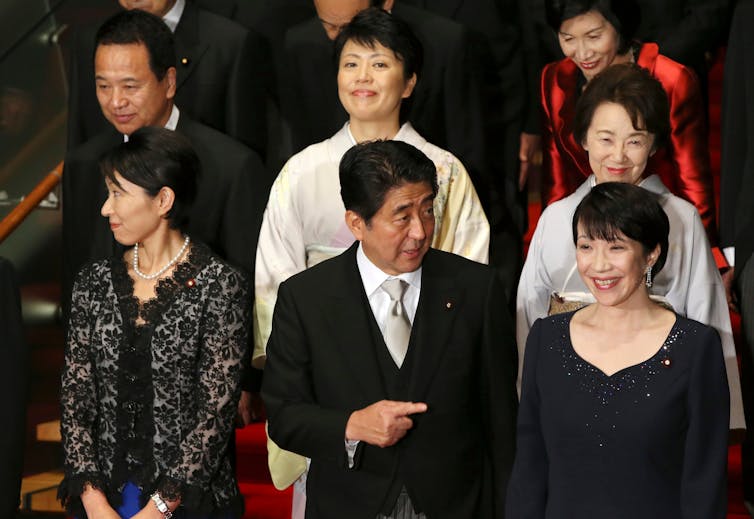
Then-Prime Minister Shinzo Abe, centre, poses for a photo with his new Cabinet members, including Internal Affairs Minister Sanae Takaichi, bottom right, at the prime minister’s official residence in Tokyo, September 3 2014.
Eugene Hoshiko/AP
Takaichi now sees her job as continuing Abe’s work. And her direction is clear.
Shortly after becoming prime minister last year, Takaichi triggered a spat with Beijing when she suggested Japan would come to Taiwan’s defence if it was attacked by China. Beijing retaliated with economic pressure and coercive rhetoric, but Takaichi refused to back down.
Neither Takaichi nor China’s leader, Xi Jinping, are in a hurry to improve diplomatic relations.
Beijing has urged Chinese tourists not to travel to Japan and warned that Takaichi’s moves threaten regional security and the international order.
Takaichi, meanwhile, is hoping an assertive China will help her overcome domestic opposition to her security agenda. So far, the public supports her government, too. In a poll after the election, 69% approved of her cabinet’s performance.
How Takaichi wants to transform Japan’s military
Takaichi’s government will soon begin work on a revision of its National Security Strategy from 2022. It is likely to adopt her declared “crisis management” approach, combining security and economic objectives with industrial policy.
Despite mounting public debt, Takaichi has already increased defence spending to 2% of Japan’s GDP ahead of schedule,