


UCF Researcher Discovers New Photon Detection Technique
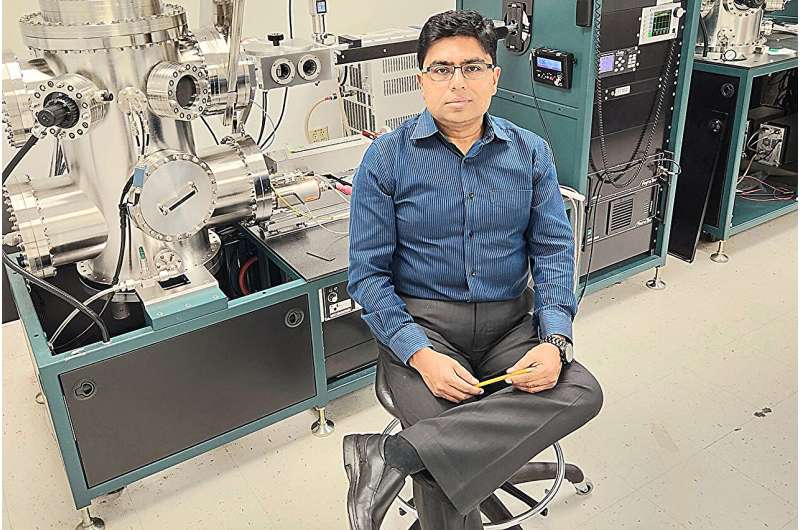
Debashis Chanda, a professor at the NanoScience Technology Center at the University of Central Florida, is revolutionizing photon detection with a groundbreaking new technique. His innovative approach could have game-changing implications across various fields, from medical imaging to scientific research.
Traditionally, photon detection has relied on changing voltage or current amplitude. Chanda’s method, however, modulates the frequency of an oscillating circuit, providing ultra-sensitive photon detection capabilities. This remarkable breakthrough is documented in a recent article published in Advanced Functional Materials.
At the heart of the technique is the use of a special phase-change material (PCM) that alters its form when exposed to light. This modulates the electrical rhythm of the material, allowing for precise and reliable photon detection. The application of this innovation extends to the long wave infrared (LWIR) range, a wavelength critical in diverse fields such as astronomy, climate science, and security.
Chanda’s pioneering work offers a low-cost, highly sensitive infrared detection solution that operates at room temperature, addressing a long-standing scientific and technological challenge. The potential for this new detection concept is vast, enabling advancements in applications like remote sensing, thermal imaging, and medical diagnostics.