


- Environment
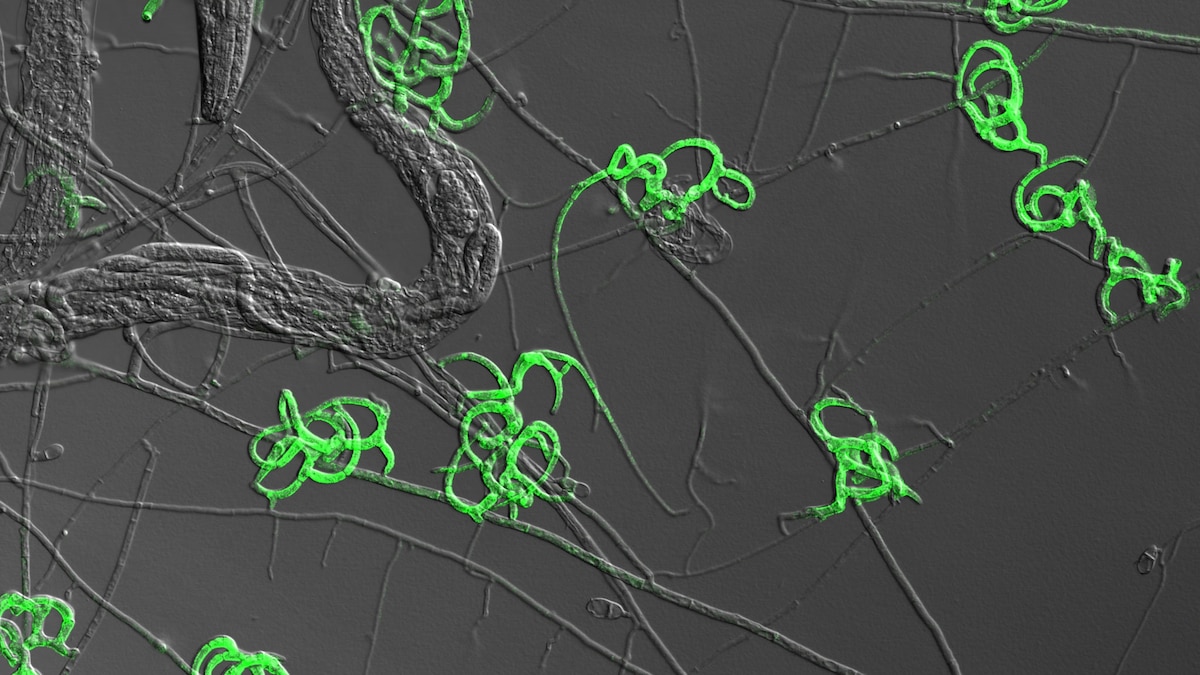
Normally content to decompose dead leaves, this fungus sets an elaborate trap to eat worms when strapped for food.
Published December 12, 2023
3 min read
How far can a fungi go to avoid the throes of starvation? In the case of Arthrobotrys oligospora, it entails transforming into a merciless predator.
In most circumstances, A. oligospora is saprotrophic, meaning it consumes decaying organic matter like dead leaves. However, scientists have found that nutritional deprivation can cause the fungi to undergo molecular changes, enabling it to become carnivorous, preying on unsuspecting worm species called nematodes.
Fungi cannot pursue its prey in the hot-on-the-heels manner that other predators do, and a study published last month outlined how the fungi have evolved a trickier, more sinister way to predate.
This fungus has a cunning trick to lure and trap worms
When A. oligospora senses a nearby nematode, it relies on pheromones to lure nematodes to its mycelium, the underground network of microscopic threads that make up a fungus.
According to research done by scientist Ping Hsueh from Taiwan’s Institute of Molecular Biology, Academia Sinica, A. oligospora “likely evolved the means to use olfactory mimicry to attract its nematode prey through the olfactory neurons in nematodes and related species.” This means that the fungus secretes food cues and sex pheromones to seduce the worm in question.
Scientists have found that the oyster mushroom also produces chemicals to paralyze its nematode prey within a few minutes of contact.
Hsueh states, “on a molecular level, we want to understand the mechanisms that enable the fungi to do this. More specifically, what genes and proteins the fungi make to sense the nematodes and give them the ability to capture them.”
Will the worm evolve to escape the fungus’s deadly trap?
The fungi’s mimicry and predation techniques may receive pushback from the primitive worm, however. Hsueh describes the ability of nematode evolution to keep up with the fungi’s predation as an “evolutionary arms race.”