

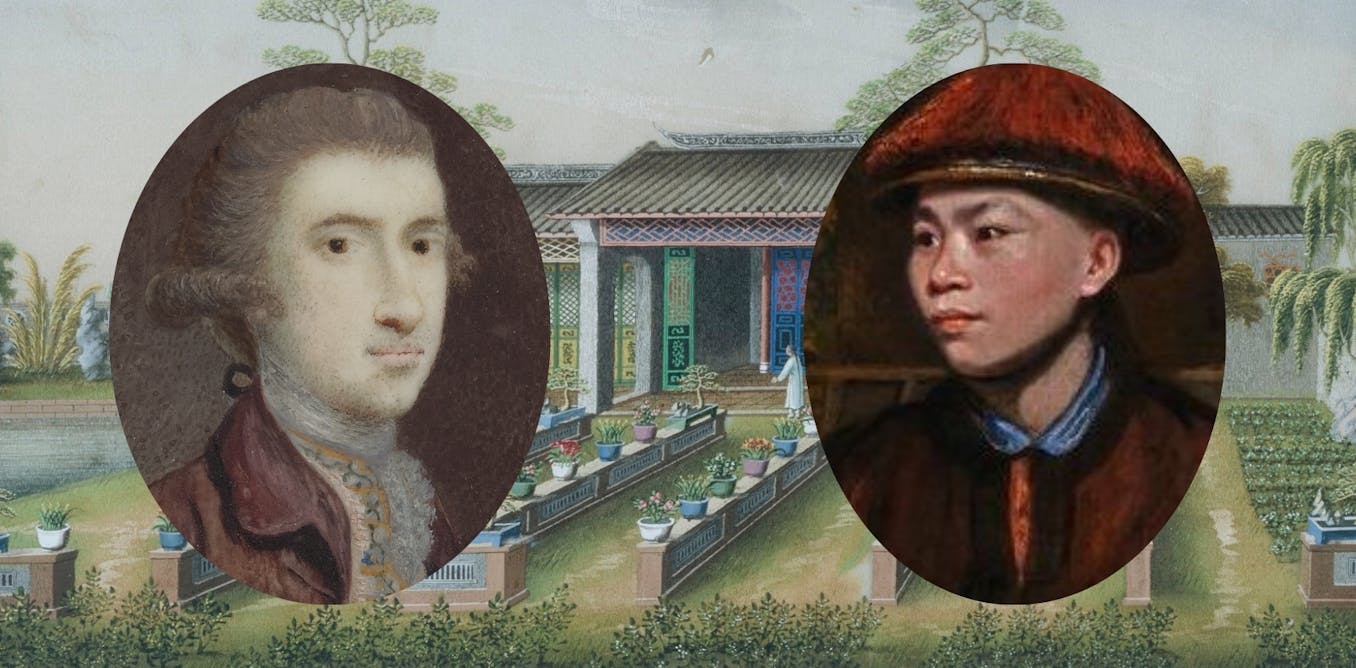

I’m standing in a deconsecrated church in Lambeth, London, now home to the Garden Museum. It has a warm and pleasant atmosphere, undeniably a church, yet far removed from its original purpose. On this quiet Friday morning, I met with Emma House, the lead curator of the exhibition Seeds of Exchange. We wandered around the exhibit, which is deceptively small for the scale of its story, crossing continents, cultures, languages and time.
Seeds of Exchange: Canton and London in the 1700s tells a story that is both local and global. It centres on a short-lived but remarkable collaboration between an English botanist and his Chinese counterparts. Together, they documented the plant life of Canton (modern-day Guangzhou) at a time when global trade, science and empires were becoming deeply entangled.
As a botanist I love plants – but this story is not only about them. It is about how knowledge moves, and who gets to shape it.
A meeting point of worlds
The late 18th century was a period of carefully controlled contact between China and Europe. Trade with the outside world in China was tightly regulated through licensed Chinese merchant guilds. Foreign traders could only operate during part of the year.
Into this system stepped John Bradby Blake, an employee of the British East India Company in the early 18th century.
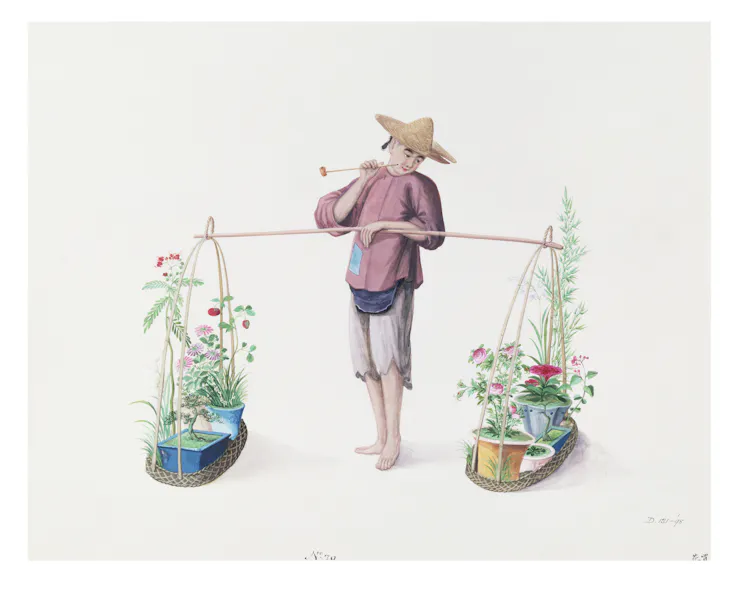
A Florist by John Dadley (18th century).
Victoria and Albert Museum, London
Like many of his contemporaries, he was not simply a passive participant in imperial trade. The East India Company allowed its agents a degree of personal enterprise, and Blake – having suffered substantial financial losses in tea speculation – turned to botany as both scientific pursuit and potential commercial opportunity.
His project was ambitious: to catalogue Chinese plants in what he envisioned as a Compleat Chinensis (Complete Chinese). Between 1766 and his death in 1773, he commissioned over 150 botanical paintings, documenting many now familiar plant species, ranging from citrus fruits and camellias to turmeric and jackfruit.
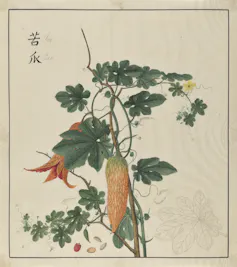
Momordica charantia by Mauk-Sow-U (1771).
Oak Spring Garden Foundation, Upperville, VA
What makes this project particularly striking is that it was not a solitary European endeavour. Blake relied heavily on local expertise, as he did not know the flora and did not speak Mandarin.
Mak Sau, a Chinese artist about whom we know very little, produced detailed botanical paintings that form the heart of this exhibition. These works are scientific documents, capturing colour and structure with fantastic precision. But they are also superb works of art and form a historically important collection of early botanically accurate watercolour paintings in China.
Local knowledge also helped identify species that Blake himself struggled to classify. Whang At Tong, Blake’s Chinese counterpart, was a merchant operating within the Canton system. He facilitated the exchange of materials, knowledge and, eventually, the transport of Blake’s collection back to Britain. The endeavour was,