


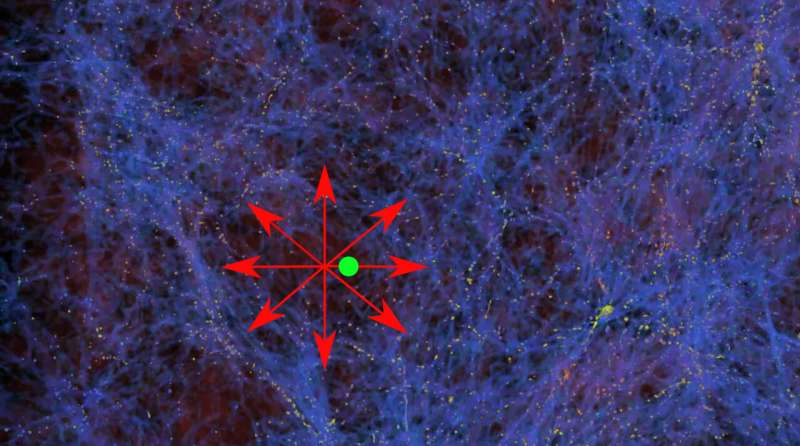
The image shows the distribution of matter in space – (blue; the yellow dots represent individual galaxies). The Milky Way (green) lies in an area with little matter. The galaxies in the bubble move in the direction of the higher matter densities (red arrows). The universe therefore appears to be expanding faster inside the bubble. Credit: AG Kroupa/University of Bonn
The universe is expanding. How fast it does so is described by the so-called Hubble-Lemaitre constant. But there is a dispute about how big this constant actually is: Different measurement methods provide contradictory values. This so-called “Hubble tension” poses a puzzle for cosmologists. Researchers from the Universities of Bonn and St. Andrews are now proposing a new solution: Using an alternative theory of gravity, the discrepancy in the measured values can be easily explained—the Hubble tension disappears. The study has now been published in the Monthly Notices of the Royal Astronomical Society (MNRAS).
The expansion of the universe causes the galaxies to move away from each other. The speed at which they do this is proportional to the distance between them. For instance, if galaxy A is twice as far away from Earth as galaxy B, its distance from us also grows twice as fast. The US astronomer Edwin Hubble was one of the first to recognize this connection. In order to calculate how fast two galaxies are moving away from each other, it is necessary to know how far apart they are. However, this also requires a constant by which this distance must be multiplied. This is the so-called Hubble-Lemaitre constant, a fundamental parameter in cosmology. Its value can be determined, for example, by looking at the very distant regions of the universe. This gives a speed of almost 244,000 kilometers per hour per megaparsec distance (one megaparsec is just over three million light-years).
“But you can also look at celestial bodies that are much closer to us—so-called category 1a supernovae, which are a certain type of exploding star,” explains Prof. Dr. Pavel Kroupa from the Helmholtz Institute of Radiation and Nuclear Physics at the University of Bonn. It is possible to determine the distance of a 1a supernova to Earth very precisely. We also know that shining objects change color when they move away from us—and the faster they move, the stronger the change. This is similar to an ambulance, whose siren sounds deeper as it moves away from us. If we now calculate the speed of the 1a supernovae from their color shift and correlate this with their distance, we arrive at a different value for the Hubble-Lemaitre constant—namely, just under 264,000 kilometers per hour per megaparsec distance. “The universe, therefore, appears to be expanding faster in our vicinity—that is, up to a distance of around three billion light years—than in its entirety,” says Kroupa. “And that shouldn’t really be the case.”
However, means that the expansion rate of the universe according to this new theory is differing from the expected rate, therefore leading to controversy. To learn more, visit the site.